
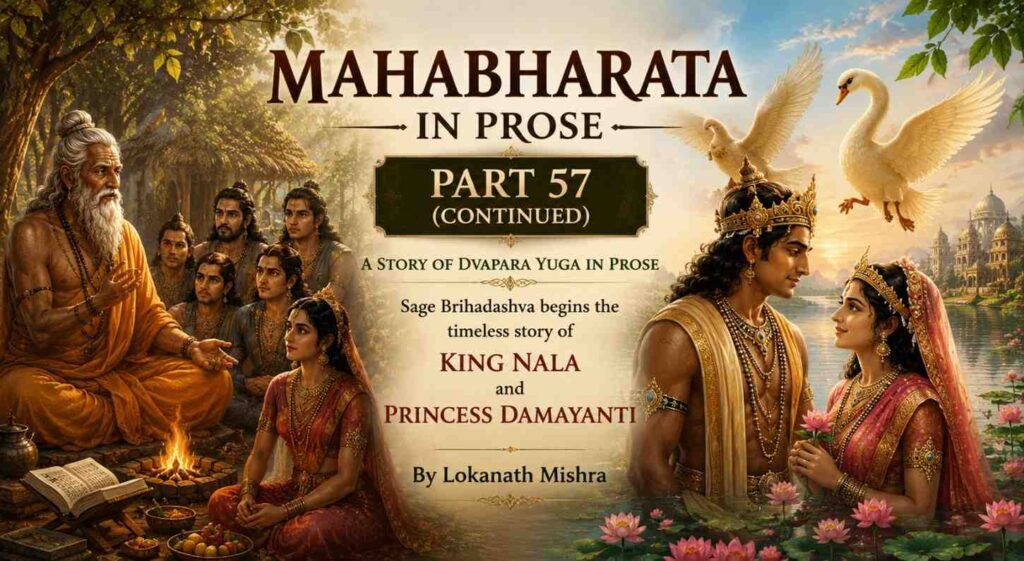
A Story of Dvapara Yuga in Prose
by Lokanath Mishra
Mahabharata in Prose – Part 57 (continued)
The days passed peacefully in the sacred forests, yet the peace was only on the surface. Deep beneath it flowed the unseen current of destiny. The Pandavas had accepted their exile with patience, but beyond the boundaries of the forest, the kings of Aryavarta watched their fortunes with growing interest. Some secretly admired their steadfastness, while others aligned themselves with the growing power of Hastinapura. Meanwhile, the fame of the Pandavas’ righteousness spread far and wide. Sages who visited their hermitage spoke everywhere of Yudhishthira’s unwavering devotion to dharma, Bhima’s unmatched strength, Arjuna’s celestial accomplishments, Nakula’s grace, Sahadeva’s wisdom, and Draupadi’s extraordinary endurance. Even the forest tribes regarded them not as exiled princes but as protectors of righteousness.
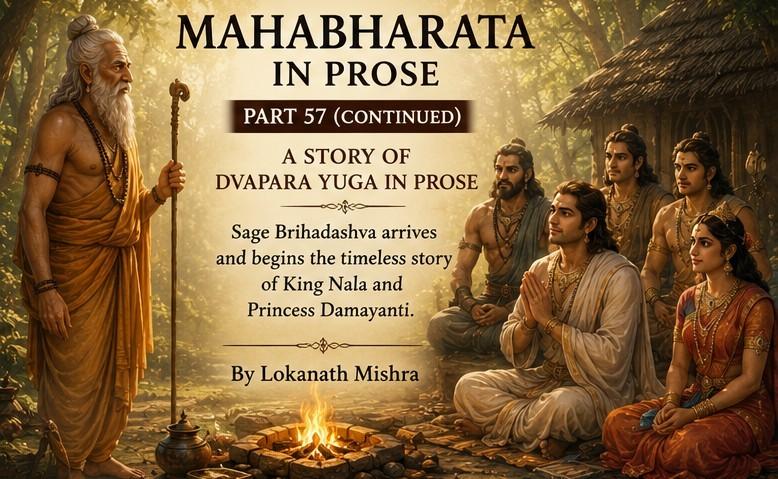
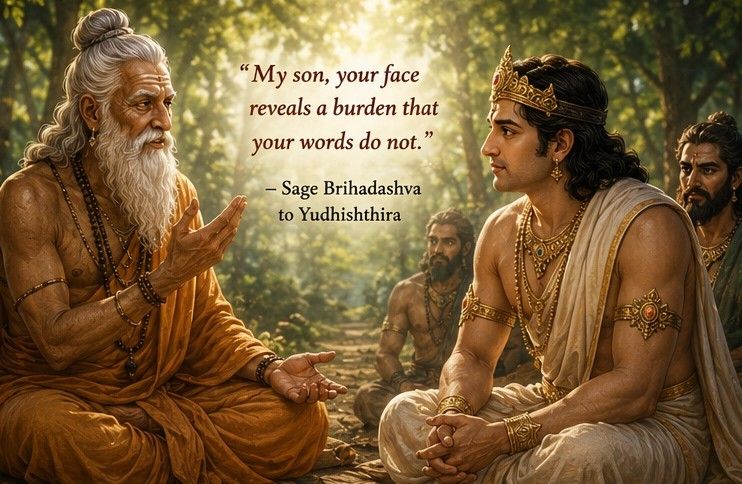
The Arrival of Sage Brihadashva One pleasant morning, as the Pandavas completed their daily rituals and offered oblations into the sacred fire, a venerable sage approached their hermitage. His matted locks were white with age, yet his face shone with youthful brilliance. His eyes reflected the serenity born of profound wisdom. It was the great sage Brihadashva. Yudhishthira immediately rose from his seat. The brothers welcomed the sage with folded hands, washed his feet according to sacred custom, and offered him fruits, roots, and cool water. After accepting their hospitality, Brihadashva looked compassionately at Yudhishthira. “My son,” he said gently, “your face reveals a burden that your words do not.” Yudhishthira smiled faintly. “Revered Sage, I do not grieve for myself. A king must endure whatever destiny brings. But I often wonder whether any ruler has suffered misfortune equal to ours.” The sage remained silent for a moment before replying. “There was once another king who lost everything—not through wickedness, but through a single weakness.” The Pandavas leaned forward attentively. His name was Nala.
Why the Story of Nala Was Told Brihadashva understood that stories were not merely entertainment. They were mirrors through which men recognized themselves. Looking toward Draupadi, he said, “Queen, just as you have remained faithful through hardship, there was once another queen whose devotion became legendary.” He then spoke the name of Damayanti. The hermitage became completely silent. Even the birds seemed to pause as the sage began his narration.
The Prosperous Kingdom of Nishadha Long before the present age, there ruled a noble king named Nala in the prosperous kingdom of Nishadha. He was renowned throughout Bharata for his righteousness, generosity, courage, and compassion. His people loved him not because they feared his authority, but because they trusted his justice. Under his rule, harvests were plentiful. Merchants prospered. The roads were safe. No widow cried from oppression. No hungry man left the palace gates without food. Above all, King Nala possessed remarkable humility. Though skilled in warfare, he never sought unnecessary conflict. Though wealthy, he never became proud. Though powerful, he always honored sages and elders. Yudhishthira listened carefully. In many ways, the life of Nala reminded him of his own before the fatal game of dice.
Princess Damayanti Far away, in the kingdom of Vidarbha, there lived Princess Damayanti. Her beauty was celebrated across kingdoms, but those who knew her admired something even greater—her purity of heart, wisdom, and unwavering devotion to truth. Kings from distant lands sought her hand in marriage. Yet Damayanti remained undecided. She believed that a husband should be chosen not merely for power or wealth, but for virtue. At that time, stories of King Nala’s goodness reached her ears. Though she had never seen him, she found herself deeply impressed by his character. Likewise, wandering sages carried tales of Damayanti’s beauty and noble qualities to Nishadha. Gradually, without ever meeting, the two developed profound admiration for one another.
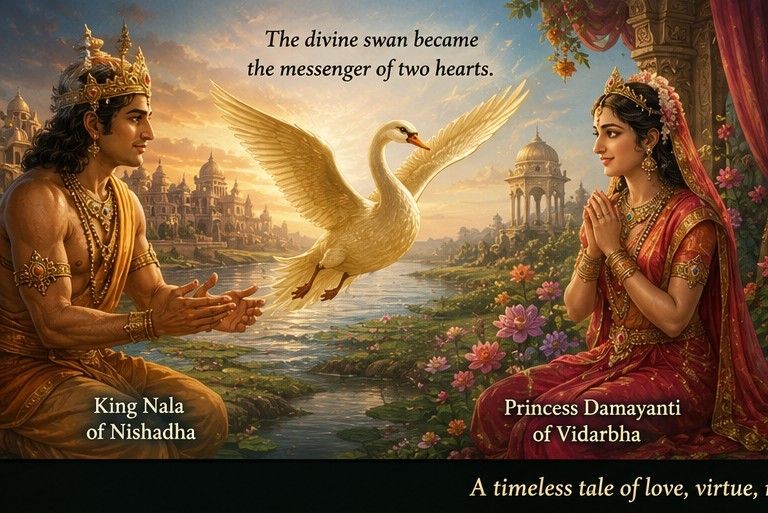
The Divine Swan One day, while walking through the royal gardens, King Nala noticed a magnificent golden swan resting beside a lotus pond. As he approached, the bird attempted to fly away but was gently caught. To Nala’s astonishment, the swan spoke in a human voice. “O King, release me, and I shall perform a service worthy of your kindness.” Surprised but composed, Nala loosened his grip. “What service can a swan perform for a king?” The swan replied, “I shall fly to Princess Damayanti and speak to her of your virtues. Likewise, I shall return with news of her heart.” Nala smiled. “If such is your wish, go with my blessing.” The golden swan flew swiftly through the skies until it reached the gardens of Vidarbha. There, Damayanti and her companions were gathering flowers. The radiant bird descended before them. Curious, the princess approached. The swan spoke gently. “O Princess, among all the kings of the earth, none equals Nala of Nishadha. He is handsome, righteous, brave, compassionate, and devoted to truth. If ever two souls were destined to unite, it is you and King Nala.” Hearing these words, Damayanti’s heart filled with quiet joy. “I too have heard of King Nala,” she replied softly. “If destiny permits, no other shall become my husband.” The swan carried this message back to Nala. Thus, before they had ever seen one another, their hearts were united through virtue rather than appearance.
Yudhishthira Reflects As Brihadashva paused in his narration, Yudhishthira remained deep in thought. “Revered Sage,” he asked, “why do you tell us this story now?” The sage smiled. “Because, O King, prosperity and adversity visit every life. But what truly defines a person is not whether fortune smiles or turns away—it is whether one remains steadfast in righteousness.” He continued, “King Nala possessed every virtue, yet even he would soon face a calamity greater than he ever imagined.” The Pandavas exchanged thoughtful glances. The sage’s words carried an unmistakable lesson. Even the noblest of men were not exempt from suffering. But suffering itself could become the path to greater wisdom.
That evening, after the sage retired for meditation, the Pandavas remained seated around the sacred fire. Bhima broke the silence. “Brother,” he said, “it seems even great kings cannot escape the trials ordained by fate.” Yudhishthira nodded thoughtfully. “No, Bhima. But perhaps destiny tests the righteous not to destroy them, but to reveal their true greatness.” The flames rose gently into the night sky. Above them, countless stars glittered in silence. And as the Pandavas reflected upon the opening chapters of King Nala’s story, they did not yet know that the tale would soon reveal striking similarities to their own lives—lessons of loss, temptation, patience, separation, and ultimate restoration. For just as darkness precedes the dawn, the deepest trials often prepare the soul for its greatest triumph.
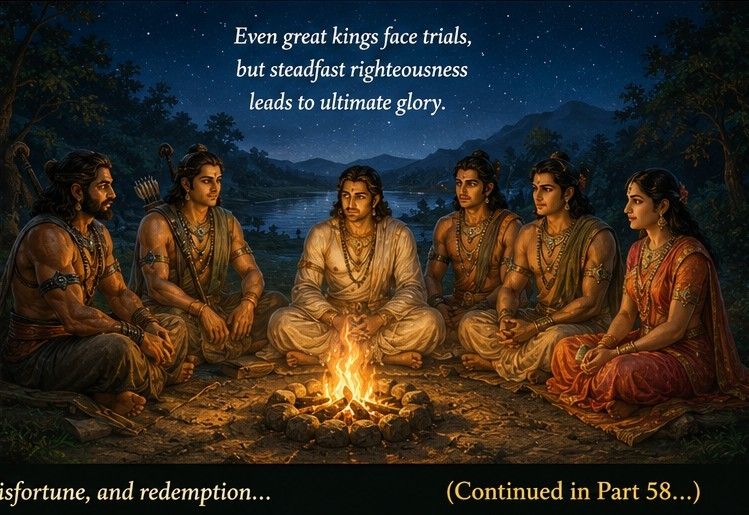
Thus began the sacred narration of the story of Nala and Damayanti—a tale of love, virtue, misfortune, and redemption, told by Sage Brihadashva to strengthen the hearts of the Pandavas during their long years of exile. (Continued in Part 58…)