
The Golconda Campaign against Tirupati during the Reign of Abdullah Qutb Shah (c. 1665–1668 CE) : Literary Testimony, Historical Context, and Sacred Memory
By Lokanath Mishra
Abstract
The seventeenth century witnessed profound political changes in South India as the Deccan Sultanates expanded into the territories of the declining Vijayanagara Empire. During the reign of Abdullah Qutb Shah, Golconda armies advanced into Rayalaseema and the eastern districts of present-day Andhra Pradesh. Among the most valuable contemporary literary testimonies to this turbulent period is the Venkatachala Vihara Satakamu, an anonymous Telugu poem generally dated between 1665 and 1668 CE. The poem vividly records military incursions, destruction of temples, desecration of sacred sites, and widespread suffering in and around Tirupati. It also reflects the anguish of a devout Vaishnavite witnessing political upheaval. This article examines the historical background of the Golconda campaign, analyses the evidence preserved in the Venkatachala Vihara Satakamu, and discusses later traditions regarding the preservation of the Tirumala temple through negotiation with Golconda authorities.
Introduction
The collapse of the Vijayanagara Empire following the Battle of Talikota transformed the political landscape of South India. Although the empire survived in diminished form from capitals such as Penukonda and later Chandragiri, its authority steadily weakened during the seventeenth century.
The Qutb Shahi dynasty exploited this political vacuum. Under Abdullah Qutb Shah (1626–1672), Golconda extended its control southwards, occupying extensive territories formerly administered by Vijayanagara chiefs. These campaigns brought the Golconda armies into the sacred region surrounding Tirumala Venkateswara Temple, one of the wealthiest and most revered Hindu pilgrimage centres.
Unlike royal chronicles that celebrate military victories, the Venkatachala Vihara Satakamu offers a rare perspective from a devotee who experienced these events firsthand.
⸻
Historical Background
By the middle of the seventeenth century, Vijayanagara authority had become largely nominal. Regional Nayakas and local chieftains exercised substantial autonomy while Golconda steadily annexed strategic forts and fertile districts.
The campaigns of Abdullah Qutb Shah into southern Andhra were motivated by several factors:
- consolidation of political authority,
- acquisition of revenue,
- control of trade routes,
- incorporation of temple-rich territories into the Golconda fiscal system.
Persian chronicles such as the Ma’asir-i-Qutb Shahi and European travel accounts indicate that Golconda’s administration often preferred to preserve productive revenue institutions rather than destroy them outright. Nevertheless, military campaigns frequently involved plunder, destruction, and temporary desecration of religious establishments during conquest.
⸻
The Venkatachala Vihara Satakamu as Historical Evidence
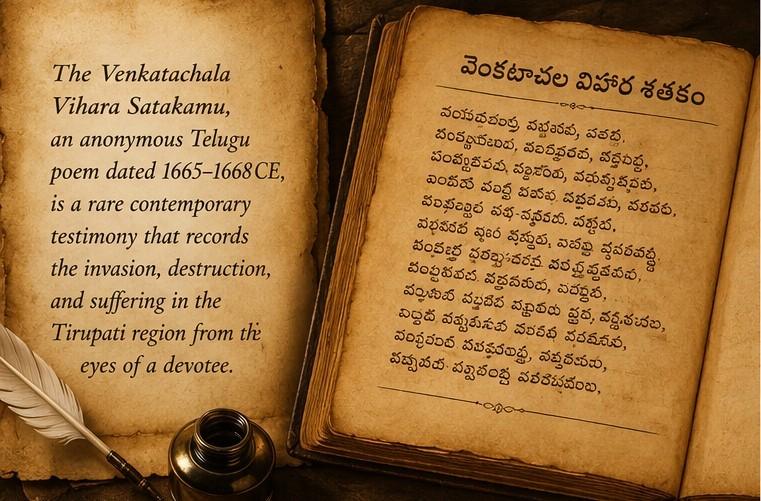
The anonymous Venkatachala Vihara Satakamu, generally dated to 1665–1668 CE, constitutes one of the most important indigenous literary records of the Golconda invasion of the Tirupati region.
Internal evidence strongly suggests that its author was a Sri Vaishnavite Brahmin deeply devoted to Lord Venkateswara.
Although devotional in form, the poem contains numerous references to contemporary military events that correspond closely with the known expansion of Golconda into southern Andhra.
Like many medieval literary works, the poem combines historical observation with emotional religious expression.
Religious Identity of the Poet
Verse 66 unmistakably establishes the poet’s Vaishnavite identity.
He asks:
“How can I abandon the Gayatri Mantra and utter the Kartaru Mantra of the Muslims? How can I remain without the sacred namam? How can I cease worshipping You, the Father of the Universe, and instead adore the Penugonda Babu?”
The verse reveals not merely religious conviction but also anxiety over political domination and cultural displacement.
⸻
The Call for Resistance
One of the most striking verses is Verse 6.
The poet declares that if he possessed Lord Venkateswara’s Sudarshana Chakra, he would personally attack the invading forces:
“…I would strike men and horses alike, heap their bodies together, and drive the Turks back to Golconda.”
Although rhetorical, this verse vividly reflects the desperation and anger generated by the invasion.
⸻
Preservation of Sacred Tradition
Verse 9 expresses another form of cultural loss.
The poet laments:
“My ears, accustomed to the sacred Tamil Prabandhams, should never be compelled to hear Muslim lore instead of the Pasurams of the Azhvars.”
The verse demonstrates the centrality of the Tamil Divya Prabandham within Sri Vaishnava worship at Tirumala.
Devastation of the Tirupati Region
Perhaps the most historically significant passage is Verse 77.
The poet asks how Nellore can withstand the terrible soldiers of Sultan Abdullah.
He describes:
- desecrated temples,
- sacred gardens damaged by war elephants,
- temple precincts occupied by military officers,
- lotus ponds polluted,
- villages falling under military occupation.
The poem specifically names numerous settlements affected by the campaign:
- Kavali
- Kovur
- Duvvuru
- Nellore
- Polur
- Manneru
- Tallapaka
- Utukuru
- Oramupadu
- Penubalapeta
- Kodur
- Kuruva
- Mamanduru
- Srikalahasti
The geographical distribution of these places strongly suggests that military operations extended across a broad region rather than being confined solely to Tirupati.
⸻
Financial Concerns and Temple Wealth
Verse 90 contains an intriguing admonition:
“As your well-wisher, I entreat you not to pay money to mean-minded people.”
This verse reflects widespread concern regarding the extraction of wealth from religious institutions during wartime.
It also provides literary evidence that financial exactions formed an important component of Golconda’s military occupation.
⸻
Local Tradition Regarding Commander Ali
A later regional tradition, preserved in temple lore and local historical narratives rather than contemporary documentary sources, concerns the Golconda commander Ali.
According to this tradition, Ali attempted to ascend Tirumala after occupying Tirupati. Local inhabitants informed him that anyone proceeding to the hill must first pass the shrine of Sri Bhu Varaha Swamy Temple at the foothills and again encounter the Varaha deity before entering Lord Venkateswara’s temple.
Because the boar (Varaha) was explained to him as a sacred form of Vishnu, Ali—reportedly viewing the pig as ritually impure according to Islamic norms—withdrew temporarily to Chandragiri and planned an alternative ascent via Srivari Mettu.
This account survives in regional oral tradition but lacks confirmation from contemporary Persian or Telugu documentary records.
⸻
Negotiation and Preservation of the Temple
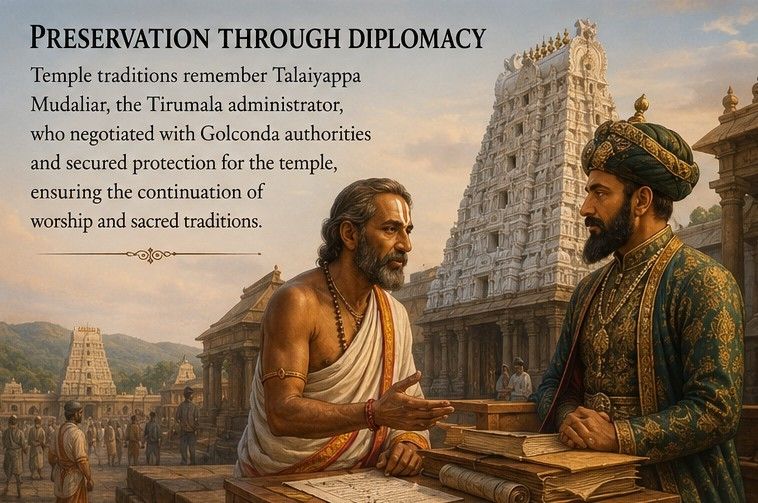
Another enduring tradition narrates that before the renewed assault could occur, the priests of Tirumala negotiated with Golconda authorities.
Drawing upon the celebrated legend that Lord Venkateswara had borrowed wealth from Kubera for His marriage to Padmavati, the priests reportedly argued that offerings made by devotees represented continuing repayment of this divine debt.
They further explained that the temple generated an annual revenue of approximately two lakh rupees, making it an economically valuable institution.
According to this tradition, Commander Ali recognised that destruction of the temple would permanently reduce state revenue. Instead, an arrangement was allegedly reached whereby the temple continued functioning while remitting revenue or tribute to Golconda authorities.
Some later narratives characterise this payment as jizya, while others describe it more generally as tribute or assessed revenue. Since no contemporary administrative record explicitly identifies the payment as jizya, historians generally treat this aspect cautiously.
Historical Assessment
Several elements of this narrative rest upon differing levels of historical evidence.
Strongly supported by contemporary evidence
- Golconda expansion under Abdullah Qutb Shah.
- Military operations in southern Andhra.
- Disturbances around Tirupati.
- Plundering of settlements.
- Desecration of temples.
- Literary testimony preserved in the Venkatachala Vihara Satakamu.
Supported primarily by later tradition
- Commander Ali’s encounter with the Varaha shrine.
- His withdrawal because of the Varaha image.
- Negotiation between temple priests and Golconda officers.
- Payment specifically described as jizya in exchange for preserving the temple.
Although these latter traditions cannot presently be verified through contemporary records, they remain important components of the historical memory surrounding Tirumala and illustrate how local communities understood the survival of one of India’s greatest temples during a period of political instability.
⸻
Conclusion
The Venkatachala Vihara Satakamu remains an indispensable primary source for understanding the Golconda campaigns in southern Andhra during the reign of Abdullah Qutb Shah. Written by an anonymous Vaishnavite witness, it records not only military occupation and religious desecration but also the emotional trauma experienced by devotees whose sacred landscape was transformed by war.
When read alongside Persian chronicles, temple records, and regional traditions, the poem offers a nuanced picture of conquest in seventeenth-century South India. While literary evidence firmly establishes that the Tirupati region experienced military devastation, later traditions concerning Commander Ali and negotiations with temple priests demonstrate how historical memory evolved to explain the preservation of the Tirumala shrine. Together, these sources underscore the complex interplay of warfare, religion, economy, and collective memory in the history of one of Hinduism’s most sacred pilgrimage centres.
⸻
References
- Rao, C. P. Brown (ed.), Venkatachala Vihara Satakamu (Telugu text and commentary), based on seventeenth-century manuscript traditions.
- A Social History of the Deccan, 1300–1761.
- A History of South India.
- The Qutb Shahis of Golconda.
- Ma’asir-i-Qutb Shahi (Persian chronicle of the Qutb Shahi dynasty).
- Tirumala Tirupati Devasthanams, historical publications on the Tirumala temple.
- Burton Stein, Vijayanagara.