
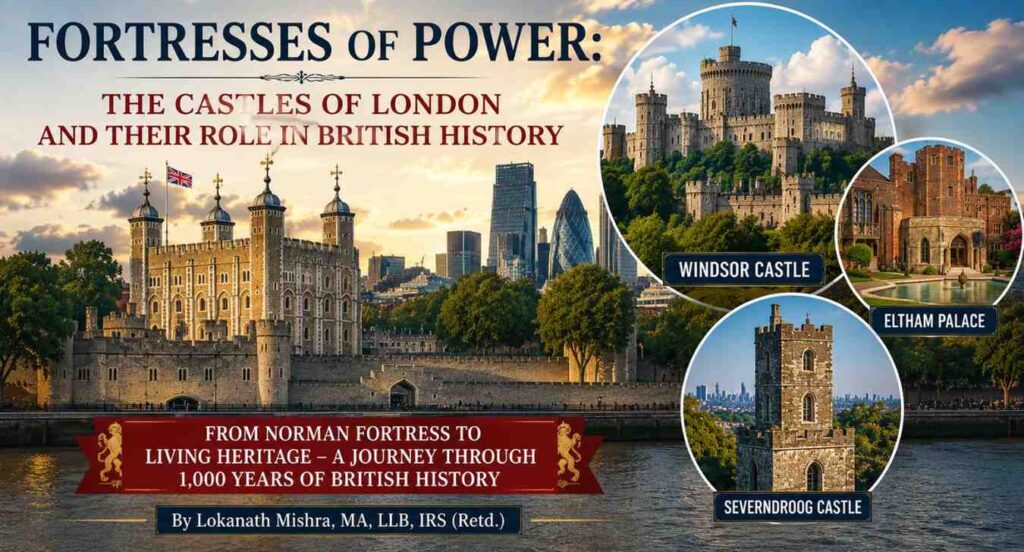
FORTRESSES OF POWER: THE CASTLES OF LONDON AND THEIR ROLE IN BRITISH HISTORY
By Lokanath Mishra, MA, LLB, IRS (Retd.)
For Journal of Heritage, Architecture & Governance
ABSTRACT
London is not conventionally regarded as a “castle city” in the manner of Edinburgh or Cardiff. Yet within its boundaries and immediate periphery stand some of the most significant fortifications in British history. From the Norman military stronghold of the Tower of London to the continuously occupied royal residence of Windsor Castle, these structures embody over 1,000 years of monarchical power, military strategy, and constitutional evolution. This article examines four principal castles associated with London — the Tower of London, Windsor Castle, Eltham Palace, and Severndroog Castle — analyzing their architectural, historical, and contemporary public significance.
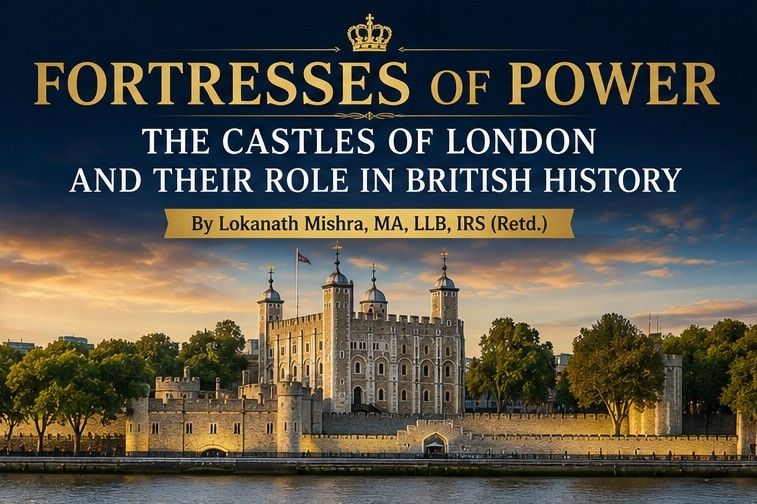
- INTRODUCTION: LONDON AND THE CASTLE TRADITION
Unlike continental capitals built around defensive citadels, London developed as a mercantile and administrative center. Nevertheless, the monarchy required secure residences, prisons, and symbols of authority within and around the metropolis. The result is a unique constellation of fortifications that served simultaneously as military bastions, royal palaces, prisons, and now, heritage sites of global importance.
Two of these — the Tower of London and Windsor Castle — are recognized worldwide as icons of British statehood. Two others — Eltham Palace and Severndroog Castle — reveal lesser-known but equally important dimensions of royal and commemorative architecture. Together they present a chronological narrative from medieval kingship to modern constitutional monarchy.
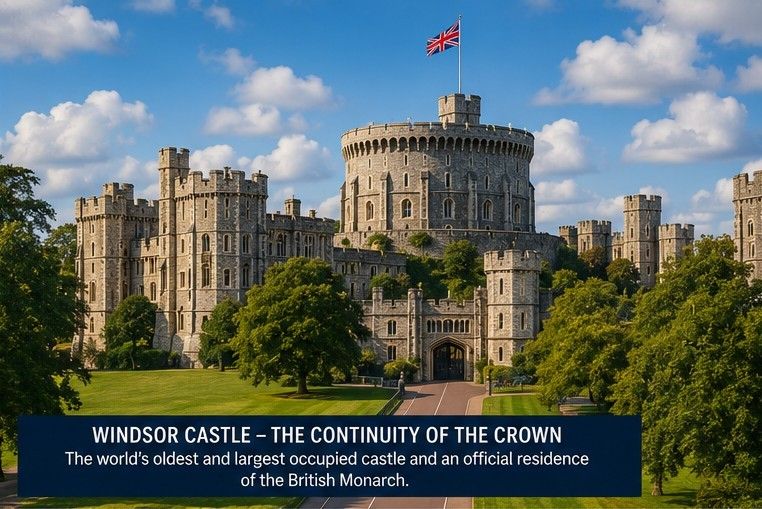
- THE TOWER OF LONDON: THE NORMAN FOUNDATION OF ROYAL AUTHORITY
Location: Tower Hill, London EC3N 4AB. North bank of the River Thames.
Founded: 1066-1078 by William the Conqueror.
The Tower of London is the most historically consequential castle in the capital. Conceived as both a fortress to dominate a restive city and a royal residence, its White Tower remains one of the finest examples of Norman military architecture in Europe.
Key Dimensions
- The Crown Jewels: Housed in the Jewel House, the collection includes St. Edward’s Crown and the Imperial State Crown. It represents the material continuity of the monarchy across a millennium.
- The Yeoman Warders and Ravens: The Beefeaters, instituted in 1485, and the resident ravens are living traditions that connect modern visitors to Tudor and Stuart court life. Legend holds that if the ravens leave, the Crown and Kingdom will fall.
- Carceral History: The Tower served as a prison for high-status captives including Anne Boleyn, Sir Thomas More, and Sir Walter Raleigh. Executions on Tower Green underscore its role as an instrument of state power.
- UNESCO Status: Inscribed in 1988, the Tower is recognized for its testimony to the development of military architecture and royal administration.
A visit today, managed by Historic Royal Palaces, offers an immersive encounter with 900 years of political intrigue, warfare, and ceremony.
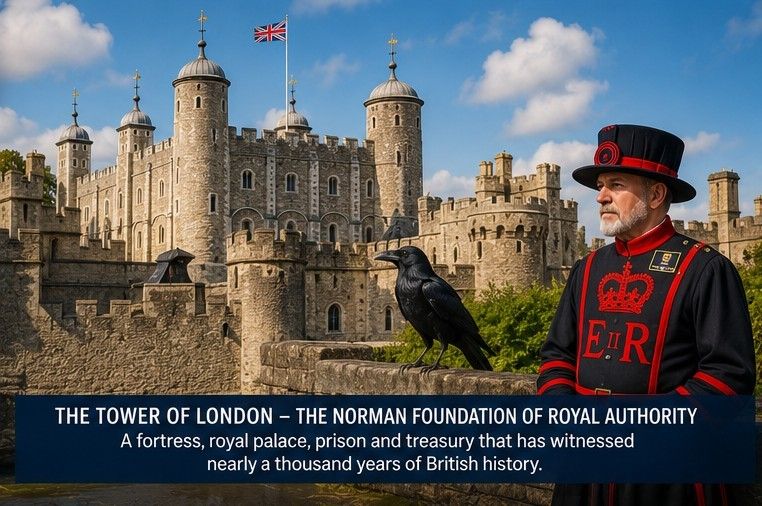
- WINDSOR CASTLE: THE CONTINUITY OF THE CROWN
Location: Windsor, Berkshire SL4 1NJ. Approximately 1 hour by rail from London Waterloo or Paddington.
Founded: 1070 by William the Conqueror.
Windsor Castle is the oldest and largest continuously occupied castle in the world and remains an official residence of the British Monarch. Its significance lies not only in antiquity but in its unbroken function as a working royal household.
Key Dimensions
- The State Apartments: Rebuilt after the 1992 fire, they display masterpieces from the Royal Collection, including works by Rembrandt, Rubens, and Canaletto. The architecture reflects successive phases from medieval to Georgian and Victorian Gothic.
- St. George’s Chapel: A masterpiece of Perpendicular Gothic. It is the spiritual home of the Order of the Garter and the burial place of ten monarchs, including Henry VIII, Charles I, and Queen Elizabeth II. Royal weddings and funerals conducted here are global events of constitutional significance.
- Queen Mary’s Dolls’ House: A marvel of 1920s craftsmanship, it contains working electricity, running water, and miniature books written by leading authors of the day. It symbolizes the intersection of monarchy and modernity.
- Living Institution: Unlike a museum, Windsor remains occupied. The changing of the guard and the presence of the Royal Standard signal that this is not a relic, but a seat of governance.
Managed by the Royal Collection Trust, advance booking is essential due to high international demand.
- ELTHAM PALACE: MEDIEVAL ROYALTY MEETS ART DECO MODERNITY
Location: Court Yard, Eltham, London SE9 5QE.
Origins: Great Hall c. 1470. Current house 1933-1936.
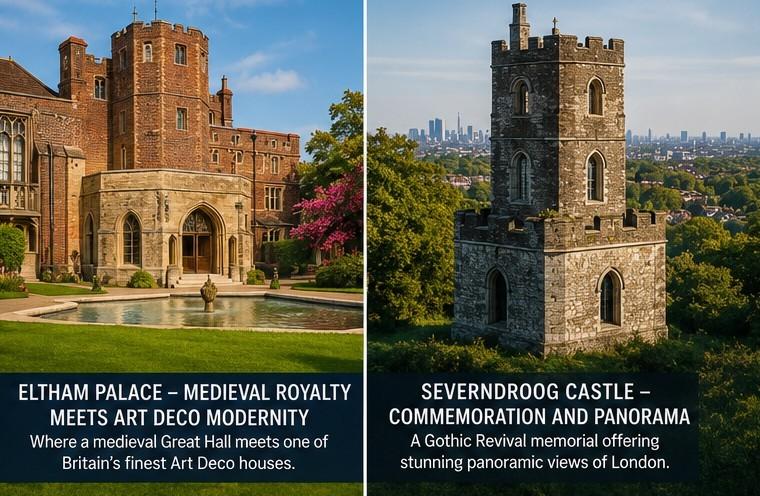
Eltham Palace presents one of the most striking architectural juxtapositions in Britain. It was a favored residence of Edward IV and Henry VIII. The medieval Great Hall, with its hammerbeam roof, survived the demolition of the Tudor palace.
In the 1930s, millionaires Stephen and Virginia Courtauld built an Art Deco mansion around the Hall. The result is a deliberate dialogue between centuries:
- Medieval Grandeur: The Great Hall hosted banquets for Henry VIII and was the site of jousts and pageants.
- Art Deco Innovation: The house features chrome, exotic woods, built-in furniture, and a domed entrance hall — representing Britain’s inter-war embrace of modern design.
- Heritage Value: Managed by English Heritage, Eltham demonstrates how heritage can be adaptive rather than static. It is not a fortress, but a palace that reveals changing notions of royal and aristocratic domesticity.
- SEVERNDROOG CASTLE: COMMEMORATION AND PANORAMA
Location: Castle Wood, Shooters Hill, London SE18 3RT. Oxleas Woods, South East London.
Built: 1784 by Lady James as a memorial to her husband, Sir William James, who captured the Indian fort of Suvarnadurg.
Severndroog is not a defensive castle but a Gothic Revival folly and monument. Its triangular plan and battlements imitate medieval military architecture while serving a commemorative purpose.
Key Dimensions
- Imperial Memory: It memorializes Britain’s 18th-century naval campaigns in India, linking London’s heritage to its imperial past.
- Public Access: Visitors may climb the spiral staircase to the viewing platform. On a clear day, one can see across London to the City and Canary Wharf — connecting 18th-century commemoration to 21st-century urbanism.
- Community Heritage: Restored by local volunteers, it represents grassroots conservation of London’s peripheral historic sites.
Though small, Severndroog illustrates how the “castle” form was appropriated in the Georgian era for memorial and aesthetic purposes.
- CONCLUSION: CASTLES AS LIVING ARCHIVES
The castles in and around London are more than tourist attractions. They are institutional archives in stone.
The Tower of London documents the centralization of Norman power and the violence of early statehood. Windsor Castle embodies the continuity and adaptation of the monarchy. Eltham Palace records the transition from medieval kingship to modern private wealth. Severndroog Castle reflects imperial memory and public commemoration.
Together, they demonstrate that London’s castle heritage is not peripheral but central to understanding British political history. For scholars, students, and visitors, these sites offer tangible access to the architecture of power.
To walk their halls is to walk through 1,000 years of British governance — from conquest to constitution, from fortress to home.
Keywords: Tower of London, Windsor Castle, Eltham Palace, Severndroog Castle, British Monarchy, Heritage Conservation, Military Architecture, UNESCO World Heritage