
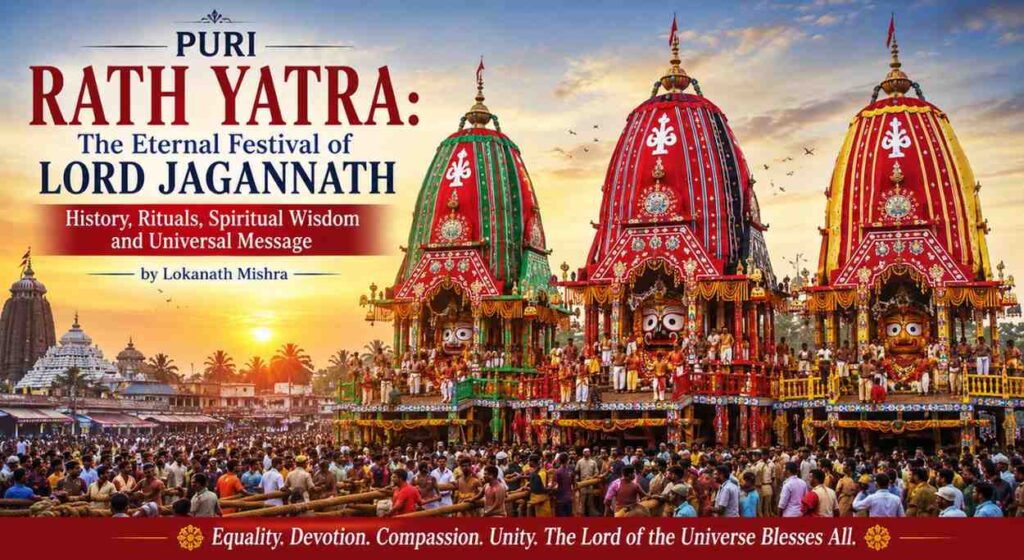
Puri Rath Yatra : The Eternal Festival of Lord Jagannath—History, Rituals, Spiritual Wisdom, and Universal Message
By Lokanath Mishra
Abstract
The Rath Yatra of Lord Jagannath at Puri, Odisha, is among the world’s oldest continuously celebrated religious festivals and one of the greatest public expressions of devotion in Hinduism. Every year, millions of pilgrims from India and abroad gather to witness the magnificent procession of Lord Jagannath, Lord Balabhadra, and Devi Subhadra from the Jagannath Temple to the Gundicha Temple. More than a religious event, the Rath Yatra embodies the universal ideals of equality, humility, devotion, compassion, and divine grace. It reminds humanity that God comes out of the temple to bless everyone without distinction of caste, creed, nationality, gender, or social status. This article examines the history, rituals, chronology, spiritual symbolism, and enduring relevance of the Rath Yatra.
Introduction
The sacred city of Puri, situated on the eastern coast of India along the Bay of Bengal, is one of Hinduism’s four Char Dham pilgrimage centres. For countless devotees, it is known as Sri Kshetra, Purushottama Kshetra, and Jagannath Dham, the earthly abode of Lord Jagannath—the “Lord of the Universe.”
The annual Rath Yatra is not merely a temple festival. It is a celebration of humanity itself. Unlike many temple rituals that are performed within the sanctum, the Lord leaves His temple and comes onto the streets so that everyone, irrespective of social or religious identity, may receive His blessings.
This extraordinary tradition has continued uninterrupted for many centuries and today inspires millions across the globe.
⸻
Historical Background
The worship of Lord Jagannath has ancient roots. The sacred land of Purushottama Kshetra is described in the Skanda Purana (Purushottama Mahatmya), Brahma Purana, Padma Purana, and several other Hindu scriptures. These texts describe Puri as a supreme pilgrimage where liberation (moksha) can be attained through sincere devotion.
The present Jagannath Temple was constructed during the reign of King Anantavarman Chodaganga Deva of the Eastern Ganga dynasty in the twelfth century CE and completed by his successors. Since then, the annual Rath Yatra has remained one of India’s most important religious traditions.
Over the centuries, saints such as Sri Chaitanya Mahaprabhu, poets, philosophers, kings, and ordinary devotees have celebrated the festival as the supreme expression of divine love.
Lord Jagannath: The Universal Lord
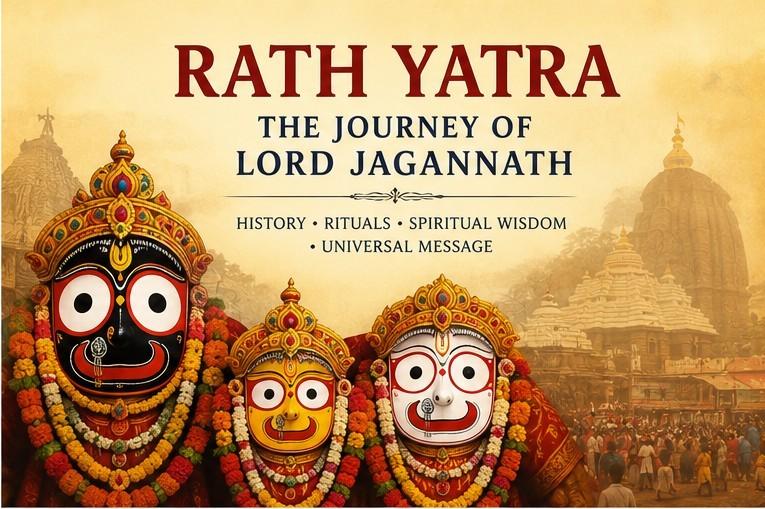
Unlike conventional images of Hindu deities, Lord Jagannath’s unique wooden form symbolizes the infinite nature of God.
The large circular eyes signify that the Lord constantly watches over every living being.
The smiling face represents unconditional compassion.
The unfinished hands remind humanity that God’s embrace extends beyond all limitations.
Jagannath belongs to everyone. Therefore, He is called the Lord of the Universe.
⸻
Annual Ritual Calendar Leading to Rath Yatra
The Rath Yatra is the culmination of a series of sacred observances that begin months earlier.
Akshaya Tritiya (Vaishakha)
Construction of the three chariots begins on the auspicious day of Akshaya Tritiya.
Selected sacred timber is ceremonially brought to Puri.
Traditional hereditary carpenters build the chariots according to precise scriptural measurements.
Spiritual message: Every great journey begins with careful preparation. Likewise, spiritual progress begins with discipline and dedication.
⸻
Snana Purnima (Jyestha Purnima)
The three deities are ceremonially bathed with 108 pitchers of sanctified water.
This public bathing ceremony is known as Snana Yatra.
Following the bath, the deities symbolically become unwell.
Spiritual message: Even God participates in human experiences, teaching compassion and closeness with humanity.
⸻
Anavasara (Fortnight of Seclusion)
Following Snana Yatra, the deities remain away from public view for approximately fifteen days.
Devotees believe that the Lords are recovering from illness.
Temple physicians offer herbal medicines and special food.
Spiritual message: Rest, healing, silence, and introspection are essential for both physical and spiritual well-being.
⸻
Netrotsava and Nava Jaubana Darshan
Before Rath Yatra, the divine eyes of the deities are ceremonially repainted.
This ritual symbolizes renewed youthful beauty.
Thousands gather for the first public darshan after Anavasara.
Spiritual message: Every ending leads to renewal. Divine grace continually restores life.
⸻
Rath Yatra (Ashadha Shukla Dwitiya)
This is the principal day of the festival.
The deities emerge from the sanctum amidst Vedic chanting, devotional music, conch shells, cymbals, and drums.
They are carried in the magnificent Pahandi Bije procession and seated on their respective chariots:
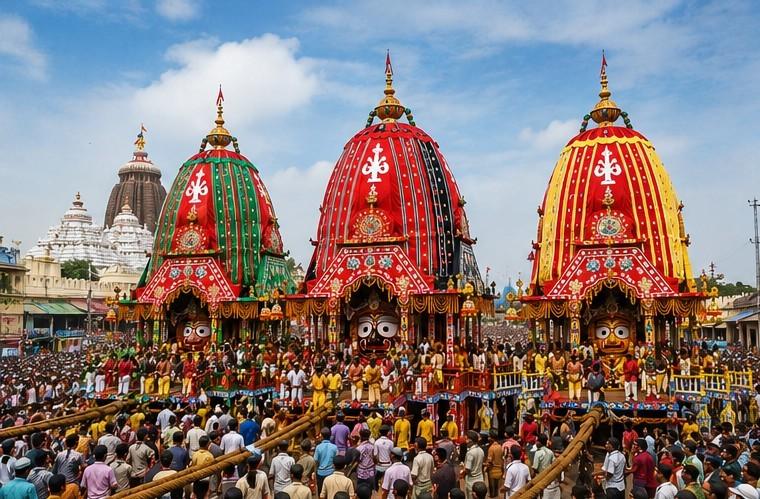
- Nandighosha of Lord Jagannath (16 wheels)
- Taladhwaja of Lord Balabhadra (14 wheels)
- Darpadalana (Devadalana) of Devi Subhadra (12 wheels)
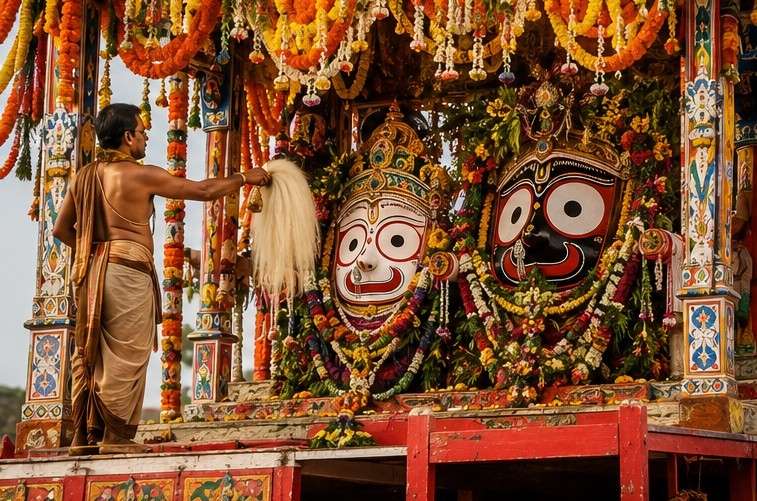
The Gajapati Maharaja performs the famous Chhera Pahanra, ceremonially sweeping the chariots with a golden broom.
This remarkable act demonstrates that even a king is only a humble servant before the Lord.
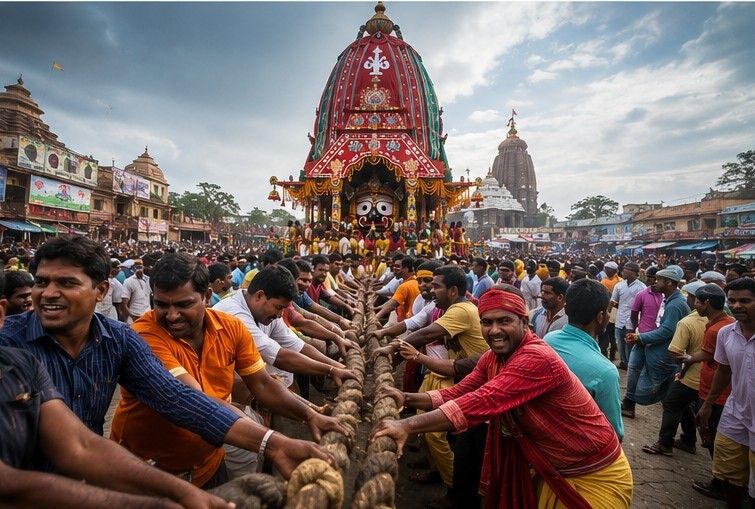
Thereafter, millions of devotees pull the sacred ropes.
Spiritual message: Pride disappears before God. True greatness lies in humility and service.
⸻
Stay at Gundicha Temple
The deities remain at Gundicha Temple for about seven days.
According to tradition, this temple is regarded as the garden residence of Lord Jagannath’s aunt.
During this period thousands offer prayers, bhajans, and charitable service.
Spiritual message: Every home becomes sacred when filled with love, simplicity, and devotion.
⸻
Hera Panchami
On the fifth day, Goddess Lakshmi symbolically visits Gundicha Temple searching for Lord Jagannath.
This beautiful ritual reflects divine love and playful affection.
Spiritual message: Relationships thrive through mutual respect, understanding, and forgiveness.
⸻
Bahuda Yatra (Return Journey)
On Ashadha Shukla Dashami the deities return to the main temple.
Again millions participate in pulling the chariots.
The return symbolizes the completion of life’s spiritual pilgrimage.
Spiritual message: Every journey ultimately returns to its Divine source.
⸻
Suna Besha (Golden Attire)
After returning, Lord Jagannath, Lord Balabhadra, and Devi Subhadra appear in magnificent golden ornaments.
This is among the grandest spectacles of the festival.
Spiritual message: The true wealth of humanity is not gold but righteousness, compassion, and devotion.
⸻
Adhara Pana
Large earthen pots filled with sacred sweet drink are offered to the deities and then ceremonially broken.
The offering is believed to satisfy invisible divine attendants.
Spiritual message: Gratitude should extend beyond what is visible.
⸻
Niladri Bije
The deities finally re-enter the Jagannath Temple.
According to tradition, Goddess Lakshmi initially refuses Lord Jagannath entry until He offers her Rasagola.
This joyful ritual concludes the festival.
Spiritual message: Love, reconciliation, forgiveness, and mutual respect sustain family and society.
⸻
Timeless Spiritual Teachings
The Rath Yatra imparts enduring values:
Equality: Anyone may pull the ropes of the chariots, symbolizing that divine grace is available to all.
Devotion: Pulling the chariots is regarded as an act of surrender and spiritual merit.
Humility: Even kings serve the Lord with a broom.
Service: True worship includes helping fellow pilgrims, feeding the hungry, and serving society.
Unity: Millions from diverse backgrounds celebrate together in harmony.
New Beginnings: Every spiritual journey starts with faith, humility, and righteous action.
⸻
Jagannath Puri: The Sacred City
Puri is celebrated for:
- The Jagannath Temple
- Mahaprasad from the temple’s great kitchen
- Gundicha Temple
- Golden Beach
- Rich Odia music, dance, literature, handicrafts, and hospitality
During Rath Yatra, the city resonates with devotional songs, kirtans, Vedic chanting, cultural performances, spiritual discourses, and charitable activities.
⸻
Cultural Celebrations
Schools, colleges, and cultural institutions organize:
- Drawing competitions
- Essay competitions
- Quiz programmes
- Classical dance performances
- Odissi recitals
- Devotional singing
- Chariot-making exhibitions
- Folk theatre
- Heritage seminars
Popular artistic themes include the three chariots, the Grand Road (Bada Danda), Chhera Pahanra, Pahandi, Mahaprasad, and the unity of devotees.
Global Significance
Today, Rath Yatra is celebrated across Asia, Europe, North America, Australia, and Africa. It has become a global symbol of peace, harmony, and universal brotherhood.
The festival reminds humanity that the Divine is not confined within temples. God comes out to embrace every person with unconditional love.
Conclusion
The Rath Yatra of Puri is an extraordinary synthesis of faith, history, philosophy, art, architecture, music, and social harmony. It teaches that God belongs to everyone, that humility is greater than power, that service is higher than status, and that every human being deserves equal respect.
As the mighty chariots roll along the Bada Danda amid the resounding chants of “Jai Jagannath,” they carry a timeless message for the modern world:
“Walk with faith. Serve with humility. Live with compassion. See God in every human being. Then every journey of life becomes a Rath Yatra leading to the Divine.”