
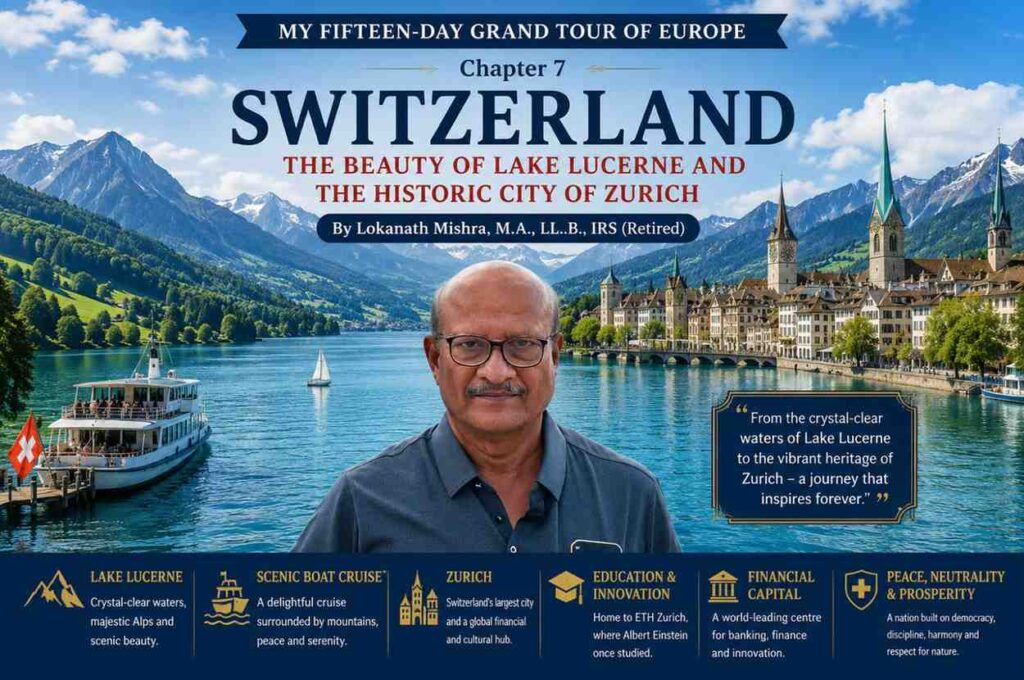
My Fifteen-Day Grand Tour of Europe
Chapter 7: Switzerland – The Beauty of Lake Lucerne and the Historic City of Zurich
By Lokanath Mishra, M.A., LL.B., IRS (Retired)
On the evening of 16th July 2026, after crossing the German-Swiss border, our Star Tour luxury coach continued its journey through the breathtaking Swiss countryside. The roads were surrounded by lush green meadows, picturesque villages, grazing cattle wearing traditional bells and magnificent mountain ranges. Every scene looked like a living painting.
Our first destination in Switzerland was one of the country’s most beautiful lakes. Although I had earlier remembered it as “Ryeme Lake,” it was actually Lake Lucerne (Vierwaldstättersee), one of Switzerland’s most celebrated lakes and a highlight of every visitor’s journey through central Switzerland.
Lake Lucerne – The Jewel of Central Switzerland
Lake Lucerne is situated in the heart of Switzerland and is surrounded by the magnificent Swiss Alps. Covering an area of about 114 square kilometres, it is one of the most picturesque lakes in Europe.
The lake has an unusual shape with several winding arms extending into different valleys. Its crystal-clear water reflects the surrounding snow-covered mountains, green forests and charming lakeside villages, creating scenery of extraordinary beauty.
The lake occupies an important place in Swiss history. The surrounding region is regarded as the birthplace of the Swiss Confederation. According to Swiss tradition, leaders from the original three cantons—Uri, Schwyz and Unterwalden—met near the shores of this lake in 1291 and pledged mutual cooperation and defence. This agreement eventually led to the formation of modern Switzerland.
For centuries, Lake Lucerne served as an important transport route connecting mountain communities before modern roads and railways were built.
Today it is one of Switzerland’s most famous tourist destinations, attracting millions of visitors every year.
A Delightful Boat Cruise
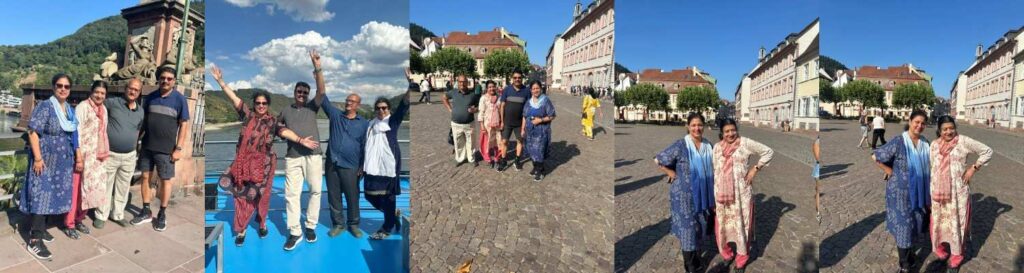
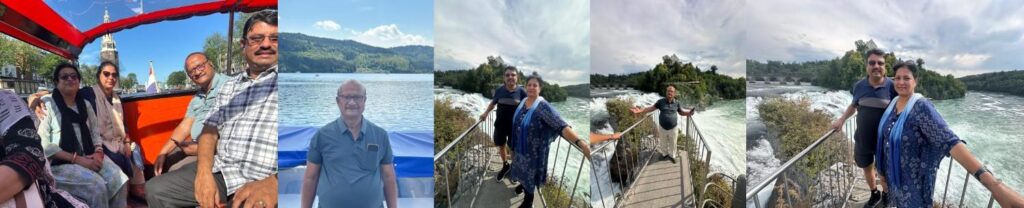
After arriving at the lakeside, we boarded a comfortable passenger boat for a cruise across the lake.
As the boat slowly glided over the calm blue waters, we were surrounded by breathtaking Alpine scenery. Snow-capped mountain peaks towered above the horizon, while green slopes descended gently towards the water. Small villages with traditional wooden houses were scattered along the shoreline, each looking peaceful and beautifully maintained.
The cool mountain breeze, the gentle movement of the boat and the crystal-clear reflections of the mountains created an unforgettable experience. Every passenger stood on the open deck, capturing photographs of the spectacular scenery.
The captain navigated the boat through different sections of the lake, offering magnificent views of famous mountains such as Mount Pilatus and Mount Rigi, both closely associated with Swiss history and folklore.
Along the shores we observed elegant hotels, beautifully maintained gardens, historic churches and small marinas filled with sailing boats and yachts. The purity of the water and the surrounding natural beauty reflected Switzerland’s deep commitment to environmental conservation.
The boat journey was peaceful and refreshing. Unlike crowded urban centres, the lake offered complete tranquillity, allowing every visitor to appreciate the grandeur of nature.
Our cruise on Lake Lucerne became one of the most memorable experiences of our entire European tour.
Journey to Zurich
After completing our lake cruise, our coach proceeded towards Zurich, the largest city in Switzerland.
The drive itself was delightful. The highways were exceptionally smooth, and every village appeared clean, orderly and beautifully landscaped. The combination of modern infrastructure and natural beauty made travelling through Switzerland a pleasure.
Zurich – Switzerland’s Financial Capital
Zurich is the largest city in Switzerland and one of the world’s leading financial centres.
Situated on the northern shore of Lake Zurich, the city has a history extending back more than 2,000 years.
Originally established by the Romans as a customs and military settlement called Turicum, Zurich gradually developed into an important trading centre because of its strategic location along European commercial routes.
During the Middle Ages, Zurich prospered through commerce, textile manufacturing and banking. In 1351, it became a member of the Swiss Confederation, strengthening both its political and economic influence.
Today Zurich is recognised internationally for its banking institutions, insurance companies, scientific research, education and high quality of life.
The Financial Centre of Europe
Zurich is often regarded as one of the financial capitals of the world.
Many leading international banks, insurance companies and investment institutions have their headquarters or major offices here.
The city’s financial strength is built upon political stability, sound economic policies, professional banking services and highly skilled human resources.
At the same time, Zurich has diversified its economy into information technology, biotechnology, engineering and advanced manufacturing.
Education and Research
Zurich is also one of Europe’s foremost centres of higher education.
The city is home to the prestigious Swiss Federal Institute of Technology (ETH Zurich), consistently ranked among the world’s leading universities in science and engineering.
Many distinguished scientists have studied or taught there, including Albert Einstein, who completed part of his higher education at ETH Zurich before becoming one of the greatest physicists in history.
The university continues to make important contributions to scientific research, engineering, artificial intelligence and environmental technology.
Historical and Cultural Heritage
Despite being a modern financial centre, Zurich has carefully preserved its historical heritage.
Its Old Town (Altstadt) contains narrow medieval streets, beautifully preserved buildings, churches and public squares dating back several centuries.
Among its famous landmarks are:
- Grossmünster, a Romanesque church associated with the Protestant Reformation in Switzerland.
- Fraumünster, renowned for its beautiful stained-glass windows designed by the celebrated artist Marc Chagall.
- St. Peter’s Church, famous for having one of the largest clock faces in Europe.
Walking through these historic streets provides a fascinating glimpse into Switzerland’s rich cultural and religious history.
Lake Zurich
Lake Zurich adds immense beauty to the city.
The lakeside promenade is lined with gardens, parks, walking paths and elegant buildings.
Residents and tourists enjoy boating, cycling, walking and relaxing along the waterfront throughout the year.
The clear waters of the lake, together with the surrounding hills and distant Alps, create a peaceful environment rarely found in large metropolitan cities.
Public Transport and Urban Planning
Zurich possesses one of the world’s most efficient public transport systems.
Trams, buses, suburban trains and boats operate with remarkable punctuality.
The city has also successfully balanced urban development with environmental conservation. Extensive green spaces, clean streets and well-maintained public facilities contribute greatly to the high quality of life enjoyed by its residents.
Reflections
Our first experiences in Switzerland left a profound impression upon us.
The magnificent beauty of Lake Lucerne, combined with the historical richness and modern prosperity of Zurich, demonstrated why Switzerland is admired throughout the world.
The country has successfully preserved its natural environment while achieving remarkable progress in science, education, finance and technology. Every mountain, lake and city reflected the Swiss people’s discipline, efficiency and respect for both nature and history.
As evening approached, we continued our journey with hearts full of admiration for this extraordinary Alpine nation, eagerly anticipating the many wonders that still awaited us in the days ahead.
(To be continued in Chapter 8…)