
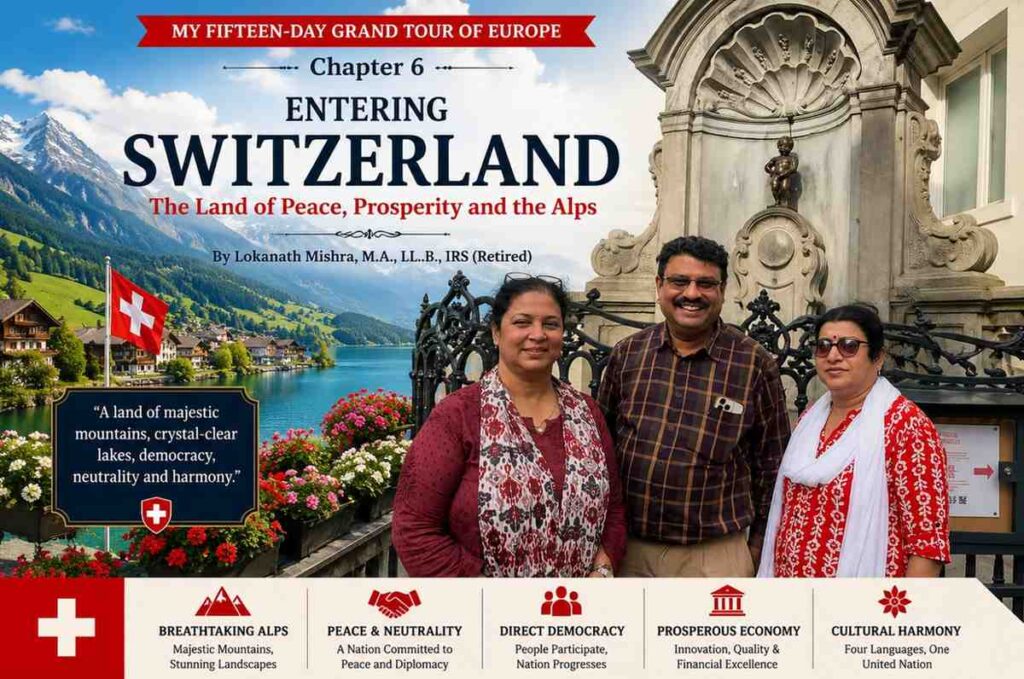
My Fifteen-Day Grand Tour of Europe
Chapter 6: Entering Switzerland – The Land of Peace, Prosperity and the Alps
By Lokanath Mishra, M.A., LL.B., IRS (Retired)
On the evening of 16th July 2026, at approximately 5:15 p.m., our Star Tour luxury coach crossed the German-Swiss border and entered Switzerland, one of the most beautiful and prosperous countries in the world.
As we entered Swiss territory, the change in the landscape was immediately noticeable. The roads were exceptionally smooth, the villages were immaculately maintained, and every house appeared to be surrounded by colourful flowers and lush green meadows. In the distance, the majestic snow-covered peaks of the Alps rose above the horizon, creating a breathtaking panorama. It seemed as though nature itself had painted a masterpiece.
For centuries, poets, writers and travellers have described Switzerland as “Heaven on Earth.” As we travelled deeper into the country, I could understand why this small nation has earned such universal admiration.
Switzerland – A Brief Historical Background
Switzerland lies in the heart of Europe and is surrounded by Germany, France, Italy, Austria and Liechtenstein. Although geographically small, it has played a remarkable role in European history.
The origins of modern Switzerland date back to 1291, when three Alpine regions—Uri, Schwyz and Unterwalden—formed a defensive alliance to protect their freedom from external domination. This agreement, known as the Federal Charter of 1291, is regarded as the foundation of the Swiss Confederation.
Over the following centuries, additional regions voluntarily joined the Confederation, creating a federation based upon mutual cooperation, local autonomy and collective security.
The independence of Switzerland was formally recognised by European powers in 1648 under the Treaty of Westphalia, which ended the Thirty Years’ War.
Since then, Switzerland has developed into one of the world’s most stable and prosperous democracies.
The Swiss Political System
One of the most remarkable features of Switzerland is its unique political system.
Unlike many countries, Switzerland combines federalism, parliamentary democracy and direct democracy.
The country consists of 26 cantons, each enjoying considerable autonomy in matters such as education, policing, taxation and local administration.
The Federal Government is responsible for national defence, foreign affairs, finance and major infrastructure.
Instead of concentrating executive authority in one individual, Switzerland is governed by a Federal Council of seven members. Each councillor heads an important department of government.
The office of the President of the Swiss Confederation rotates annually among these seven members. The President performs mainly ceremonial and coordinating duties rather than exercising extensive executive powers.
This collective leadership has contributed significantly to political stability.
The Swiss System of Direct Democracy
Perhaps Switzerland’s greatest contribution to modern political science is its practice of direct democracy.
Swiss citizens enjoy extensive constitutional rights to participate directly in national decision-making.
The most important instrument is the referendum.
Whenever Parliament passes certain important laws or constitutional amendments, citizens may demand that the issue be decided by the people through a nationwide vote.
Similarly, through a popular initiative, citizens themselves may propose amendments to the Constitution if they collect the required number of signatures.
Several referendums may be held each year, allowing ordinary citizens to participate directly in shaping national policies.
This system has strengthened public confidence in government and encouraged responsible citizenship.
Although referendums can sometimes slow the legislative process, they ensure that major decisions enjoy broad public support.

Switzerland’s Policy of Neutrality
One of Switzerland’s most distinctive characteristics is its long-standing policy of neutrality.
The Swiss policy of neutrality was internationally recognised at the Congress of Vienna in 1815.
Since then, Switzerland has generally avoided participating as a military combatant in international wars between other countries.
During both the First World War and the Second World War, Switzerland remained neutral, although it maintained strong national defence forces to protect its sovereignty.
Swiss neutrality has enabled the country to become an important centre for international diplomacy.
Many international organisations have established their headquarters in Switzerland, including the United Nations Office at Geneva, the International Committee of the Red Cross, the World Health Organization, the World Trade Organization and numerous other global institutions.
This role has earned Switzerland worldwide respect as a mediator in international disputes and humanitarian affairs.
Swiss Banking and Financial Services
Switzerland is also famous for its highly developed banking sector.
For many decades, Swiss banks earned an international reputation for financial stability, professional management and strong client confidentiality. This attracted deposits from businesses and individuals around the world.
Historically, strict Swiss banking secrecy laws led to a perception that people could easily hide undeclared or illicit wealth in Swiss banks. However, this perception no longer fully reflects the present situation.
During the past two decades, Switzerland has significantly reformed its banking regulations. In response to international agreements and efforts to combat tax evasion, money laundering and financial crime, Swiss banks now cooperate much more closely with foreign governments through information-sharing arrangements.
Today, Switzerland continues to be one of the world’s leading financial centres because of its political stability, sound economic policies, strong legal system and expertise in wealth management, rather than because of absolute banking secrecy.
Economy and Prosperity
Despite having limited natural resources, Switzerland possesses one of the world’s strongest economies.
Its prosperity is based upon:
- Precision engineering
- Pharmaceutical industries
- Biotechnology
- Banking and financial services
- Insurance
- Tourism
- Scientific research
- High-quality manufacturing
Swiss products enjoy an excellent international reputation for precision, durability and quality.
World-famous Swiss watches, medical equipment, pharmaceuticals, chocolates and engineering products are exported to almost every country.
The country’s vocational education system produces highly skilled workers, contributing significantly to industrial excellence.
Cultural Diversity
Switzerland is a unique multicultural nation.
It has four official languages:
- German
- French
- Italian
- Romansh
People belonging to different linguistic and cultural traditions have lived together peacefully for centuries.
This diversity has become one of Switzerland’s greatest strengths.
The country is known for its discipline, punctuality, cleanliness, honesty and respect for law.
Visitors immediately notice the orderly traffic, immaculate public spaces and efficient public transport system.
Why Switzerland is Called “Heaven on Earth”
Many travellers describe Switzerland as one of the most beautiful countries in the world.
Several factors justify this description.
The magnificent Alps, covered with snow throughout much of the year, dominate the landscape. Crystal-clear lakes, green valleys, waterfalls and colourful alpine villages create scenery of extraordinary beauty.
The country has carefully preserved its natural environment through strict environmental laws.
Air pollution is minimal, rivers and lakes remain remarkably clean, and forests are protected for future generations.
Swiss towns and villages combine modern facilities with traditional architecture. Wooden chalets decorated with flowers, grazing cattle wearing traditional bells and peaceful mountain meadows create scenes that appear almost dreamlike.
The transportation system is among the finest in the world. Trains, buses and cable cars operate with remarkable punctuality, connecting even remote mountain villages.
Equally impressive are the safety, cleanliness and high quality of public services.
The combination of natural beauty, political stability, economic prosperity, efficient administration and respect for the environment explains why millions of tourists from across the globe visit Switzerland every year and why it is often described as “Heaven on Earth.”
Reflections
As our coach continued towards the heart of Switzerland on that pleasant summer evening, I reflected upon the remarkable achievements of this small Alpine nation.
Switzerland demonstrates that a country need not be large in size to become great in reputation. Through democracy, neutrality, scientific progress, respect for diversity and responsible governance, it has built one of the world’s most peaceful, prosperous and admired societies.
Our entry into Switzerland marked the beginning of a new chapter in our European journey. The majestic Alps, sparkling lakes and picturesque mountain villages that awaited us promised unforgettable experiences in the days to come.
(To be continued in Chapter 7…)