
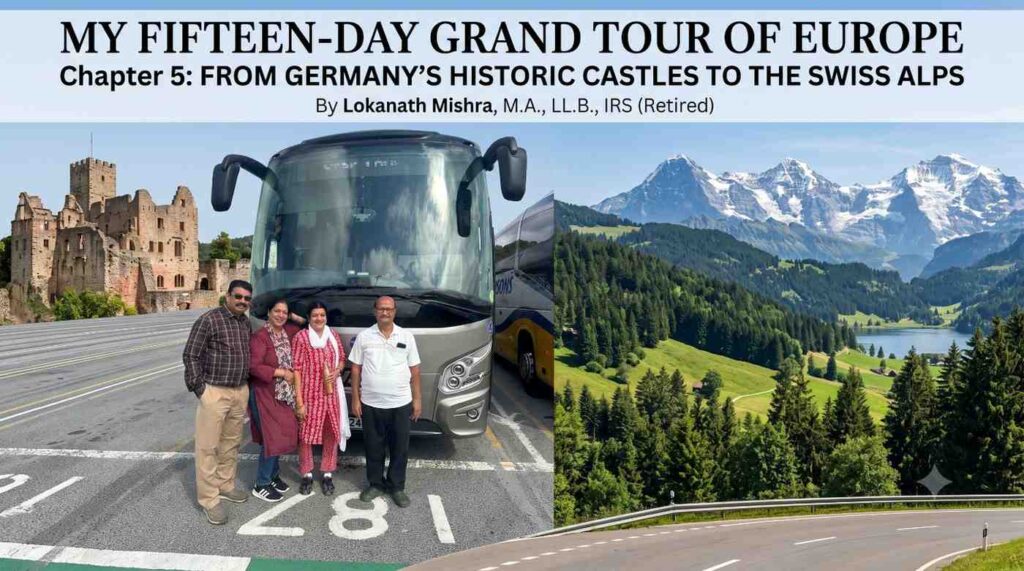
My Fifteen-Day Grand Tour of Europe
Chapter 5: From Germany’s Historic Castles to the Swiss Alps:
By Lokanath Mishra, M.A., LL.B., IRS (Retired)
On the morning of 16th July 2026, after breakfast, we continued our memorable journey through southern Germany. This day was particularly exciting because it combined medieval history, the enchanting Black Forest, the scenic beauty of southern Germany, and our entry into the beautiful country of Switzerland.
Visit to Burg Rötteln (Rötteln Castle):
Our first destination was the historic Rötteln Castle, situated near the town of Lörrach in southwestern Germany, only about 10 kilometres northeast of Basel, Switzerland.
Rötteln Castle is one of the largest medieval castle ruins in the German state of Baden-Württemberg. Built around the beginning of the thirteenth century, it served as the residence of the powerful Margraves of Hachberg-Sausenberg, who ruled this region for several centuries.
The castle occupies a commanding position on a hill, allowing its rulers to monitor important trade routes between Germany, Switzerland and France.
Walking through the massive stone gateways, ancient towers and ruined halls, we could easily imagine the life of medieval knights, nobles and soldiers who once defended this mighty fortress.
Three Major Attacks on Rötteln Castle
The history of Rötteln Castle is closely associated with war and political conflict.
The First Attack – 1356
In 1356, a devastating earthquake, known as the Basel Earthquake, caused extensive damage to the castle. Shortly afterwards, troops from the nearby Swiss city of Basel attacked and temporarily occupied the weakened fortress.
The Second Attack – 1638
The castle again became the centre of conflict during the Thirty Years’ War (1618–1648), one of the bloodiest religious wars in European history.
The war was fought mainly between Catholic and Protestant powers and devastated much of Central Europe.
In 1638, Swedish Protestant forces heavily bombarded and captured Rötteln Castle after fierce fighting. Large sections of the fortress suffered severe destruction.
The Final Destruction – 1678
The last and most devastating attack occurred in 1678 during the Franco-Dutch War.
The armies of King Louis XIV of France deliberately destroyed the castle with explosives to prevent it from being used again as a military stronghold.
Since then, Rötteln Castle has remained a magnificent ruin, preserving the memories of more than seven centuries of European history.
Today it is regarded as the third-largest castle ruin in the Baden region of Germany, attracting thousands of visitors every year.
Standing among its ancient walls, I reflected on how Europe has transformed from a continent frequently divided by war into one that now values peace, cooperation and unity.
Germany’s Historical Journey
Germany occupies a central place in European history.
For centuries, the region consisted of numerous kingdoms, duchies and principalities before becoming a unified nation under Otto von Bismarck in 1871.
Germany and the First World War
The First World War (1914–1918) began after the assassination of Archduke Franz Ferdinand of Austria. Germany fought alongside Austria-Hungary and other Central Powers. After four years of devastating warfare, Germany was defeated, leading to the Treaty of Versailles in 1919, which imposed heavy reparations and territorial losses.
Germany and the Second World War
Political instability after the First World War led to the rise of Adolf Hitler and the Nazi Party.
In 1939, Germany invaded Poland, triggering the Second World War. The conflict spread across Europe, Africa and Asia, becoming the deadliest war in human history.
After Germany’s defeat in 1945, the country was divided into West Germany and East Germany.
The Berlin Wall:
One of the most significant symbols of the Cold War was the Berlin Wall, constructed in 1961 to separate East Berlin from West Berlin.
For nearly twenty-eight years, families remained divided by this concrete barrier.
On 9 November 1989, the Berlin Wall finally fell, becoming a powerful symbol of freedom and the reunification of Germany.
Today Germany is one of the world’s strongest democracies and among the leading economies in science, engineering, education and technology.
Frankfurt
We also learned about Frankfurt, Germany’s financial capital.
Frankfurt houses the European Central Bank, one of Europe’s busiest airports, major international banks and modern skyscrapers. It represents Germany’s economic strength and global financial importance.
Through the Black Forest
Leaving Rötteln Castle, our coach continued through the legendary Black Forest (Schwarzwald).
The Black Forest is famous for its dense evergreen forests, picturesque villages, traditional farmhouses, cuckoo clocks, delicious Black Forest cake and scenic mountain roads.
The beautiful drive through the forest offered breathtaking views of dark pine trees, rolling hills and charming countryside.
Lake Titisee:
Our coach reached the beautiful town of Lake Titisee, the largest natural lake in the Black Forest region.
Surrounded by dense forests and gentle mountains, Lake Titisee is one of Germany’s most popular tourist destinations.
The crystal-clear water reflected the surrounding hills, creating a picture-perfect landscape.
Visitors enjoyed boating, lakeside walks, cafés, souvenir shops and the peaceful atmosphere.
We spent some time walking along the promenade, admiring the natural beauty and purchasing souvenirs, including the famous Black Forest cuckoo clocks.
Lunch at an Indian Restaurant
After sightseeing, we enjoyed another delicious lunch at an Indian restaurant.
Even in the heart of Germany, authentic Indian cuisine reminded us of home and provided welcome comfort during our long journey.
Towards Switzerland
After lunch, we resumed our journey towards Switzerland.
Travelling south through the Black Forest, we gradually approached the German-Swiss border. The roads became increasingly scenic, with snow-capped Alpine peaks appearing in the distance.
By approximately 5:00 p.m., our coach crossed the border near Basel, one of Switzerland’s most important gateway cities. From there we continued towards the beautiful Alpine region of central Switzerland, where we would stay near Engelberg, famous for Mount Titlis. The Black Forest–Titisee route naturally leads towards the Swiss border in this region.
Reflections
The day’s journey was a remarkable blend of history and natural beauty.
From the ruined walls of Rötteln Castle, which witnessed earthquakes, religious wars and royal invasions, to the tranquil waters of Lake Titisee and the majestic scenery of the Black Forest, every destination illustrated a different chapter of European history.
Germany’s transformation—from a land of medieval kingdoms and devastating world wars to one of the world’s leading democratic and industrial nations—is truly inspiring.
As evening approached and we entered Switzerland, we eagerly looked forward to exploring the breathtaking Alps, snow-covered mountains and picturesque lakes that awaited us in the days ahead.
(To be continued in Chapter 6…)