
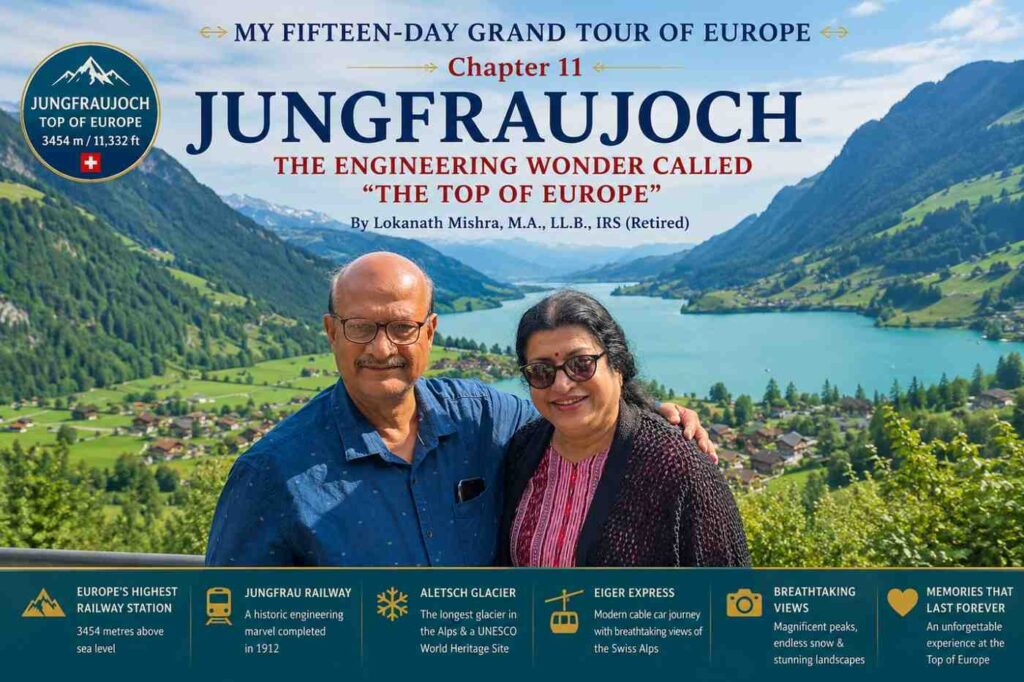
My Fifteen-Day Grand Tour of Europe
Chapter 11: Jungfraujoch – The Engineering Wonder Called the “Top of Europe”
By Lokanath Mishra, M.A., LL.B., IRS (Retired)
The visit to Jungfraujoch on 17th July 2026 was undoubtedly the most thrilling and unforgettable experience of our fifteen-day European tour. For me, my wife Smt. Basanti Mishra, my brother-in-law Shri Basant Mishra, and his wife Smt. Puspita Mishra, it was a dream fulfilled. Standing amidst the eternal snow of the Swiss Alps, we felt as if we had entered another world.

Although Jungfraujoch is popularly known as the “Top of Europe,” it is not the highest mountain in Europe. Rather, it is Europe’s highest railway station, situated at an altitude of 3,454 metres (11,332 feet) above sea level. The surrounding peaks rise even higher, and to many visitors the elevation feels close to 12,000 feet. Because of its extraordinary height, permanent snow and spectacular Alpine scenery, it has become one of the most famous tourist destinations in the world.
The Meaning of Jungfraujoch
The word “Jungfrau” means “Virgin” in German, while “Joch” means “mountain pass” or “saddle.” Jungfraujoch is therefore the mountain saddle lying between the majestic peaks of Jungfrau (4,158 metres) and Mönch (4,107 metres).
Below this high mountain pass stretches the magnificent Aletsch Glacier, the longest glacier in the Alps, extending for about 23 kilometres. Together with the surrounding mountains, it forms part of the Swiss Alps Jungfrau-Aletsch UNESCO World Heritage Site, recognised for its exceptional natural beauty and geological significance.
An Extraordinary Engineering Achievement
More than one hundred years ago, reaching Jungfraujoch was considered almost impossible. The steep mountains, glaciers and severe weather presented enormous challenges.
The vision belonged to the Swiss industrialist Adolf Guyer-Zeller, who proposed constructing a railway through the mountains so that ordinary people could experience the beauty of the high Alps.
Construction of the Jungfrau Railway began in 1896. Thousands of engineers, surveyors and workers laboured under extremely difficult conditions. They blasted tunnels through solid granite rock, transported machinery to inaccessible locations and continued working despite snowstorms and freezing temperatures.
After sixteen years of determined effort, the railway was completed in 1912.

Even today, engineers around the world admire this remarkable achievement. The railway remains one of the finest examples of precision engineering ever undertaken in mountainous terrain.
Modern Ropeway and Cable Car System
In addition to the historic railway, Switzerland has continuously modernised access to Jungfraujoch.
The construction of the Eiger Express tricable gondola has greatly reduced travelling time from Grindelwald Terminal to Eigergletscher Station.
The cabins are spacious, comfortable and equipped with modern safety systems. Large panoramic windows allow passengers to enjoy magnificent aerial views of forests, valleys, glaciers and towering mountain peaks.
The integration of railway, cable cars, roads and tourist facilities demonstrates Switzerland’s exceptional planning and engineering expertise.
The entire transportation network functions with remarkable punctuality, cleanliness and efficiency, reflecting the Swiss commitment to excellence.
A World-Famous Tourist Destination
Every year, millions of visitors from every continent travel to Jungfraujoch.
Tourists come for many reasons:
- To experience permanent snow even during summer.
- To view the magnificent Aletsch Glacier.
- To visit the Ice Palace carved inside the glacier.
- To enjoy panoramic views of the Alps.
- To experience Europe’s highest railway station.
- To witness one of the greatest engineering achievements in mountain transportation.
Scientists also visit the region to conduct research on glaciers, climate change, atmospheric science and Alpine ecology.
Thus, Jungfraujoch serves both tourism and scientific research.
High Altitude and Low Oxygen
One aspect that visitors must understand is the effect of high altitude on the human body.
At Jungfraujoch, the atmospheric pressure is much lower than at sea level. Consequently, the amount of oxygen available in each breath is reduced.
Healthy individuals usually adapt quickly, but some visitors may experience mild symptoms of altitude, such as:
- Shortness of breath.
- Mild headache.
- Dizziness.
- Fatigue.
- Rapid heartbeat.
Older persons, those with heart disease, lung disease or uncontrolled high blood pressure may experience these symptoms more noticeably.
During our visit, we observed several elderly tourists moving slowly and taking frequent rests. The management has thoughtfully provided seating areas, medical assistance and clearly marked pathways to ensure visitor safety.
Walking on Snow and Ice
Walking on snow-covered surfaces requires great care.
Snow may appear soft, but underneath it there can be hard, slippery ice. A single careless step may result in slipping and injury.
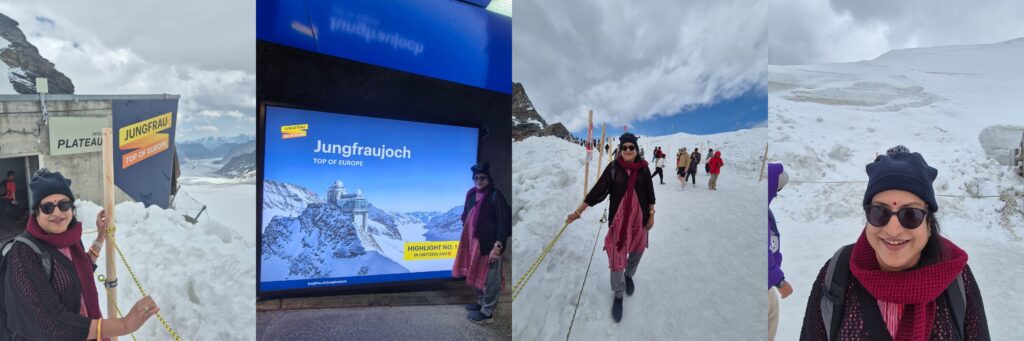
Visitors should remain within designated tourist areas and should never wander onto glaciers or steep snowfields without trained mountain guides and proper equipment.
The weather in the Alps can change with remarkable speed. A clear sunny morning may suddenly give way to thick clouds, snowfall or strong winds.
Therefore, tourists should always follow official weather advisories and instructions issued by local authorities.
Precautions for Elderly Visitors
Based on our observations, I believe elderly visitors should take the following precautions while visiting Jungfraujoch:
- Consult a doctor before travelling if they have serious heart or lung diseases.
- Walk slowly and avoid unnecessary physical exertion.
- Drink adequate water to remain hydrated.
- Wear warm layered clothing, gloves, woollen caps and suitable footwear with good grip.
- Avoid running or climbing on snow.
- Take frequent rests whenever necessary.
- Follow the marked tourist paths.
- Use sunglasses and sunscreen, as snow reflects strong ultraviolet rays.
- Immediately seek medical help if they experience severe breathlessness, chest pain or persistent dizziness.
With these simple precautions, most visitors—including senior citizens—can safely enjoy this remarkable destination.
Is Jungfraujoch the Highest Place in the World?
Many tourists refer to Jungfraujoch as the “Top of Europe,” but this title should be correctly understood.
It is not the highest mountain in Europe, nor is it the highest place in the world.
Its distinction lies in being the highest railway station in Europe that is easily accessible to ordinary tourists by rail.
The highest mountain in Europe is generally regarded as Mount Elbrus in the Caucasus Mountains, standing at 5,642 metres (18,510 feet) above sea level.
The highest mountain in the world is Mount Everest, located on the Nepal–China border, with a height of 8,849 metres (29,032 feet) above sea level.
Nevertheless, Jungfraujoch remains one of the world’s most accessible high-altitude destinations and one of the greatest achievements in mountain tourism.

Reflections
As I stood on the snow-covered observation platform, surrounded by magnificent peaks and endless fields of ice, I realised that Jungfraujoch represents far more than a tourist attraction.
It symbolises the triumph of human determination, scientific knowledge and engineering excellence over seemingly impossible natural obstacles. More importantly, Switzerland has achieved this development while preserving the fragile Alpine environment with great care and responsibility.
Our visit to Jungfraujoch taught us that true progress lies not only in constructing magnificent infrastructure but also in protecting nature for future generations.
As we descended the mountains by cable car towards Grindelwald, carrying unforgettable memories of the “Top of Europe,” I silently thanked Almighty God for giving us the opportunity to witness one of the most extraordinary natural and engineering wonders on Earth.
(To be continued in Chapter 12…)