
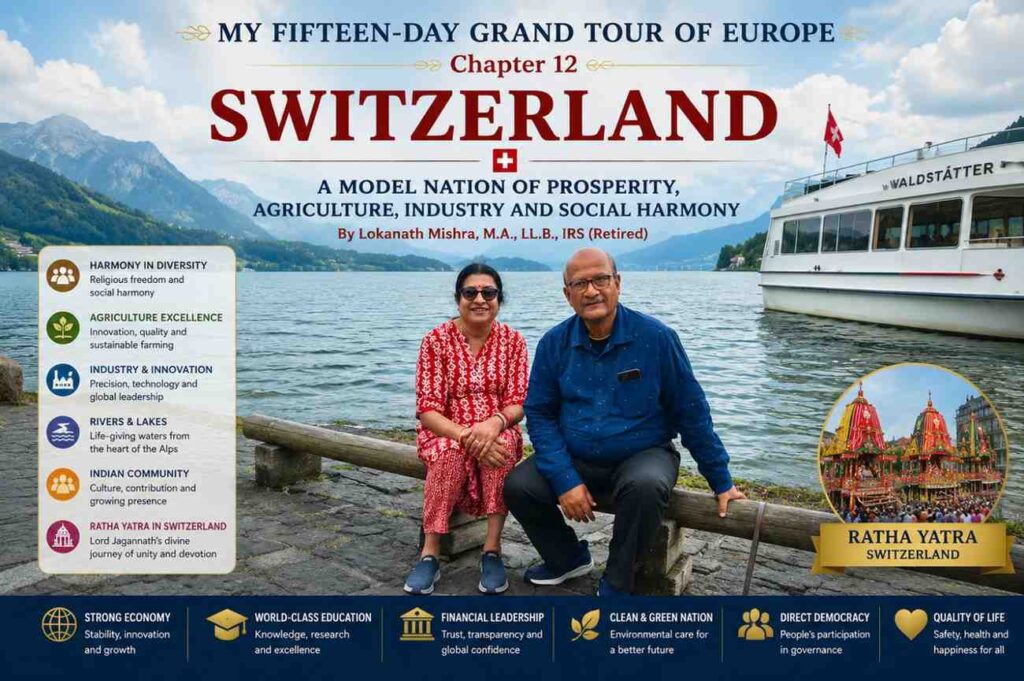
My Fifteen-Day Grand Tour of Europe
Chapter 12: Switzerland – A Model Nation of Prosperity, Agriculture, Industry and Social Harmony
By Lokanath Mishra, M.A., LL.B., IRS (Retired)
Our journey through Switzerland during the European tour provided us with an opportunity to understand not only its breathtaking natural beauty but also the remarkable social, economic and political systems that have made this small Alpine nation one of the most prosperous countries in the world.
Although Switzerland occupies a relatively small geographical area of about 41,300 square kilometres and has a population of around 9 million people, its influence in banking, finance, science, engineering, pharmaceuticals and tourism far exceeds its size.
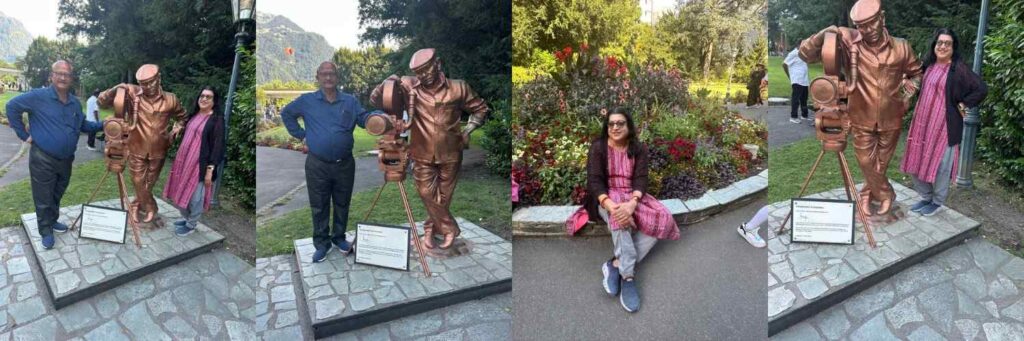
During our stay in Switzerland, we observed a country where discipline, honesty, hard work and respect for law are deeply rooted in the daily lives of its people. Clean roads, punctual public transport, efficient administration and well-preserved natural resources reflect a society that values both progress and environmental conservation.
Religions in Switzerland
Switzerland has always respected religious freedom. People belonging to different faiths live peacefully and enjoy equal constitutional rights.
According to recent demographic estimates:
- Christianity is the largest religion, accounting for about 65–70% of the population.
- Roman Catholics constitute approximately 32–34%.
- Swiss Reformed (Protestant) Christians account for about 20–22%.
- Other Christian denominations make up the remainder.
- Islam is followed by approximately 5–6% of the population.
- Hinduism accounts for about 1–2%.
- Buddhism represents less than 1%.
- Judaism accounts for around 0.2–0.3%.
- A significant and growing proportion of people describe themselves as having no religious affiliation, reflecting modern secular trends.
Although Hindus constitute a small minority, Hindu temples and cultural organisations exist in major cities such as Zurich, Geneva and Basel. Indian festivals including Diwali, Holi and Navaratri are celebrated enthusiastically by the Indian community.
Indian Community in Switzerland
The Indian community has grown steadily over the past several decades.
Most Indians living in Switzerland are highly educated professionals employed in:
- Information Technology
- Pharmaceutical industries
- Banking
- Scientific research
- Engineering
- Higher education
- Hospitality
- International organisations
Many Indian families have also established restaurants, retail businesses and trading companies.
Indian food, yoga, classical music and cultural festivals have become familiar features of Swiss multicultural society.
Employment and Labour Market
Switzerland enjoys one of the lowest unemployment rates in Europe, generally remaining below 5% in recent years. The country’s strong economy creates opportunities in manufacturing, finance, healthcare, tourism and technology.
However, employment is highly competitive. Employers generally expect:
- Professional qualifications.
- Technical expertise.
- Knowledge of German, French or Italian, depending on the region.
- Strong work ethics.
- High productivity.
Because wages are among the highest in Europe, labour costs are also very high. Consequently, industries increasingly rely on automation, robotics and advanced technology.
Cost of Living and Price Rise
Visitors immediately notice that Switzerland is one of the most expensive countries in the world.
Accommodation, transport, restaurants and consumer goods are considerably more costly than in many neighbouring countries.
The principal reasons include:
- High wages.
- Strong Swiss Franc.
- Excellent quality standards.
- Strict environmental regulations.
- High cost of public services.
- Limited agricultural land.
- Dependence on imports for many consumer goods.
Although prices are high, salaries are also comparatively high, enabling most residents to maintain a comfortable standard of living.
The Swiss Government carefully monitors inflation through prudent monetary and fiscal policies. As a result, price increases have generally remained lower than in many other countries.
Rivers of Switzerland
Despite its mountainous terrain, Switzerland possesses an abundant supply of fresh water.
Several important European rivers originate in the Swiss Alps.
The Rhine
The Rhine River begins in the Swiss Alps and flows through Switzerland, Germany, France and the Netherlands before entering the North Sea.
It is one of Europe’s most important commercial waterways.
The Rhône
The Rhône River originates from the Rhône Glacier in Switzerland and flows through Lake Geneva before entering France and eventually the Mediterranean Sea.
The Aare
The Aare River is Switzerland’s longest river entirely within the country. It passes through the capital city of Bern before joining the Rhine.
The Reuss
The Reuss River flows through central Switzerland and the city of Lucerne before joining the Aare.
The Ticino
The Ticino River flows southward into Italy, eventually joining the River Po.
These rivers provide drinking water, hydroelectric power, irrigation, tourism and recreational opportunities.
Famous Lakes of Switzerland
Switzerland is often called the “Land of Lakes.”
Among its most beautiful lakes are:
- Lake Geneva
- Lake Zurich
- Lake Lucerne
- Lake Thun
- Lake Brienz
- Lake Lugano
- Lake Constance (Bodensee)
- Lake Neuchâtel
These lakes contribute significantly to:
- Tourism.
- Drinking water supply.
- Inland navigation.
- Hydroelectric power generation.
- Fisheries.
- Recreation and water sports.
- Environmental conservation.
Their crystal-clear waters are protected by strict environmental regulations.
Agriculture in Switzerland
Although only a relatively small proportion of Swiss land is suitable for cultivation because of the mountains, agriculture remains highly productive through scientific methods.
Swiss agriculture emphasizes quality rather than quantity.
Major agricultural products include:
- Wheat.
- Barley.
- Maize.
- Potatoes.
- Sugar beet.
- Vegetables.
- Fodder crops.
- Grapes.
Dairy farming is especially important.
Swiss farmers produce high-quality:
- Milk.
- Butter.
- Cheese.
- Yogurt.
- Cream.
Swiss cheeses such as Emmental, Gruyère and Appenzeller are internationally renowned.
Modern machinery, scientific breeding and cooperative farming contribute greatly to agricultural efficiency.
Fruits and Kitchen Gardens
Swiss orchards produce a variety of excellent fruits.
Important fruits include:
- Apples.
- Pears.
- Cherries.
- Plums.
- Apricots.
- Peaches.
- Grapes.
- Strawberries.
- Raspberries.
- Blueberries.
In warmer southern regions, walnuts, chestnuts and some Mediterranean fruits are also cultivated.
Many Swiss households maintain kitchen gardens, where they grow vegetables and herbs for domestic consumption.
Common kitchen garden crops include:
- Tomatoes.
- Lettuce.
- Spinach.
- Cabbage.
- Carrots.
- Beans.
- Onions.
- Garlic.
- Cucumbers.
- Herbs such as parsley, basil and thyme.
These gardens encourage healthy living and reduce dependence on commercially produced vegetables.
Industrial Development
Switzerland possesses one of the world’s most advanced industrial economies.
Major industries include:
- Pharmaceuticals.
- Biotechnology.
- Precision engineering.
- Scientific instruments.
- Medical equipment.
- Watches.
- Electronics.
- Food processing.
- Chocolate manufacturing.
- Banking and financial services.
- Tourism.
- Renewable energy technologies.
Swiss companies are recognised internationally for their precision, innovation and quality.
Food Security
One question that naturally arises is whether Switzerland faces shortages of food.
The answer is generally no.
Although the country cannot produce all the food required by its population because of limited cultivable land, Switzerland combines efficient domestic agriculture with carefully managed imports from neighbouring European countries.
Cold storage facilities, excellent transportation and strong purchasing power ensure a stable food supply throughout the year.
As a result, food shortages are extremely rare.
Reflections
During our stay in Switzerland, I realised that the country’s prosperity is not based on any single factor. Rather, it is the result of centuries of disciplined governance, quality education, scientific research, technological innovation, environmental conservation and the hard work of its people.
The Swiss have demonstrated that even a small nation with limited natural resources can achieve extraordinary success through honesty, planning, skill and respect for democratic values.
For visitors like us, Switzerland is much more than a picturesque tourist destination. It is a living example of how nature, science, industry and human values can coexist harmoniously to create one of the world’s happiest and most prosperous societies.
As our memorable journey through this magnificent Alpine nation continued, we carried with us not only photographs and souvenirs but also valuable lessons in nation-building, environmental protection and responsible citizenship.
Celebration of Ratha Yatra in Switzerland:
One of the most remarkable examples of India’s spiritual influence in Switzerland is the annual celebration of Ratha Yatra, the world-famous Chariot Festival of Lord Jagannath, originally associated with the sacred city of Puri in Odisha.
Although Switzerland is thousands of kilometres away from India, the festival is celebrated with great devotion by members of the Indian community and devotees of the International Society for Krishna Consciousness (ISKCON).
Every year, Ratha Yatra processions are organised in major Swiss cities such as Zurich, Geneva, Lausanne, and occasionally in Bern and Basel, depending on local arrangements. Hundreds of devotees, including Indians, Swiss citizens and people from many other countries, participate enthusiastically.
Beautifully decorated wooden chariots carrying the deities of Lord Jagannath, Lord Balabhadra and Goddess Subhadra are pulled through the streets by devotees while thousands chant the Hare Krishna Mahamantra:
“Hare Krishna Hare Krishna, Krishna Krishna Hare Hare,
Hare Rama Hare Rama, Rama Rama Hare Hare.”
The procession is accompanied by devotional singing (kirtan), traditional Indian musical instruments, dancing and the distribution of flowers and sanctified food (prasadam) to everyone, irrespective of nationality or religion.
Many Swiss citizens join the procession out of curiosity and admiration for India’s rich spiritual traditions. The colourful dresses, devotional music and joyful atmosphere attract large numbers of tourists and local residents.
The festival also serves as a cultural bridge between India and Switzerland. It introduces Swiss society to the timeless teachings of Lord Jagannath, Lord Krishna, the Bhagavad Gita and the values of universal brotherhood, peace, compassion and selfless service.
ISKCON temples in Switzerland organise lectures on Indian philosophy, Bhagavad Gita study classes, devotional music, vegetarian food festivals and cultural programmes throughout the year. During Ratha Yatra, volunteers prepare hundreds of kilograms of vegetarian prasadam, which is freely distributed among devotees and visitors.

For Odias like us, witnessing or learning about the celebration of Ratha Yatra in Switzerland evokes deep emotions. It demonstrates that the glory of Lord Jagannath of Puri has crossed national boundaries and reached distant lands. The same spiritual enthusiasm that fills the Grand Road (Bada Danda) of Puri during the annual Ratha Yatra can also be experienced, in a smaller but equally devotional manner, on the streets of Swiss cities.
As an Odia, I felt immense pride that the culture of Jagannath has become a part of the multicultural life of Switzerland. It is a living testimony to the universal message of Lord Jagannath—that all humanity belongs to one family and that devotion, love and service transcend all barriers of language, nationality and religion.
(To be continued in Chapter 13…)