
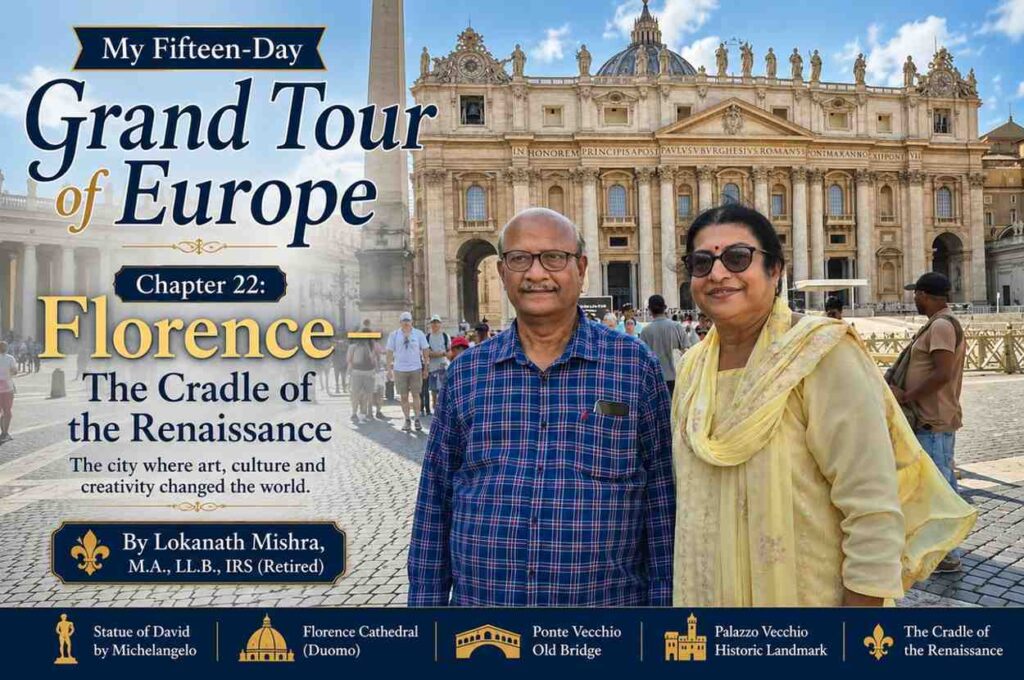
My Fifteen-Day Grand Tour of Europe
Chapter 22: Florence – The Cradle of the Renaissance
By Lokanath Mishra, M.A., LL.B., IRS (Retired)
On the morning of 21st July 2026, our Star Tour coach left Padova and proceeded towards Florence (Firenze), one of the most celebrated cities in the history of world civilization. Florence is often called the “Cradle of the Renaissance” because it was here that Europe witnessed a remarkable rebirth of art, literature, science and culture after the medieval period.
As we approached the city, our coach first stopped at a scenic viewpoint from where we could enjoy a panoramic view of the entire city of Florence. At this viewpoint stood the famous naked statue of David, a replica of Michelangelo’s masterpiece. From this elevated position, we admired the magnificent skyline of Florence, with its red-tiled roofs, ancient towers, churches and the majestic dome of the Florence Cathedral rising proudly above the city.
The sight was breathtaking and filled us with admiration for the artistic genius and cultural heritage of Italy.
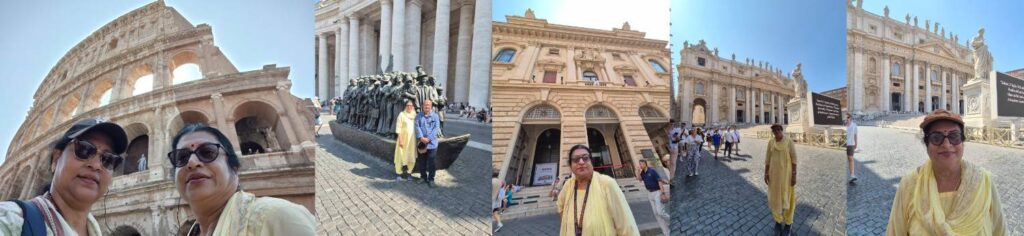
The Statue of David
The statue we saw was the famous David, originally sculpted by the great Renaissance artist Michelangelo Buonarroti between 1501 and 1504.
The original marble statue is housed in the Galleria dell’Accademia in Florence, while replicas are displayed in various parts of the city, including the viewpoint we visited.
David represents the biblical hero who defeated the giant Goliath. Michelangelo depicted David as a young man standing confidently before battle, symbolising courage, strength, intelligence and the triumph of good over evil.
The statue is considered one of the greatest masterpieces of sculpture in human history because of its extraordinary anatomical accuracy, emotional expression and artistic perfection.
Standing before this magnificent work, we felt humbled by the creative brilliance of Michelangelo, whose art continues to inspire people across the world even after more than five centuries.
A Panoramic View of Florence
From the viewpoint, we could see the entire city spread across the valley of the River Arno.
The most prominent feature was the enormous dome of the Cathedral of Santa Maria del Fiore, popularly known as the Florence Cathedral or Duomo. Its red-tiled dome dominated the skyline and reflected the architectural genius of the Renaissance.
We also observed the Palazzo Vecchio, ancient churches, bridges over the River Arno and countless historic buildings that have made Florence a living museum of art and architecture.
The view reminded us that Florence is not merely a modern city; it is a treasure house of human civilization.
The Early History of Florence
The history of Florence dates back to 59 BC, when it was founded by the Romans as a settlement called Florentia.
Its location on the banks of the River Arno made it an important centre for trade and communication.
After the decline of the Roman Empire, Florence experienced periods of invasion and political instability. However, during the Middle Ages, it gradually emerged as a prosperous commercial city.
By the twelfth and thirteenth centuries, Florence had become one of Europe’s wealthiest cities due to its flourishing textile industry and banking system.
Florentine merchants traded throughout Europe, bringing immense wealth to the city.
The Rise of the Medici Family
One of the most important chapters in the history of Florence is the rise of the Medici family.
The Medici were wealthy bankers who gained enormous political influence during the fifteenth century.
Under rulers such as Cosimo de’ Medici and Lorenzo de’ Medici, Florence became the centre of the Renaissance.
The Medici family generously supported artists, architects, writers and scientists, including:
Michelangelo
Leonardo da Vinci
Botticelli
Raphael
Galileo Galilei
Their patronage transformed Florence into the artistic capital of Europe.
The Medici rulers were not only wealthy bankers but also visionary leaders who understood the importance of culture, education and scientific progress.
Florence and the Renaissance
The Renaissance, meaning “rebirth,” began in Florence during the fourteenth century.
It marked a revival of interest in classical Greek and Roman art, literature and philosophy.
Florence became the birthplace of modern humanism, which emphasized the dignity, creativity and intellectual potential of human beings.
The Renaissance influenced every aspect of life:
Painting
Sculpture
Architecture
Literature
Science
Music
Philosophy
Artists in Florence developed new techniques such as perspective, realistic anatomy and emotional expression, revolutionising the world of art.
Customs and Culture of Florence
The people of Florence are proud of their rich cultural heritage.
Traditional Florentine customs include:
Celebrating religious festivals with processions.
Preserving historical costumes and ceremonies.
Enjoying classical music and opera.
Participating in local food festivals.
Maintaining family traditions.
Florence is also famous for its Tuscan cuisine, which includes:
Pasta
Olive oil
Bread
Cheese
Wine
Grilled meats
Traditional soups
The culture of Florence reflects a harmonious blend of medieval traditions and modern Italian life.
The Florence Cathedral (Duomo)
The most famous building in Florence is the Cathedral of Santa Maria del Fiore.
Construction began in 1296 and continued for more than a century.
The cathedral is renowned for its enormous dome, designed by Filippo Brunelleschi, one of the greatest architects of the Renaissance.
Brunelleschi’s dome was an engineering miracle of its time because it was built without the traditional wooden scaffolding used in large constructions.
The cathedral’s exterior is decorated with white, green and pink marble, creating a magnificent visual effect.
Its intricate carvings, statues and stained-glass windows demonstrate the artistic excellence of Florence.
Palazzo Vecchio
We also saw the Palazzo Vecchio, the historic town hall of Florence.
Built in the fourteenth century, this fortress-like palace served as the centre of political power in Florence.
Its tall clock tower and massive stone walls symbolise the strength and independence of the Florentine Republic.
Inside the palace are magnificent halls decorated with frescoes, sculptures and paintings that narrate the history of Florence.
Ponte Vecchio
Another famous landmark is the Ponte Vecchio, meaning “Old Bridge.”
This medieval bridge spans the River Arno and is lined with shops built directly upon it.
Originally occupied by butchers and merchants, the bridge is now famous for its jewellery shops and artistic atmosphere.
The Ponte Vecchio survived the destruction of the Second World War and remains one of Florence’s most beloved symbols.
Churches and Religious Buildings
Florence is home to numerous historic churches, including:
Basilica of Santa Croce, where many famous Italians are buried.
Basilica of Santa Maria Novella, known for its beautiful frescoes.
Basilica of San Lorenzo, closely associated with the Medici family.
These churches are not only places of worship but also repositories of priceless art and history.
Statues and Public Squares
Florence is often described as an open-air museum because its public squares are filled with magnificent statues.
In Piazza della Signoria, we saw replicas and original sculptures depicting mythological and historical figures.
These statues were created to celebrate courage, justice, freedom and civic pride.
The square itself has been the political and social heart of Florence for centuries.
Florence Today
Modern Florence successfully preserves its historical heritage while functioning as a vibrant contemporary city.
It is famous for:
Art museums
Fashion and leather goods
Tourism
Education
Architecture
Cultural festivals
Millions of visitors come to Florence every year to admire its artistic treasures and experience its unique atmosphere.
Reflections
Our visit to Florence was one of the most intellectually enriching experiences of our European tour.
The city taught us that human creativity, when supported by enlightened leadership and cultural appreciation, can produce works of art that endure for centuries.
From the majestic statue of David to the magnificent Florence Cathedral, every monument reflected the genius of the Renaissance and the enduring spirit of Florence.
As we walked through the ancient streets of the city, we felt as though we were travelling through the pages of history itself.
Florence remains a shining example of how a city can preserve its glorious past while continuing to inspire the present and future generations.
(To be continued in Chapter 23…)