
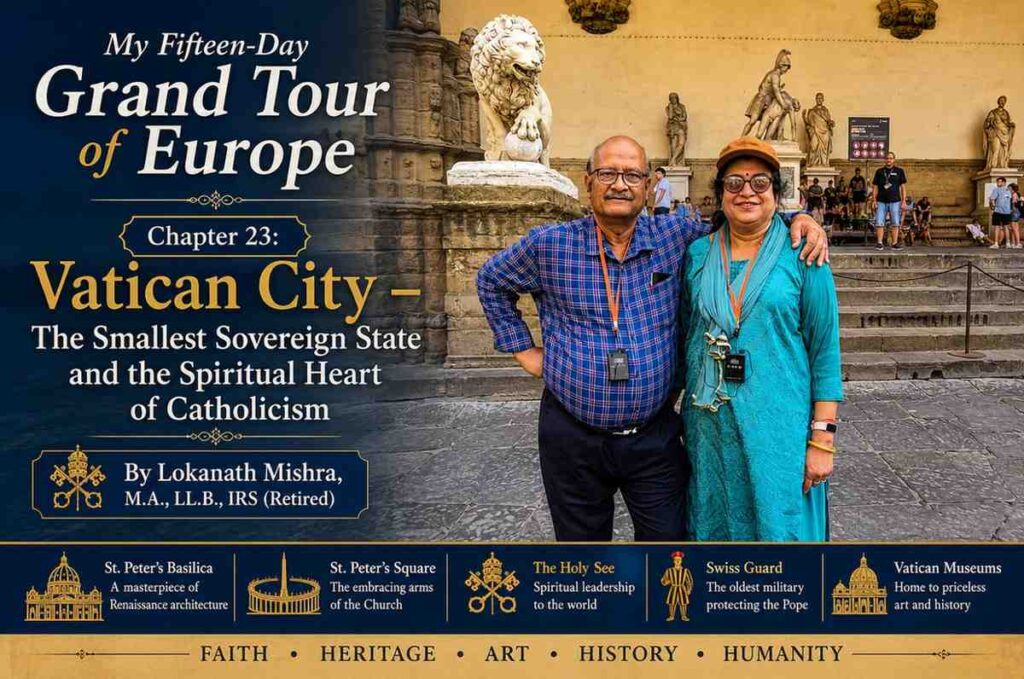
My Fifteen-Day Grand Tour of Europe
Chapter 23: Vatican City – The Smallest Sovereign State and the Spiritual Heart of Catholicism
By Lokanath Mishra, M.A., LL.B., IRS (Retired).
On the evening of 22nd July 2026, we had the extraordinary privilege of visiting Vatican City, one of the most remarkable places in the world. Although geographically tiny, Vatican City possesses immense spiritual, cultural and historical importance. It is the residence of the Pope, the supreme spiritual leader of the Roman Catholic Church, and serves as the religious centre for more than 1.3 billion Catholics across the globe.
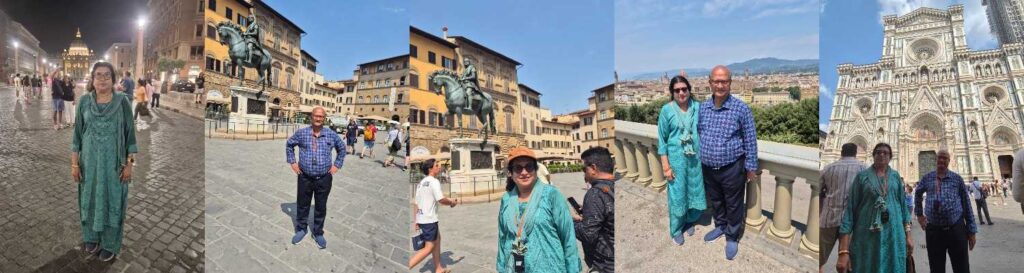
As we approached Vatican City, we felt a sense of awe and reverence. The magnificent architecture, vast open squares and sacred atmosphere immediately distinguished this place from any other city we had visited during our European tour.
Vatican City – A Separate Sovereign State
Vatican City is an independent sovereign state entirely surrounded by the city of Rome, Italy. It is the smallest country in the world, covering an area of only about 44 hectares (110 acres).
Its population is approximately 700–800 people, consisting mainly of clergy, Swiss Guards, officials and employees who work within the Vatican.
Despite its small size, Vatican City is recognised internationally as a fully independent nation with its own:
Government.
Postal system.
Currency arrangements.
Passport.
Flag.
Radio and media services.
Diplomatic relations.
The independence of Vatican City was established through the Lateran Treaty of 1929, signed between the Holy See and the Government of Italy. This treaty resolved a long-standing dispute and recognised Vatican City as a sovereign state.
The Holy See and Vatican City
It is important to understand the distinction between Vatican City and the Holy See.
The Holy See refers to the central governing authority of the Roman Catholic Church, headed by the Pope.
Vatican City is the physical territory that provides independence and security to the Holy See.
Thus, while Vatican City is geographically small, the Holy See exercises enormous spiritual influence throughout the world.
St. Peter’s Square
Our first impression of Vatican City was the breathtaking St. Peter’s Square (Piazza San Pietro).
Designed by the great Italian architect Gian Lorenzo Bernini in the seventeenth century, the square is one of the most beautiful public spaces in the world.
The square is surrounded by massive colonnades consisting of hundreds of columns arranged in a graceful oval shape. Bernini designed these colonnades to symbolize the embracing arms of the Church, welcoming people from every nation and culture.
At the centre of the square stands a towering Egyptian obelisk, which was brought to Rome more than two thousand years ago.
The square can accommodate hundreds of thousands of pilgrims who gather here during important religious ceremonies and papal audiences.
Standing in this vast square, surrounded by pilgrims from different countries, we felt the universal character of Vatican City.
St. Peter’s Basilica
The most magnificent building in Vatican City is St. Peter’s Basilica, one of the largest and most beautiful churches in the world.
The basilica is built over the traditional burial site of Saint Peter, one of the twelve apostles of Jesus Christ and considered the first Pope.
Construction of the present basilica began in 1506 and was completed in 1626, taking more than 120 years.
Several of the greatest artists and architects of the Renaissance contributed to its construction, including:
Michelangelo
Bernini
Bramante
Raphael
Michelangelo’s Dome
One of the most impressive features of St. Peter’s Basilica is its enormous dome, designed by Michelangelo.
The dome rises majestically above the city of Rome and has become one of the most recognizable symbols of Christianity.
Its architectural brilliance demonstrates the extraordinary creativity of Renaissance art.
Interior of the Basilica
The interior of St. Peter’s Basilica is breathtaking.

It contains:
Magnificent marble floors.
Golden decorations.
Beautiful mosaics.
Ornate chapels.
Sacred relics.
Masterpieces of sculpture.
One of the most famous sculptures inside the basilica is Michelangelo’s Pietà, depicting the Virgin Mary holding the body of Jesus after the Crucifixion.
The sculpture is admired for its emotional expression and artistic perfection.
The Residence of the Pope
Within Vatican City is the Apostolic Palace, where the Pope traditionally resides and carries out his official duties.
The Pope is not only the head of Vatican City but also the spiritual leader of the worldwide Catholic Church.
From this palace, the Pope addresses millions of faithful people, issues religious teachings and participates in international humanitarian and diplomatic activities.
During our visit, we observed the area from where the Pope often appears to bless pilgrims gathered in St. Peter’s Square.
The thought that we were standing in the same place where countless world leaders, saints and pilgrims had stood before us was deeply moving.
The Vatican Museums
Vatican City is also home to the famous Vatican Museums, which contain one of the world’s greatest collections of art and historical treasures.
The museums preserve works from ancient Egypt, Greece, Rome and the Renaissance.
Among the most celebrated attractions is the Sistine Chapel, famous for Michelangelo’s magnificent ceiling paintings depicting scenes from the Bible.
The frescoes of the Sistine Chapel are considered among the greatest artistic achievements in human history.
Although our time was limited, we admired the grandeur and cultural richness that the Vatican represents.
The Swiss Guard
One of the most distinctive sights in Vatican City is the Swiss Guard, the ceremonial military force responsible for protecting the Pope.
The Swiss Guard was established in 1506 and is one of the oldest military units still in existence.
The guards wear colourful traditional uniforms and are known for their discipline, loyalty and dedication.
Only Swiss citizens who meet strict requirements are eligible to serve in this prestigious force.
Vatican City’s Global Role
Despite its small population, Vatican City plays a significant role in international affairs.
The Holy See maintains diplomatic relations with more than 180 countries and participates in discussions on:
Peace.
Human rights.
Poverty.
Education.
Healthcare.
Environmental protection.
Humanitarian assistance.
The Pope often appeals for peace during international conflicts and encourages dialogue among nations and religions.
Cultural and Religious Importance
Vatican City is not only a political entity but also a centre of immense cultural and spiritual heritage.
It preserves centuries of Christian history, art, music and architecture.
Pilgrims from every continent visit Vatican City to pray, seek blessings and experience its sacred atmosphere.
For people of all faiths, Vatican City represents the enduring power of spirituality, art and human devotion.
Reflections

Our visit to Vatican City was one of the most profound experiences of our European tour.
Although it is the smallest country in the world, its influence on religion, culture, art and international diplomacy is immeasurable.
Standing in St. Peter’s Square, gazing at the magnificent basilica and reflecting upon the history of the Popes, we felt a deep sense of respect for this extraordinary place.
Vatican City taught us that true greatness is not measured by geographical size or population, but by the depth of spiritual influence, cultural heritage and service to humanity.
As we left Vatican City that evening, the illuminated dome of St. Peter’s Basilica remained etched in our memory, symbolizing faith, peace and the timeless aspirations of mankind.
(To be continued in Chapter 24…)