
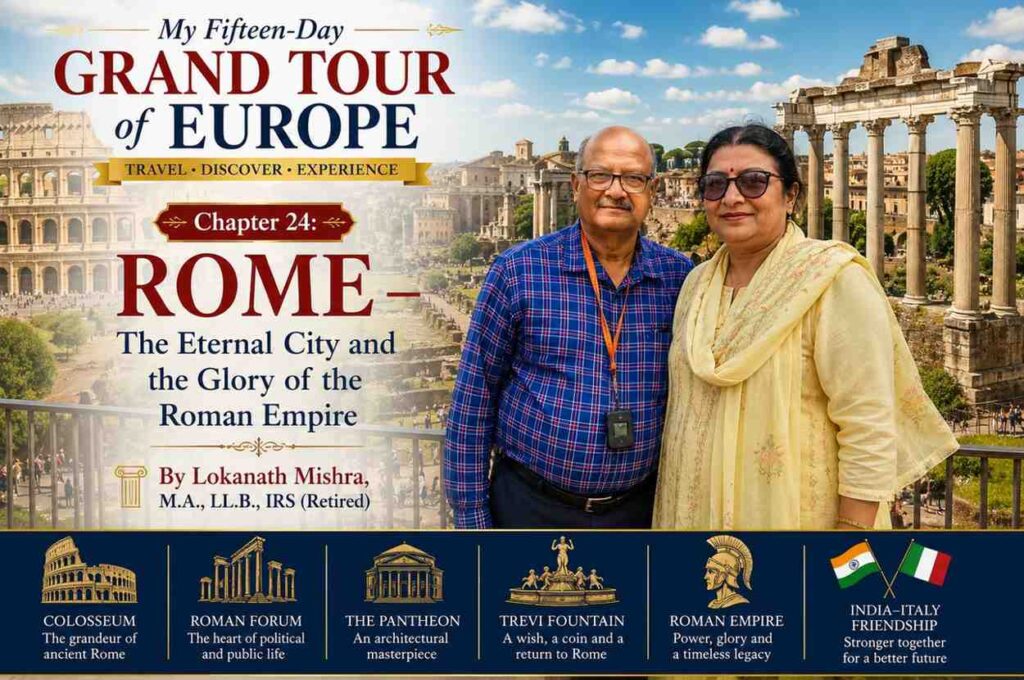
My Fifteen-Day Grand Tour of Europe
Chapter 24: Rome – The Eternal City and the Glory of the Roman Empire
By Lokanath Mishra, M.A., LL.B., IRS (Retired)
On 22nd July 2026, after our memorable visit to Vatican City, we continued our journey to Rome, the capital of Italy and one of the greatest historical cities in the world. Rome is often called the “Eternal City” because its history extends over nearly three thousand years, and its influence on civilization, law, architecture, politics and religion continues even today.
Walking through Rome was like turning the pages of a living history book. Every street, monument and ruined building reminded us of the rise and fall of one of the greatest empires in human history. Although many structures have been damaged by wars, earthquakes and the passage of time, their grandeur still reflects the glory of ancient Rome.
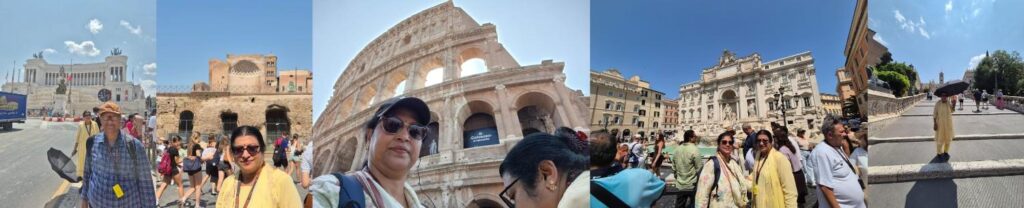
For all four of us—Lokanath Mishra, Basanti Mishra, Basant Mishra and Puspita Mishra—Rome was one of the most educational destinations of our entire European tour.
The Early History of Rome
According to Roman tradition, Rome was founded in 753 BC by the twin brothers Romulus and Remus. Legend says that they were raised by a she-wolf after being abandoned as infants.
Initially, Rome was ruled by kings. Around 509 BC, the Romans abolished the monarchy and established the Roman Republic, one of the earliest republics in world history.
During the Republic, Rome gradually expanded by defeating neighbouring kingdoms and eventually became the dominant power in the Mediterranean region.
The Roman Empire
In 27 BC, Augustus Caesar became the first Roman Emperor, marking the beginning of the Roman Empire.
For nearly five centuries, Rome ruled territories stretching across:
- Italy
- France
- Spain
- Britain
- Germany (parts)
- Greece
- Turkey
- Egypt
- Syria
- North Africa
The Roman Empire became one of the largest and most powerful empires ever established.
The Romans built:
- Magnificent roads
- Bridges
- Aqueducts
- Amphitheatres
- Temples
- Palaces
- Public baths
- Libraries
Many of these engineering achievements continue to inspire architects and engineers even today.
Famous Roman Emperors
Several emperors left a lasting mark on history.
Augustus Caesar
He established peace and stability after years of civil war. His reign, known as the Pax Romana (Roman Peace), brought prosperity, administrative reforms and economic growth.
Trajan
Trajan expanded the empire to its greatest territorial extent. He was admired for his military leadership and public works.
Hadrian
Rather than expanding the empire, Hadrian strengthened its frontiers. Hadrian’s Wall, built in Britain, still survives as an important historical monument.
Constantine the Great
Constantine legalised Christianity through the Edict of Milan (313 AD) and later founded Constantinople (modern Istanbul), which became the capital of the Eastern Roman Empire.
Rise and Fall of the Empire
No empire remains powerful forever.
During the fourth and fifth centuries, Rome faced numerous difficulties:
- Political instability.
- Corruption.
- Economic decline.
- Heavy taxation.
- Civil wars.
- Invasions by Germanic tribes.
In 476 AD, the Western Roman Empire came to an end when the last emperor, Romulus Augustulus, was deposed.
However, the Eastern Roman (Byzantine) Empire continued for nearly another thousand years until 1453.
Although the empire collapsed, Roman law, language, engineering and political ideas profoundly influenced Europe and much of the modern world.
The Colosseum
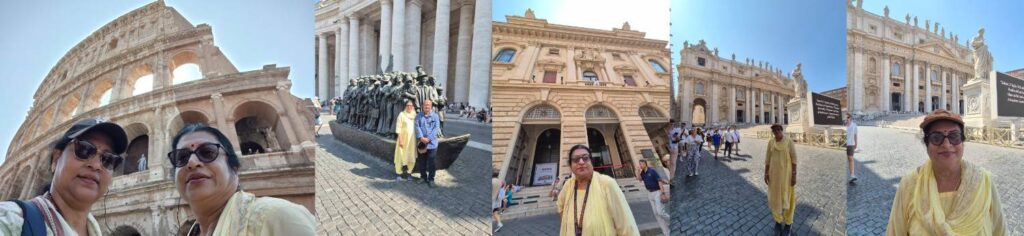
One of the greatest monuments we saw was the Colosseum, the largest amphitheatre built in the ancient world.
Completed around 80 AD under Emperor Titus, it could accommodate nearly 50,000 spectators.
Here, gladiators fought one another, hunted wild animals and staged dramatic public spectacles.
The Colosseum symbolises both the engineering brilliance and the complex social life of ancient Rome.
Despite earthquakes and centuries of damage, it remains one of the world’s most famous historical monuments.
The Roman Forum
Nearby lies the Roman Forum, which served as the political, commercial and religious centre of ancient Rome.
This was where senators debated, judges delivered justice, merchants conducted business and citizens gathered for public ceremonies.
Today, the remaining columns, arches and temple ruins provide a vivid picture of the city’s former greatness.
Walking through these ruins, one can almost imagine the voices of Roman senators and citizens discussing the affairs of the empire.
Palatine Hill
We also viewed Palatine Hill, traditionally believed to be the place where Rome was founded.
It later became the residential area of Roman emperors and wealthy nobles.
Ruins of imperial palaces still stand on the hill, overlooking the Roman Forum.
Arch of Constantine
The Arch of Constantine, built in 315 AD, commemorates Emperor Constantine’s victory at the Battle of the Milvian Bridge.
Its sculptures and carvings beautifully depict scenes from Roman military campaigns and imperial ceremonies.
Circus Maximus
We also passed the site of the Circus Maximus, the enormous stadium where ancient Romans enjoyed chariot races.
It was capable of accommodating more than 150,000 spectators, making it one of the largest sports arenas of the ancient world.
The Pantheon
Another architectural masterpiece is the Pantheon, originally built as a temple dedicated to all Roman gods.
Its massive dome remains one of the greatest engineering achievements in history.
Nearly two thousand years after its construction, the Pantheon continues to amaze architects because of its remarkable design and durability.
Trevi Fountain
We also admired the beautiful Trevi Fountain, one of Rome’s most famous landmarks.
Built in the eighteenth century, it is decorated with magnificent sculptures representing Neptune, the Roman god of the sea.
According to a popular tradition, visitors throw a coin into the fountain while making a wish, believing that they will one day return to Rome.
Roman Roads and Engineering
One aspect that particularly impressed me was Roman engineering.
The ancient Romans built thousands of kilometres of roads, many of which formed the foundation of Europe’s transportation network.
They also constructed:
- Aqueducts to supply drinking water.
- Bridges across rivers.
- Sewage systems.
- Public baths.
- Drainage systems.
Their engineering knowledge remains a source of admiration even today.
Roman Culture
Roman civilization was greatly influenced by Greek culture but developed its own distinctive identity.
The Romans excelled in:
- Law.
- Administration.
- Literature.
- Military organisation.
- Architecture.
- Engineering.
- Philosophy.
Latin, the language of ancient Rome, became the foundation of Italian, French, Spanish, Portuguese and Romanian.
Roman law has influenced the legal systems of many modern nations.
Modern Italy
Today, Italy is a democratic republic with Rome as its capital.
It is one of the founding members of the European Union, NATO and the G7.
Italy possesses one of the world’s richest cultural heritages and receives millions of tourists annually.
The country’s economy is supported by:
- Manufacturing.
- Fashion.
- Tourism.
- Agriculture.
- Automobile production.
- Engineering.
- Food processing.
- Wine production.
India–Italy Relations
India and Italy enjoy friendly diplomatic relations that have steadily strengthened over the years.
The two countries cooperate in:
- Trade and investment.
- Defence.
- Science and technology.
- Renewable energy.
- Education.
- Culture.
- Space research.
Many Italian companies operate successfully in India, while Indian professionals and students contribute significantly to Italian society.
Cultural exchanges, tourism and academic cooperation continue to deepen the friendship between the two nations.
Prime Minister Narendra Modi and Prime Minister Giorgia Meloni
In recent years, relations between India and Italy have become warmer through regular meetings between Prime Minister Narendra Modi and Italian Prime Minister Giorgia Meloni.
During one of these meetings, Prime Minister Modi presented Prime Minister Meloni with Indian handicrafts and traditional gifts, reflecting India’s rich cultural heritage. Their cordial interactions attracted considerable public attention and symbolised the strengthening partnership between the two democracies.
The two leaders have emphasised cooperation in areas such as clean energy, technology, defence, economic development and cultural exchange, further reinforcing the long-standing friendship between India and Italy.
Reflections
Rome is not merely the capital of Italy; it is one of the great classrooms of human history.
Every ruined temple, broken column, ancient road and magnificent monument tells the story of a civilization that shaped the political, legal and cultural foundations of much of the modern world.
Our visit to Rome filled us with admiration for the achievements of the Roman people and reminded us that even the mightiest empires must eventually decline. Yet the values of good governance, engineering excellence, artistic creativity and respect for knowledge can survive long after empires disappear.
As we concluded our tour of Rome, we carried with us unforgettable memories of the Eternal City—a place where history, culture and civilization continue to inspire visitors from every corner of the world.
(To be continued in Chapter 25…)