
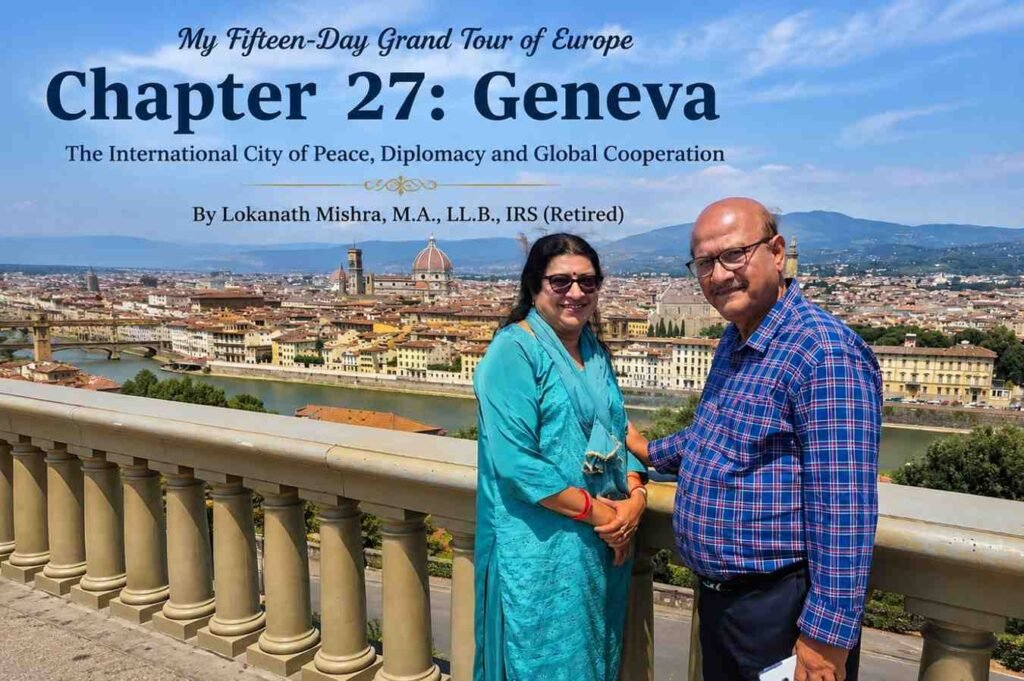
My Fifteen-Day Grand Tour of Europe
Chapter 27 : Geneva – The International City of Peace, Diplomacy and Global Cooperation
By Lokanath Mishra, M.A., LL.B., IRS (Retired)
On 23rd July 2026, after completing our memorable visit to Pisa, our Star Tour coach continued its journey towards Geneva, one of the world’s most important international cities. The day’s journey itself was an unforgettable experience. We travelled through the beautiful countryside of northern Italy, crossed into France, and later re-entered Switzerland before reaching Geneva.
The route passed through magnificent mountain ranges, deep valleys and several long tunnels built through the Alps. As our coach entered one tunnel after another, we were amazed by the engineering achievements of the European nations. These tunnels have greatly reduced travel time while preserving the beauty of the mountains. Some of them extend for several kilometres through solid rock and are equipped with advanced ventilation systems, emergency exits, fire protection measures and electronic traffic monitoring.
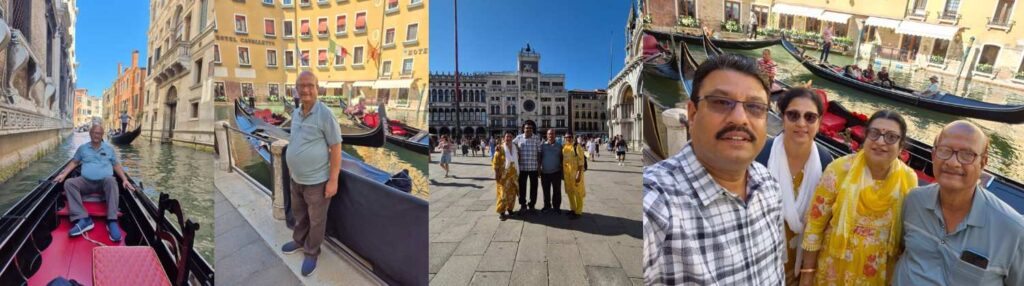
Throughout the journey, we saw snow-covered mountain peaks, green forests, rivers and waterfalls. The scenery changed from the fertile plains of Italy to the rolling countryside of France and finally to the majestic landscapes of Switzerland. Every kilometre of the journey reminded us of the harmony between nature and modern engineering.
Arrival in Geneva
In the afternoon, we reached Geneva, one of Switzerland’s most famous cities.
Situated on the shores of Lake Geneva (Lac Léman), Geneva is internationally recognised as the City of Peace, the Capital of International Diplomacy, and one of the world’s leading centres for humanitarian work.
Unlike Zurich, which is Switzerland’s financial capital, Geneva has become the centre for international cooperation, diplomacy and global governance.
The city is exceptionally clean, peaceful and well planned. Wide roads, beautiful parks, colourful flower gardens and the crystal-clear waters of Lake Geneva make it one of the most attractive cities in Europe.
⸻
Lake Geneva
Our first destination was the beautiful Lake Geneva, the largest lake in Central Europe shared by Switzerland and France.
The lake stretches for about 73 kilometres and covers an area of approximately 580 square kilometres.
Fed mainly by the Rhône River, Lake Geneva has supplied drinking water, transportation and economic prosperity to the surrounding region for centuries.
The calm blue waters of the lake, framed by the Alps and green hills, create one of the most beautiful natural landscapes in Europe.
Walking along its promenade, we enjoyed the refreshing breeze and admired the well-maintained gardens and historic buildings surrounding the lake.
The Jet d’Eau – Geneva’s Famous Fountain
The most spectacular attraction on Lake Geneva is the Jet d’Eau, one of the tallest fountains in the world.
Originally constructed in 1886 as a safety valve for a hydraulic power network, it was later transformed into a magnificent public monument.
Today the fountain shoots water approximately 140 metres into the air.
Powerful pumps force nearly 500 litres of water every second upward at tremendous speed, creating an impressive column of water visible from many parts of Geneva.
Standing near the Jet d’Eau, we were fascinated by its beauty. The sunlight reflecting through the fine spray often produces beautiful rainbows, making it one of Switzerland’s most photographed landmarks.
⸻
Geneva – A City of Peace
Geneva has a long tradition of promoting peace, dialogue and humanitarian values.
During the sixteenth century, it became an important centre of the Protestant Reformation under the leadership of John Calvin.
In later centuries, Geneva developed into a neutral meeting place where representatives from different countries could resolve disputes through discussion rather than war.
This tradition continues today.
⸻
Switzerland’s Neutrality
One of the principal reasons why so many international organisations are located in Geneva is Switzerland’s long-standing policy of neutrality.
Switzerland has maintained permanent neutrality since the early nineteenth century and has avoided participation in most international wars.
Because Switzerland is regarded as politically neutral, countries with differing political systems feel comfortable holding negotiations there.
The country’s stability, security and efficient administration have made it an ideal location for international institutions.
⸻
The United Nations Office at Geneva
One of the highlights of our visit was seeing the United Nations Office at Geneva (UNOG).
After the United Nations headquarters in New York, Geneva is the organisation’s second most important centre.
The UN Office occupies the magnificent Palais des Nations, originally built for the League of Nations.
The League of Nations was established after the First World War in 1920 with the objective of preventing future wars through international cooperation.
Although the League ultimately failed to stop the Second World War, it laid the foundation for the creation of the United Nations in 1945.
Today, the United Nations Office in Geneva hosts thousands of international meetings every year on subjects including:
- Human rights.
- Refugee protection.
- Public health.
- Labour standards.
- Trade.
- Disarmament.
- Sustainable development.
- Climate change.
Representatives from almost every nation gather here to discuss global challenges and seek peaceful solutions.
⸻
World Health Organization (WHO)
We also visited the headquarters of the World Health Organization (WHO).
The WHO was established in 1948 as a specialised agency of the United Nations.
Its primary objective is to improve global health.
The organisation works in areas such as:
- Disease prevention.
- Vaccination programmes.
- Maternal and child health.
- Nutrition.
- Medical research.
- Emergency response.
- Pandemic preparedness.
During the COVID-19 pandemic, WHO played a central role in coordinating international public health efforts, although many aspects of its response were also widely debated and scrutinised by governments and experts.
Today, WHO continues to support countries in strengthening their healthcare systems and combating infectious and non-communicable diseases.
⸻
International Labour Organization (ILO)
Another important institution in Geneva is the International Labour Organization (ILO).
The ILO was founded in 1919 following the First World War.
It became the first specialised agency associated with the United Nations.
Its mission is to promote:
- Decent working conditions.
- Fair wages.
- Safe workplaces.
- Elimination of child labour.
- Social justice.
- Workers’ rights.
The ILO has significantly influenced labour laws across many countries, including India.
⸻
International Committee of the Red Cross (ICRC)
Geneva is also home to the International Committee of the Red Cross (ICRC).
The organisation was founded in 1863 by Henry Dunant, a Swiss humanitarian deeply moved by the suffering he witnessed during the Battle of Solferino.
The Red Cross works throughout the world by providing:
- Emergency medical assistance.
- Relief during wars.
- Support for prisoners of war.
- Disaster relief.
- Humanitarian aid.
The famous Geneva Conventions, which establish rules for protecting civilians, wounded soldiers and prisoners during armed conflicts, were negotiated in Geneva under the leadership of the Red Cross.
These conventions remain among the most important documents in international humanitarian law.
⸻
Other International Organisations
Geneva also hosts many other important organisations, including:
- World Trade Organization (WTO), which oversees international trade rules.
- World Intellectual Property Organization (WIPO), which protects patents, trademarks and copyrights.
- United Nations High Commissioner for Refugees (UNHCR), which assists refugees around the world.
- International Telecommunication Union (ITU), which coordinates global telecommunications and radio frequencies.
- World Meteorological Organization (WMO), which promotes international cooperation in weather and climate science.
- Numerous non-governmental organisations, research institutions and diplomatic missions.
Together, these institutions make Geneva one of the world’s leading centres for international governance.
⸻
Why Are So Many International Organisations Located in Switzerland?
Several factors explain Switzerland’s unique role:
- Permanent Neutrality – Switzerland has remained politically neutral for generations, making it an acceptable meeting place for nations with differing interests.
- Political Stability – The country has stable democratic institutions and a predictable legal system.
- Peaceful Environment – Switzerland has a long tradition of dialogue, mediation and humanitarian work.
- Excellent Infrastructure – Efficient transport, communications and conference facilities support international meetings.
- Security – Switzerland provides a safe environment for diplomats, officials and international staff.
- Central European Location – Geneva is easily accessible from most European capitals.
These qualities have encouraged governments and international organisations to establish their headquarters in Geneva.
⸻
Geneva Today
Modern Geneva is a multicultural city where people from many nations live and work together.
The city combines:
- International diplomacy.
- Scientific research.
- Banking and finance.
- Higher education.
- Tourism.
- Humanitarian service.
Despite hosting thousands of international officials, Geneva retains a peaceful atmosphere and a high quality of life.
⸻
Reflections
Our visit to Geneva was one of the most inspiring experiences of our European journey.
Unlike cities celebrated primarily for ancient monuments, Geneva is admired because it represents humanity’s aspiration for peace, cooperation and mutual understanding.
Standing beside the magnificent Jet d’Eau, visiting the headquarters of organisations that serve millions of people worldwide, and observing the calm dignity of this international city filled us with admiration.
Geneva demonstrated that the greatest achievements of civilization are not only magnificent buildings or powerful empires but also institutions dedicated to promoting peace, protecting human dignity and encouraging cooperation among nations.
The Broken Chair Monument in Front of the United Nations Office at Geneva
One of the most striking and emotionally moving landmarks that we saw in Geneva was the famous Broken Chair, located in Place des Nations, directly opposite the United Nations Office at Geneva (Palais des Nations).
The monument immediately catches the attention of every visitor because of its extraordinary size and powerful message. Standing approximately 12 metres (39 feet) high, the Broken Chair is made of wood and appears like a giant chair with one of its front legs broken off. Despite the missing leg, the chair continues to stand upright, symbolising resilience, hope and the determination of humanity to stand against violence.
History of the Broken Chair:
The Broken Chair was created by the Swiss sculptor Daniel Berset and was erected in 1997 by the humanitarian organisation Handicap International (now known in many countries simply as Humanity & Inclusion).
The monument was installed to encourage governments to support the Ottawa Treaty (Mine Ban Treaty), an international agreement prohibiting the use, production, stockpiling and transfer of anti-personnel landmines.
Although the original intention was for the sculpture to remain for only a few months, it became so meaningful and admired that it was later restored and permanently retained at Place des Nations.
Meaning of the Broken Chair
The missing leg of the chair symbolises the countless people around the world who have lost limbs because of:
- Anti-personnel landmines.
- Cluster munitions.
- Explosive remnants of war.
The chair reminds world leaders that behind every war are innocent civilians—children, women and ordinary people—who continue to suffer long after conflicts have ended.
The monument conveys a powerful message:
- Respect human life.
- End the use of indiscriminate weapons.
- Assist victims of war.
- Promote peace and humanitarian values.
- Resolve international disputes through dialogue rather than violence.
Importance of the Monument
The Broken Chair has become one of Geneva’s most recognised landmarks and a symbol of humanitarian action.
Thousands of diplomats, delegates and visitors passing into the United Nations complex see the monument every day. It serves as a constant reminder that international decisions should always consider the suffering of ordinary human beings.
The monument also reflects Switzerland’s long humanitarian tradition and Geneva’s role as a centre for international diplomacy, peace negotiations and humanitarian law.
My Reflections:
Standing before the Broken Chair, I felt that it was far more than a piece of modern art. It represents the pain of millions of innocent victims whose lives have been permanently changed by war.
As a visitor from India, I realised that true strength does not lie in weapons or military power alone, but in compassion, justice and the collective determination of nations to prevent unnecessary suffering.
The Broken Chair silently tells every visitor that even one broken limb represents a broken family, a broken childhood or a broken future. It urges humanity to work together to build a world where disputes are settled through peaceful dialogue and where future generations can live free from the fear of hidden explosives.
For us, the visit to the Broken Chair completed our journey through Geneva. After seeing the headquarters of the United Nations, the World Health Organization, the International Labour Organization and the International Committee of the Red Cross, this powerful monument reminded us that the ultimate purpose of all these international institutions is to protect human dignity, preserve peace and reduce human suffering across the world.
As we departed Geneva, we carried with us not only wonderful memories of its natural beauty but also renewed hope that international dialogue and humanitarian values will continue to guide the world towards a more peaceful future.
(To be continued in Chapter 28…)