
My Fifteen-Day Grand Tour of Europe
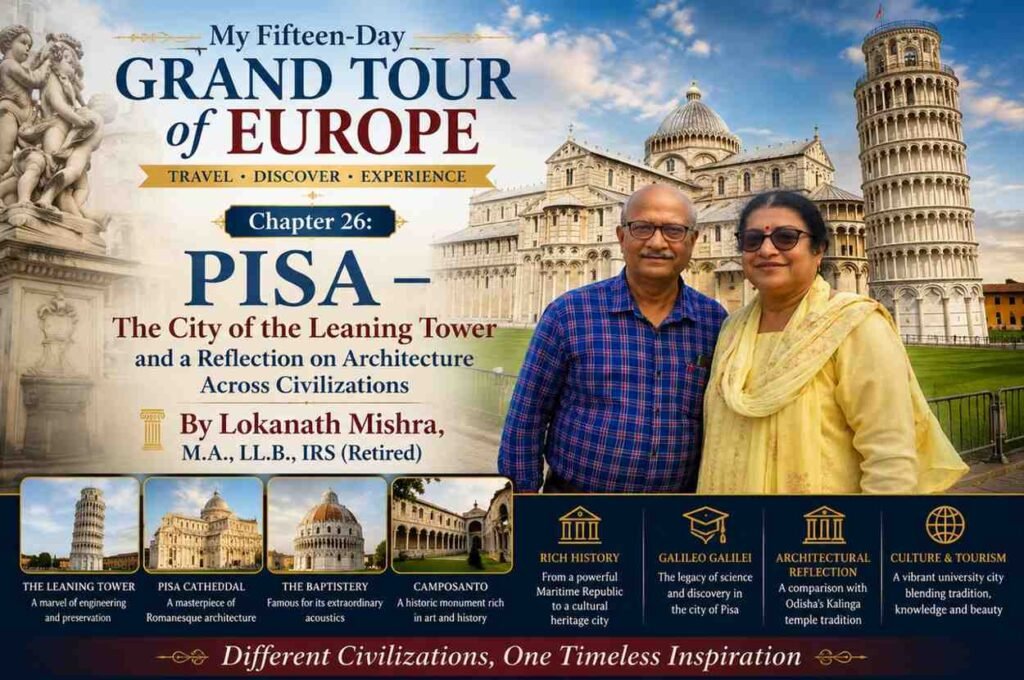
Chapter 26: Pisa – The City of the Leaning Tower and a Reflection on Architecture Across Civilizations
By Lokanath Mishra, M.A., LL.B., IRS (Retired):
On 23rd July 2026, our European tour brought us to one of Italy’s most celebrated cities—Pisa, situated in the beautiful region of Tuscany on the banks of the River Arno. Although Pisa is a comparatively small city today, its name is known throughout the world because of the famous Leaning Tower of Pisa, one of the most recognizable monuments in human history.
For all four of us—Lokanath Mishra, Basanti Mishra, Basant Mishra and Puspita Mishra—the visit to Pisa was both fascinating and thought-provoking. Standing before the Leaning Tower, we admired not only its beauty but also the remarkable determination of generations of engineers who preserved this unique monument.
The Early History of Pisa:
The origins of Pisa go back to ancient times.
Historians believe that Pisa existed before the Roman Empire and later became an important Roman settlement because of its location near the Mediterranean Sea.
During the Middle Ages, Pisa developed into one of the four great Maritime Republics of Italy, together with Venice, Genoa and Amalfi.
From the eleventh to the thirteenth centuries, Pisa possessed a powerful navy and controlled important trade routes throughout the Mediterranean.
Its ships carried merchants, pilgrims and goods to distant lands, making Pisa prosperous and influential.
The wealth generated through maritime trade enabled the people of Pisa to build magnificent churches, towers, palaces and public buildings that continue to attract visitors from all over the world.
The Rise and Decline of Pisa:
For several centuries, Pisa was one of Europe’s leading commercial centres.
However, conflicts with neighbouring states gradually weakened its influence.
The decisive defeat came in 1284, when Pisa lost the Battle of Meloria against Genoa.
Later, Florence gained control over Pisa, and the city’s political importance declined.
Despite this decline, Pisa remained an important centre of education, culture and architecture.
Today, it is home to the prestigious University of Pisa, founded in 1343, where the famous scientist Galileo Galilei studied and later taught.
Piazza dei Miracoli – The Square of Miracles:
The heart of Pisa is the magnificent Piazza dei Miracoli (Square of Miracles), recognised as a UNESCO World Heritage Site.
The square contains four extraordinary monuments:
- The Leaning Tower.
- Pisa Cathedral.
- The Baptistery.
- The Monumental Cemetery (Camposanto).
Together these buildings represent one of the finest achievements of medieval European architecture.
As we entered the square, the brilliant white marble buildings shining against the green lawns created a scene of remarkable beauty.
The Leaning Tower of Pisa:
The world’s most famous leaning structure is undoubtedly the Leaning Tower of Pisa.
Construction began in 1173 as the bell tower (campanile) of Pisa Cathedral.
After only a few floors had been completed, builders discovered that the soft clay and sandy soil beneath one side of the foundation was sinking.
Consequently, the tower began to lean.
Instead of abandoning the project, engineers continued construction while attempting to compensate for the tilt by building the upper floors at slightly different angles.
Construction continued intermittently for nearly 200 years, finally being completed in the fourteenth century.
The tower stands about 56 metres high and contains 294 steps leading to the bell chamber.
Modern engineering projects completed during the late twentieth and early twenty-first centuries successfully stabilised the tower, ensuring that future generations can continue to admire this remarkable monument.
Today, the Leaning Tower is regarded not as a construction failure but as one of the greatest examples of engineering conservation.
Why Does the Tower Lean?
The leaning occurred because:
- The foundation is only about three metres deep.
- The underlying soil consists of soft clay, sand and silt.
- One side of the foundation settled more than the other.
- Medieval builders lacked modern geotechnical knowledge.
Instead of demolishing the structure, modern engineers strengthened the foundation by carefully removing soil, installing stabilising systems and continuously monitoring the movement.
The tower still leans, but it is now considered safe.
Pisa Cathedral:
Adjacent to the tower stands the magnificent Cathedral of Santa Maria Assunta, commonly called Pisa Cathedral.
Construction began in 1064.
The cathedral combines Romanesque architecture with influences from Byzantine and Islamic artistic traditions.
Its white and grey marble exterior, graceful arches and richly decorated façade reflect the prosperity of medieval Pisa.
Inside, visitors admire beautiful mosaics, marble columns, paintings and an impressive wooden ceiling.
The Bell Tower and Its Bells:
The Leaning Tower serves as the cathedral’s bell tower.
Several large bronze bells are installed near its summit.
These bells were historically rung to:
- Call the faithful to prayer.
- Announce religious festivals.
- Mark important civic occasions.
- Warn citizens during emergencies.
When I observed the arrangement of the bells, I was reminded of the bell installed in the back side of Garada Ghara in the sacred Shri Jagannath Temple at Puri in Odisha. Now it has been kept in the Niladri Vihar museum.
Similarly, the temple of Mahadev at Huma near Sambalpur is also very similar to this tower and temple forms that evoke a familiar feeling for visitors from Odisha.
Although these monuments belong to different religious traditions and were built independently, they all illustrate the universal human use of bells in places of worship to gather communities and mark sacred time.
Similarity with the Rekha (Linear) Temple Style of Odisha:
While observing Pisa Cathedral and its bell tower, I found an interesting architectural comparison with the temples of Odisha.
The Jagannath Temple at Puri and the famous Leaning Tower of Pisa do not belong to the same architectural tradition, but both are striking vertical landmarks that dominate their surroundings.
The Jagannath Temple and the Huma Temple are built in the Kalinga style of architecture. Their main shrine is known as a Rekha Deula, characterised by a tall, curving vertical tower (shikhara) that rises in a continuous upward profile.
By contrast, the Leaning Tower of Pisa is a Romanesque bell tower, cylindrical in shape and composed of stacked arcaded galleries. Its purpose is different: it houses church bells rather than the temple sanctum.
The resemblance that many visitors notice lies mainly in their strong vertical emphasis and their role as highly visible religious landmarks, rather than in identical architectural design.
This comparison reminded me that different civilizations often developed monumental towers to express devotion, aspiration and the desire to create enduring sacred spaces.
The Baptistery
Another remarkable building is the Baptistery of St. John, the largest baptistery in Italy.
Its enormous circular structure possesses excellent acoustics.
Visitors often demonstrate the building’s unique echo by singing a few notes that reverberate beautifully throughout the interior.
Camposanto Monumentale
The Camposanto Monumentale is the historic cemetery of Pisa.
According to tradition, soil brought from Jerusalem during the Crusades was spread here, making it a sacred burial place.
Its elegant cloisters, frescoes and monuments preserve centuries of religious and artistic history.
Galileo Galilei and Pisa
Pisa occupies a special place in the history of science because it is associated with Galileo Galilei, one of the greatest scientists in history.
According to a well-known tradition, Galileo demonstrated principles of gravity by dropping objects of different weights from the Leaning Tower.
Whether or not this specific experiment occurred exactly as described, Galileo’s work transformed physics and astronomy and laid the foundations of modern scientific thought.
Culture of Pisa
Modern Pisa is a peaceful university city with a rich cultural life.
Its traditions include:
- Religious festivals.
- Classical music.
- Art exhibitions.
- Academic conferences.
- Tuscan cuisine.
- Traditional markets.
The presence of thousands of university students gives Pisa an energetic and youthful atmosphere while preserving its historical identity.
Economy of Pisa
The economy of Pisa is supported by:
- Tourism.
- Higher education.
- Scientific research.
- Information technology.
- Healthcare.
- Agriculture.
- Small-scale manufacturing.
Visitors from around the world contribute significantly to the city’s prosperity.
Reflections
Our visit to Pisa was much more than an opportunity to see a famous leaning tower.
It was a lesson in history, architecture, engineering and the determination to preserve humanity’s cultural heritage.
As an Indian visitor from Odisha, I found it especially interesting to reflect on the different yet equally inspiring architectural traditions of Pisa and the great temples of Puri and Huma. Though they arose in different cultures and served different religious purposes, each demonstrates the skill of its builders and the enduring importance of sacred architecture in human civilization.
Standing before the Leaning Tower, I realised that what began as an engineering challenge has become one of the world’s most beloved monuments. Pisa teaches us that imperfections, when understood and carefully preserved, can become lasting symbols of human creativity and resilience.
(To be continued in Chapter 27…)