
Should the Commercial Sex Industry Be Banned?
A Traveller’s Reflection on Society, Law, and Human Dignity
By Lokanath Mishra, MA, LLB, IRS (Retired)
My journey through Europe introduced me to magnificent mountains, medieval castles, world-famous museums, and ancient churches. Yet among all the places I visited, one neighbourhood continued to occupy my thoughts long after I returned home—the Red Light District of Amsterdam.
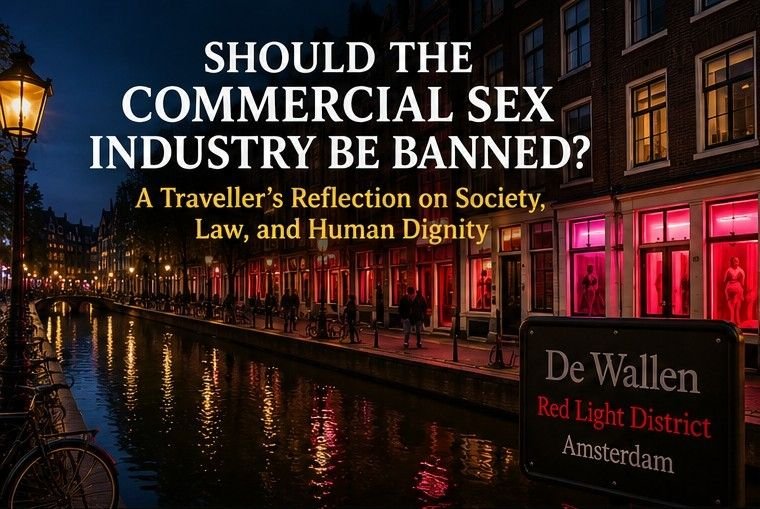
At first sight, it appeared peaceful. The canals reflected the evening lights, tourists walked in large numbers, and police officers maintained order. Everything seemed organised and carefully regulated. There was no visible chaos, no loud disturbances, and no signs of fear.
But as I watched the crowds moving through the narrow streets, another question quietly entered my mind.
Can any society truly prosper when human intimacy becomes a commercial transaction?
The question stayed with me throughout the night.
A fellow traveller noticed my silence.
“What are you thinking?” he asked.
“I am not judging the people here,” I replied. “I am wondering whether the world has found the right answer.”
He smiled.
“That debate has continued for centuries.”
Indeed, history shows that prostitution has existed in almost every civilisation. Some governments have attempted to prohibit it completely. Others have regulated it through law. A few have accepted it as part of society while trying to protect those involved.
Each approach has produced both successes and failures.
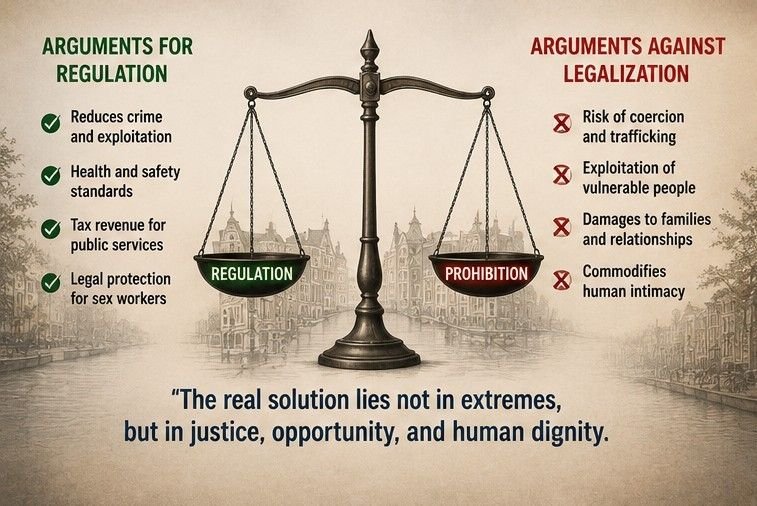
Supporters of legal regulation argue that prohibition alone rarely eliminates prostitution. Instead, they say, it often pushes the activity underground, where violence, organised crime, exploitation, and health risks become even greater. Regulation, they argue, allows governments to enforce health standards, collect taxes, monitor workplaces, and provide greater legal protection for sex workers.
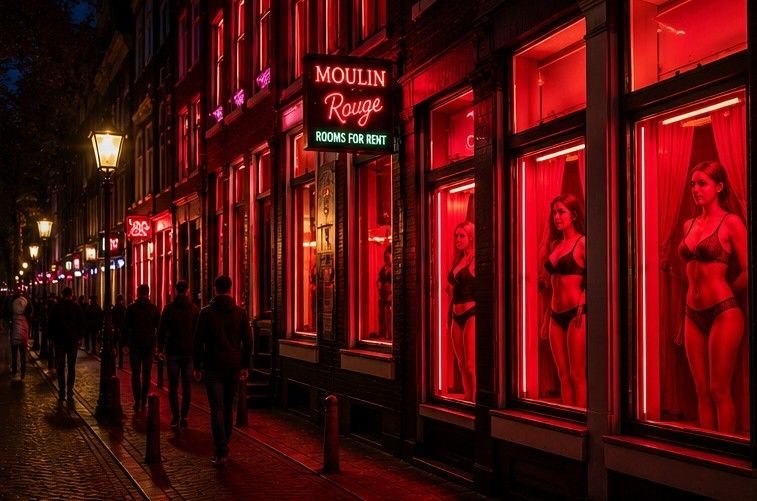
This is one of the principal reasons countries such as the Netherlands have adopted a regulated system.
Critics, however, raise equally serious concerns.
They argue that even when legal, commercial sex can still involve coercion, human trafficking, economic desperation, or unequal power. They question whether genuine freedom exists when people enter the trade because of poverty, lack of education, addiction, or limited employment opportunities. They also express concern about the effects on families, relationships, and society’s understanding of human dignity.
As our group continued walking, we passed ancient churches standing only a few streets away from the illuminated windows.
The contrast was striking.
Places of worship reminded visitors of compassion, morality, and spiritual values.
The commercial district reflected freedom of individual choice within the framework of law.
Both existed side by side.
Neither erased the other.
That contrast itself became a lesson.
During our return journey, discussion inside the coach became lively. Travellers from different countries expressed different opinions.
One gentleman believed every nation should prohibit prostitution completely.
Another argued that banning it would simply force it into hidden places, making conditions more dangerous.
A lady from another country suggested that governments should focus less on punishment and more on prevention by improving education, creating employment opportunities, protecting women and children from exploitation, and providing support for those who wish to leave the profession.
Her words remained with me.
Perhaps the real question is not simply whether prostitution should be banned.
Perhaps the deeper question is why people enter it in the first place.
If poverty drives someone into commercial sex, reducing poverty becomes part of the solution.
If human trafficking is involved, stronger law enforcement becomes essential.
If addiction or abuse plays a role, rehabilitation and healthcare are necessary.
If discrimination limits employment opportunities, equal access to education and decent work becomes crucial.
No single law can solve every underlying problem.
History offers many examples. Countries that have imposed complete bans have not necessarily eliminated prostitution. In some places it has continued secretly, making exploitation more difficult to detect. Likewise, countries that regulate the industry still face challenges such as trafficking and illegal operations outside the legal system.
This suggests that legislation alone cannot determine the outcome.
A healthy society depends upon many factors working together—strong families, quality education, equal opportunities, effective policing, social welfare, and respect for human rights.
As travellers, we should also remember another important principle.
Visiting another country does not require us to adopt all its customs, nor should we dismiss them without understanding their historical and social context. Every nation develops its laws according to its own experiences, values, and democratic processes. Observing respectfully while thinking critically is one of the greatest rewards of travel.
When our coach finally departed Amsterdam, I looked once more at the calm canals disappearing into the distance.
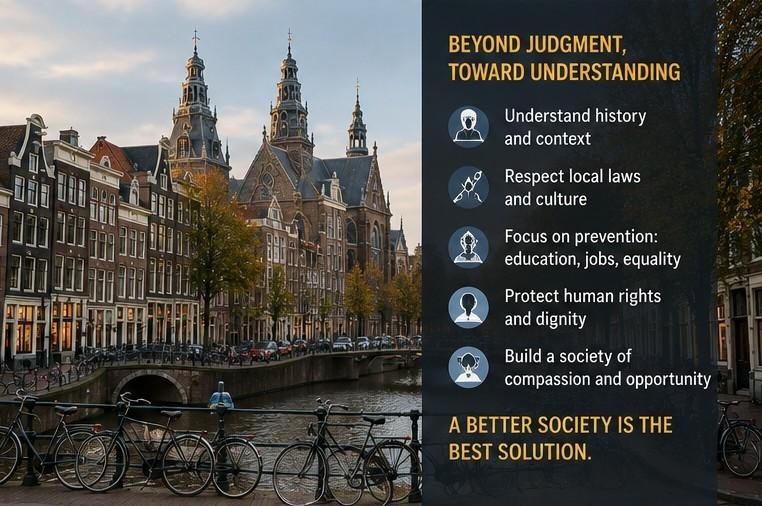
The glowing lights gradually faded behind us.
Yet the questions remained.
Can law alone create morality?
Can prohibition alone eliminate exploitation?
Can regulation alone guarantee dignity?
Perhaps the future lies not at either extreme but in building a society where every individual has genuine opportunities, where no one is forced into exploitation by poverty or coercion, where victims of trafficking receive justice, and where public policy protects both individual rights and the welfare of society.
The true measure of civilisation is not simply whether an activity is legal or illegal. It is whether society succeeds in protecting human dignity, preventing exploitation, expanding opportunity, and ensuring that every person can live with freedom, safety, and self-respect.
That, I believe, is a goal upon which people of many cultures and many opinions can agree.