
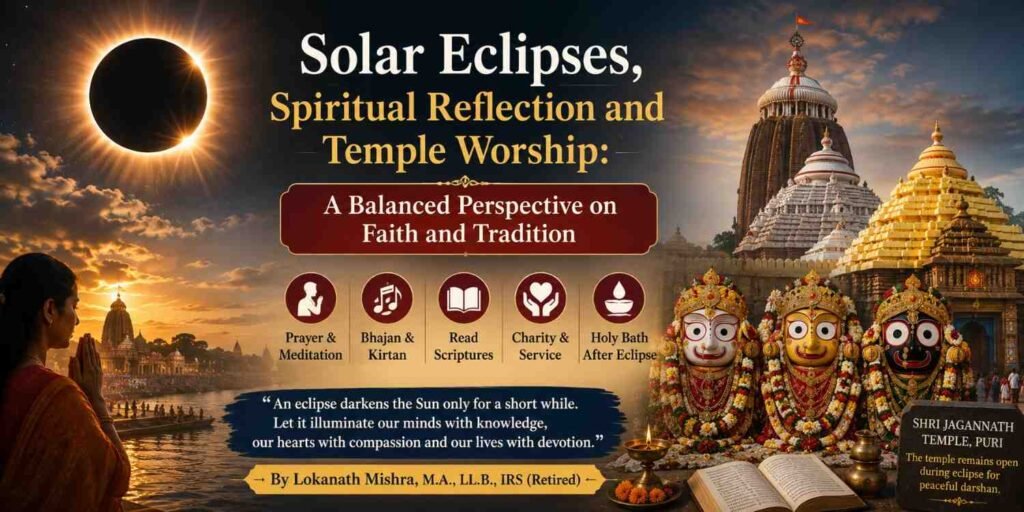
Solar Eclipses, Spiritual Reflection and Temple Worship: A Balanced Perspective on Faith and Tradition:
By Lokanath Mishra, M.A., LL.B., IRS (Retired)
Introduction:
A solar eclipse is one of nature’s most fascinating astronomical events. Modern science explains that it occurs when the Moon passes between the Earth and the Sun, temporarily blocking all or part of the Sun’s light. Today, astronomers can predict eclipses with remarkable accuracy many years in advance. Therefore, there is no scientific evidence that a solar eclipse itself creates harmful influences requiring everyone to observe strict rituals or compulsory fasting.
At the same time, for millions of people, a solar eclipse is a spiritually meaningful occasion. Throughout history, different communities have developed different customs for observing eclipses. These traditions deserve respect when they are followed voluntarily and with understanding.
Science and Religious Practice:
Science and religion address different questions.
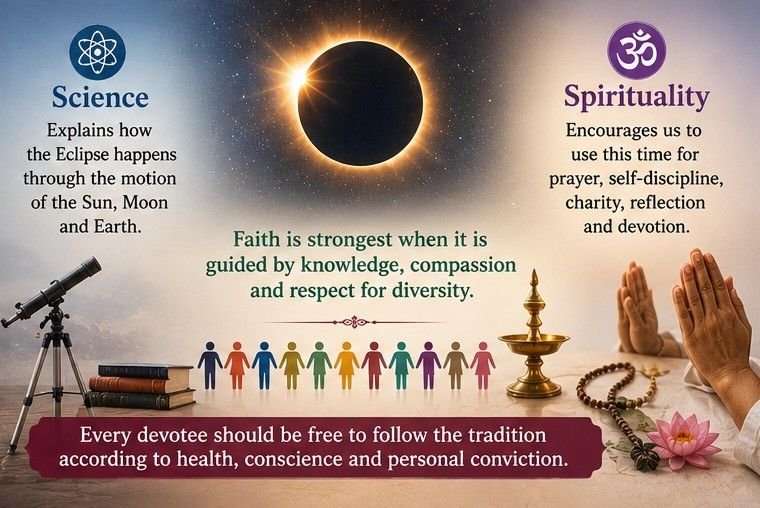
Science explains how a solar eclipse occurs through the predictable motions of the Earth and the Moon. Religion and spirituality often encourage people to use such extraordinary natural events as opportunities for prayer, self-discipline, charity and reflection.
Because science has not established that fasting during an eclipse is medically or scientifically necessary for the general public, observing a fast should be regarded as a matter of personal religious faith rather than a universal obligation.
A devotee who wishes to fast may certainly do so. Equally, a person who does not fast should not be criticised merely for following a different religious understanding or personal practice.
The Example of Shri Jagannath Temple:
An interesting aspect of eclipse observance is found in the traditions associated with the Shri Jagannath Temple at Puri.
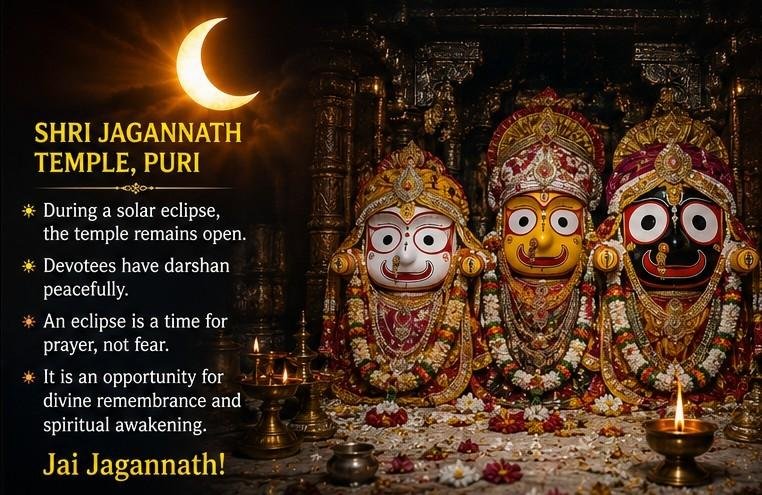
According to the premise of this article, during an eclipse the temple remains open and devotees are able to have darshan peacefully. For devotees, this period is regarded not as a time of fear but as a sacred opportunity for prayer and divine remembrance.
This perspective conveys an important spiritual message. Instead of allowing fear or superstition to dominate the mind, an eclipse can become a time for strengthening one’s relationship with God through devotion, humility and contemplation.
A Time for Bhajan, Kirtan and Prayer:
Rather than treating an eclipse as an occasion for anxiety, it may be viewed as a suitable occasion for spiritual activities.
Devotees may spend the eclipse period by:
- Participating in Bhajan and Kirtan.
- Chanting the holy names of God.
- Reading the Bhagavad Gita, Bhagavata Purana or other sacred scriptures.
- Offering silent prayer and meditation.
- Reflecting upon moral values and self-improvement.
Such practices promote inner peace, mental discipline and spiritual growth.
Charity as the Highest Worship:
Many Hindu scriptures praise charity as one of the noblest religious duties.
An eclipse can therefore become an appropriate occasion to express compassion through acts of kindness. Donating food, clothing, medicines or financial assistance to poor and needy people reflects the true spirit of service.
When charity is performed with sincerity and without expectation of reward, it benefits both the recipient and the giver. In this sense, service to humanity becomes an expression of devotion to God.
Bathing After the Eclipse:
In many Hindu traditions, devotees take a bath after the eclipse, often in a sacred river, the sea or another clean source of water.
From a spiritual point of view, this bath symbolizes inner purification and the beginning of renewed spiritual commitment. Even where a holy river is not available, a normal bath may serve as a symbolic act of cleanliness and renewal.
Whether or not one follows this practice is a matter of individual faith and family tradition.
Should Fasting Be Compulsory?
This is perhaps the most important question.
There is no established scientific evidence that every person must remain without food during a solar eclipse. Therefore, fasting should not be imposed as a compulsory religious rule upon everyone.
Many elderly persons, children, pregnant women, patients and individuals taking regular medicines may not be able to fast safely. Compassion and practical wisdom should always accompany religious observance.
Those who wish to observe fasting may do so with devotion. Those who do not fast should also be respected. True spirituality is measured not merely by abstaining from food but by purity of thought, honesty, compassion and service.
Respect for Diversity
India is a land of diverse religious traditions and customs. Even within Hinduism, different temples, regions and families follow different practices regarding eclipses.
This diversity should be appreciated rather than criticised. Faith grows through understanding, not through coercion.
Similarly, people belonging to other religions may observe an eclipse according to their own beliefs and traditions. Mutual respect strengthens social harmony and reflects the universal values shared by all humanity.
Conclusion
A solar eclipse is both a magnificent astronomical event and, for many believers, a meaningful spiritual occasion.
Science teaches us the physical causes of the eclipse. Religion inspires devotion, charity and self-reflection. Spirituality reminds us to cultivate humility, compassion and inner peace.
Rather than making compulsory fasting the central feature of eclipse observance, greater emphasis may be placed on prayer, Bhajan, Kirtan, meditation, reading sacred scriptures, helping the poor through charity and remembering God with a sincere heart.
After the eclipse, those who wish may take a holy bath in a river or the sea as part of their personal religious tradition.
Ultimately, every devotee should be free to observe the eclipse according to his or her conscience, health, family tradition and spiritual conviction. Faith is strongest when it is embraced willingly, guided by knowledge, compassion and respect for others.
“An eclipse darkens the Sun only for a short while. Let it illuminate our minds with knowledge, our hearts with compassion and our lives with devotion.”
Every well said Sir with guiding the spiritual importance of the SOLAR ECLIPSE. Thank you very much for your guidelines all way in all the important subjects in life from health to life philosophy. With regards. God bless
Shri Loknath Mishra n family.🙏🙏
Every well said Sir with guiding the spiritual importance of the SOLAR ECLIPSE. Thank you very much for your guidelines all way in all the important subjects in life from health to life philosophy. With regards. God bless
Shri Loknath Mishra n family.🙏🙏