
The Gen Z Movement: Youth Power, Democratic Aspirations and the Limits of Street Politics:
By Lokanath Mishra
Introduction:
The twenty-first century has witnessed a new form of political awakening among young people. Generation Z—generally understood as those born between approximately 1997 and 2012—has emerged as an important force in political and social movements across different parts of the world. Young people are increasingly using social-media platforms and digital communication networks to express dissatisfaction with corruption, unemployment, economic hardship, censorship, poor public services and political failures.
What has come to be described broadly as the Gen Z movement is not one single international organisation with a common constitution, leadership or programme. Rather, it is a broad phenomenon of youth-led protests that has appeared in different countries in response to different local circumstances. Digital platforms such as TikTok, Telegram, Discord and other social-media networks have enabled young people to communicate rapidly, organise demonstrations and bring large numbers of people into the streets.
These movements deserve serious attention because they demonstrate that the younger generation is unwilling to remain silent when it believes that governments have failed to respond to legitimate public concerns. At the same time, however, enthusiasm for youth activism should not lead society to overlook a fundamental question:
Can a government in a constitutional democracy legitimately be replaced by a relatively small group of protesters who have not been elected by the people?
The answer must be approached carefully. Peaceful protest is an essential component of democracy, but protest itself is not the same thing as democratic government. A movement may successfully force a government to resign, yet that does not automatically give the movement a democratic mandate to govern.
This distinction is particularly important when examining the growing phenomenon of Gen Z protests around the world.
The Rise of a Digitally Connected Generation:
Generation Z has grown up in a world fundamentally different from that experienced by earlier generations. The smartphone, internet and social media have become integral parts of everyday life. Political communication no longer depends exclusively upon newspapers, television, political parties or traditional organisations.
A young person with a mobile phone can now communicate an opinion to thousands or even millions of people within minutes. A photograph, video, slogan or hashtag can cross national borders almost instantly.
This has transformed political mobilisation.
Traditional political movements generally required offices, membership organisations, leaders, meetings and financial resources. Digital movements can begin with a few individuals posting messages online. If the message resonates with a sufficiently large number of people, it can rapidly develop into a mass mobilisation.
The Gen Z phenomenon therefore represents a new form of political participation—fast, decentralised and heavily dependent upon digital communication.
Why Do Young People Protest?
The reasons vary from country to country.
In some places, young people have protested against corruption and abuse of public resources. In others, economic hardship, unemployment, taxation, inflation, shortages of essential services or rising living costs have become the principal causes.
Other movements have emerged in response to censorship, restrictions on social media, allegations of governmental authoritarianism or dissatisfaction with established political parties.
Local grievances can therefore become the starting point for broader political demands.
A particular policy may trigger a demonstration, but once thousands of young people gather together, the protest can expand into a demand for fundamental political change.
This is one of the defining characteristics of contemporary youth movements: a local grievance can quickly become a national political movement.
The Power of Digital Mobilisation:
The most striking feature of Gen Z activism is the use of digital communication.
Platforms such as TikTok, Telegram and Discord can allow participants to circulate information rapidly, coordinate demonstrations and communicate without relying upon conventional political organisations.
Digital communication can also help movements remain decentralised. There may be no single leader whom the government can negotiate with or arrest. Instead, thousands of participants can operate through loosely connected networks.
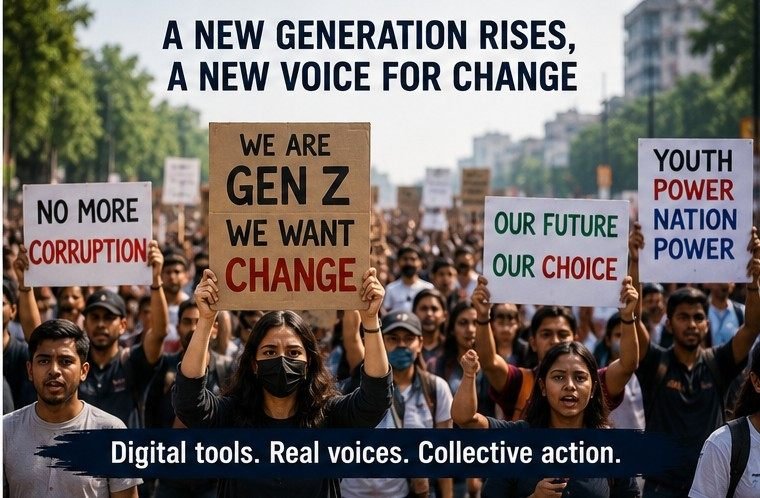
This decentralisation has advantages. It makes mobilisation extraordinarily fast and gives ordinary citizens an opportunity to participate.
But it also creates serious problems.
A movement without recognised leadership may have difficulty determining who legitimately speaks on behalf of its participants. Different groups may have completely different objectives. A protest that begins with one demand may eventually acquire several contradictory demands.
The absence of formal leadership may therefore be a source of strength during protest but a source of weakness when the question becomes:
Who will govern after the protest succeeds?
The Positive Side of the Gen Z Movement:
It would be unfair to dismiss Gen Z movements simply because they operate outside traditional political structures.
Young citizens have every right to question governments. They have the right to assemble peacefully, express dissatisfaction and demand accountability. Indeed, democratic societies depend upon active citizens.
Youth movements can perform several valuable functions.
First, they can expose problems that established political institutions have ignored.
Second, they can compel governments to listen to citizens who otherwise feel politically powerless.
Third, they can draw attention to corruption, administrative inefficiency and failures in public services.
Fourth, they can encourage younger generations to become interested in public affairs.
Finally, peaceful civic mobilisation can strengthen democracy by reminding elected representatives that political authority ultimately belongs to the people.
Therefore, the Gen Z movement should not be viewed merely as disorder or rebellion. In many circumstances it represents genuine civic dissatisfaction.
The Fundamental Democratic Question
Nevertheless, there is an important constitutional boundary between protesting against a government and taking control of government.
In a representative democracy, governments derive their authority from the people through constitutional and electoral processes. Citizens vote. Political parties and candidates present programmes. Elections determine which representatives receive a mandate to govern.
This principle is fundamental.
A protest movement may consist of thousands or even millions of people, but participation in a protest does not necessarily establish a constitutional mandate to govern.
Suppose a government has been elected through a free and fair election. Later, a group of citizens becomes dissatisfied with that government and organises demonstrations. Their grievances may be completely legitimate. They may demand reform, accountability or even the government’s resignation.
But if the government is removed solely because a relatively small group of unelected activists has managed to occupy streets, government buildings or public spaces, an important democratic question arises.
Where is the electoral mandate for the government that is supposed to replace it?
This is the central weakness that must be examined in certain forms of street-based political change.
Protest Is Democratic; Government Must Be Constitutionally Legitimate
There is no contradiction in supporting the right to protest while insisting that government must ultimately rest upon democratic legitimacy.
The two principles can coexist.
Citizens may protest against an elected government. They may criticise its policies. They may demand its resignation. They may campaign for a change of government.
But the replacement government should itself derive legitimacy from the constitution and the people.
Otherwise, one risks replacing electoral democracy with street democracy.
Street strength is not necessarily democratic strength.
The loudest group is not necessarily the majority.
The most active protesters are not necessarily representative of the entire population.
And the people occupying the streets may represent only a particular section of society.
This distinction is particularly important in large and diverse countries where millions of citizens may have different political opinions.
The Danger of the “Few Represent the Many” Principle
One of the greatest dangers of leaderless political movements is the assumption that those who are most visible automatically represent the entire population.
They do not necessarily do so.
A country may contain millions of citizens who support the existing government, millions who oppose it and millions who are politically undecided.
If a few thousand or even several hundred thousand protesters force the government out of office, the protesters cannot automatically claim to represent every citizen.
Democracy is based upon the principle of political equality.
One person’s political opinion is not worth more simply because that person is louder, more active online or more successful in mobilising crowds.
The ultimate question is:
What does the majority of the electorate want?
The answer should ordinarily be determined through constitutional mechanisms such as elections, parliamentary procedures, votes of confidence, referendums where constitutionally provided, or other lawful mechanisms.
The Problem of Unelected Representatives
Another difficulty arises when protest leaders begin to claim authority on behalf of the entire nation.
A movement may have spokespersons, influencers, student leaders, social-media personalities or prominent activists. They may be courageous and sincere. But sincerity does not itself confer a democratic mandate.
An unelected activist cannot automatically become a national leader merely because he or she has acquired popularity on social media.
Similarly, a movement cannot assume that its internal popularity is equivalent to national electoral support.
If protesters demand that an elected government resign, a constitutionally sound next step must be identified.
Who will appoint the interim administration?
Who will determine its powers?
How long will it remain in office?
Who will supervise it?
When will elections be held?
Who will prepare the electoral roll?
How will opposition parties participate?
Who will ensure that the armed forces, police and civil service remain politically neutral?
Without answers to these questions, removing an elected government can create a dangerous institutional vacuum.
The Bangladesh Experience and the Wider Global Phenomenon
The youth-led political upheaval in Bangladesh in 2024 became an important reference point in discussions about Gen Z activism. The events demonstrated the enormous power of young people when digital communication, public dissatisfaction and mass mobilisation converge.
Subsequently, youth-led or youth-dominated protests in different countries have demonstrated similar characteristics, although their individual causes and political circumstances differ.
In Nepal, dissatisfaction surrounding restrictions on social media became a significant trigger.
In Madagascar, grievances concerning shortages of water and electricity contributed to public unrest.
In Kenya, economic and taxation policies became major sources of youth mobilisation.
These examples illustrate an important principle: Gen Z movements are global in their methods but local in their causes.
They cannot therefore be treated as one uniform political ideology.
The same digital culture may produce very different political demands in different countries.
The One Piece Flag and the New Language of Protest
One interesting feature of recent youth protests has been the adoption of popular cultural symbols.
The Straw Hat Jolly Roger associated with the Japanese manga and anime series One Piece has appeared as a symbol of resistance in some protests.
This illustrates how political communication is changing.
Earlier generations frequently used ideological symbols, party flags or revolutionary slogans. Younger protesters may instead use symbols from entertainment, popular culture, gaming or internet communities.
Such symbols can create a shared emotional identity without requiring a formal political organisation.
But symbols alone cannot provide a constitution.
A flag can unite protesters; it cannot establish a government.
A slogan can express anger; it cannot create a legal system.
A social-media campaign can bring people into the streets; it cannot by itself determine who possesses the democratic mandate to govern.
When Does a Protest Become Anti-Democratic?
It is important not to describe every protest as anti-democratic.
Peaceful protest is an important democratic right. Indeed, preventing all criticism of an elected government would itself be anti-democratic.
The problem arises when a movement claims that street mobilisation is superior to electoral legitimacy.
If protesters say, “We disagree with the government and want the people to elect a different government,” they are participating in democracy.
If protesters say, “We are a sufficiently large or powerful group, therefore we alone will determine who governs the country,” the situation becomes fundamentally different.
The second approach risks undermining representative democracy.
Democracy cannot mean that whoever can assemble the largest crowd obtains the permanent right to rule.
Otherwise, every government would remain vulnerable to removal by organised minorities.
Majority Rule and Minority Rights
At the same time, democracy cannot be reduced to simple majority rule.
A constitutional democracy protects minorities as well as majorities.
The majority cannot legitimately suppress fundamental rights merely because it has more votes. Constitutional safeguards, judicial review, freedom of expression and equality before the law remain essential.
Therefore, the correct democratic principle is not simply “the majority can do anything.”
It is:
Government must derive its authority from the people through constitutional processes, while respecting fundamental rights and the rule of law.
This principle protects society both from authoritarian governments and from authoritarian movements.
The Risk of Political Instability
Removing governments through street pressure can also produce unintended consequences.
A government may fall, but the underlying economic and administrative problems may remain.
Inflation does not disappear merely because a cabinet resigns.
Unemployment does not disappear because a president leaves office.
Electricity shortages do not automatically end after demonstrations.
Corruption cannot be eliminated merely through slogans.
Running a modern state requires institutions, administrative experience, financial management, legislation, courts, public servants and long-term policy.
A protest movement may be highly effective at saying “No” to the existing system. Its greater challenge is explaining what comes next.
The difference between opposition and governance is enormous.
The Digital Echo Chamber
There is another danger peculiar to social-media-driven movements: the echo chamber.
Algorithms often show users content similar to what they have already viewed or liked. Consequently, protesters may develop the impression that their position represents almost universal public opinion.
Online popularity, however, is not necessarily a reliable measure of national opinion.
A video can receive millions of views without representing the political preferences of an entire country.
A hashtag can trend nationally without constituting a majority.
A digital community can become politically powerful while remaining socially unrepresentative.
Therefore, social-media visibility should never be confused with democratic legitimacy.
Misinformation and Manipulation
Digital movements also face the serious problem of misinformation.
False information can spread faster than verified information. Edited videos, misleading photographs, fabricated statements and anonymous allegations can inflame public anger.
External political actors, extremist groups or foreign interests may also attempt to manipulate online movements.
This does not mean that every digital movement is manipulated. It means that democratic societies must develop strong mechanisms for verifying information.
Young activists should therefore cultivate a culture of evidence.
Before sharing a dramatic claim, they should ask:
- Who produced it?
- What is the original source?
- Can the claim be independently verified?
- Is the photograph or video current?
- Does another reliable source confirm it?
Responsible activism requires responsible information.
From Protest to Political Participation
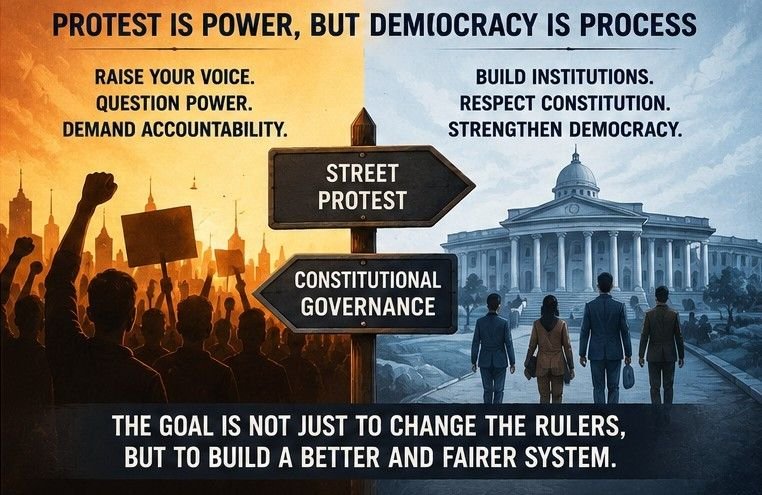
The most constructive future for Gen Z activism is not the abandonment of democracy but deeper participation in it.
Young protesters can establish political organisations.
They can join existing political parties.
They can create new parties.
They can contest elections.
They can stand as independent candidates.
They can campaign for constitutional reform.
They can participate in local government.
They can use digital platforms to educate voters.
They can monitor elections and demand transparency.
In this way, the energy of protest can be transformed into the institutional power of democratic politics.
A movement that begins in the street can eventually enter Parliament—but it should do so through the ballot box.
The Right Lesson for Governments
Governments should also learn from the emergence of Gen Z movements.
It would be a mistake for governments to dismiss young protesters simply as troublemakers.
When thousands of young people repeatedly take to the streets, political leaders should ask why.
Are young people unable to find employment?
Are public services deteriorating?
Is corruption undermining public confidence?
Are taxes perceived as unfair?
Is the government communicating effectively?
Are young citizens being excluded from political decision-making?
Are institutions responding to legitimate grievances?
Governments that ignore genuine public dissatisfaction may eventually face much greater unrest.
The solution is therefore neither blind repression nor unconditional surrender to street pressure.
The solution is dialogue, reform, accountability and constitutional democracy.
The Responsibility of Gen Z
Young activists also have responsibilities.
The right to protest carries a responsibility to remain peaceful.
The right to criticise government carries a responsibility to distinguish fact from misinformation.
The right to demand political change carries a responsibility to respect the rights of people who disagree.
The demand for government accountability must itself be accompanied by accountability within the movement.
Most importantly, activists should understand that democracy is not merely the power to remove someone from office.
Democracy is the process by which citizens decide who should govern, under what laws, for how long and subject to what constitutional restraints.
A Democratic Path Forward
If an elected government becomes unpopular, there are legitimate democratic routes for change.
Citizens can campaign against it.
Political parties can oppose it.
Parliament can exercise constitutional checks.
Courts can review unlawful executive action.
Citizens can organise peaceful demonstrations.
Where the constitution provides for it, a government can lose a vote of confidence or face other lawful mechanisms.
Ultimately, voters can remove the government at the next election.
If extraordinary circumstances require an interim administration, that administration should be established according to the constitution or through a clearly defined legal framework and should have the limited objective of restoring normal democratic governance.
The principle should remain simple:
A government may be challenged by the people, but the authority to govern must ultimately return to the people.
Conclusion
The Gen Z movement is one of the most significant developments in contemporary political culture. It reflects the frustration, aspirations and political energy of a generation that has grown up with unprecedented access to information and communication.
Its positive contribution should not be underestimated. Young people can expose corruption, challenge complacent governments, demand better public services and bring neglected issues into national debate.
But democratic societies must also recognise the limits of street politics.
A government should not be considered legitimate merely because it controls the streets, nor illegitimate merely because it is unpopular with a particular protest movement. Political legitimacy must rest upon the constitution, the rule of law and the consent of the people expressed through appropriate democratic mechanisms.
The Gen Z generation therefore faces a historic choice.
It can remain primarily a force of protest, capable of bringing governments down.
Or it can become a force of democratic renewal, capable of building better institutions.
The second path is far more difficult—but far more valuable.
The true measure of a successful youth movement is not simply how effectively it can overthrow an existing political arrangement, but whether it can help create a more accountable, constitutional and genuinely democratic system afterwards.
Street power may awaken a nation.
Digital power may mobilise a generation.
But ultimately, the power to govern in a democracy must belong to the people through their constitutional and electoral institutions—not to a few unelected individuals or groups, however popular, vocal or influential they may be.
— Lokanath Mishra