
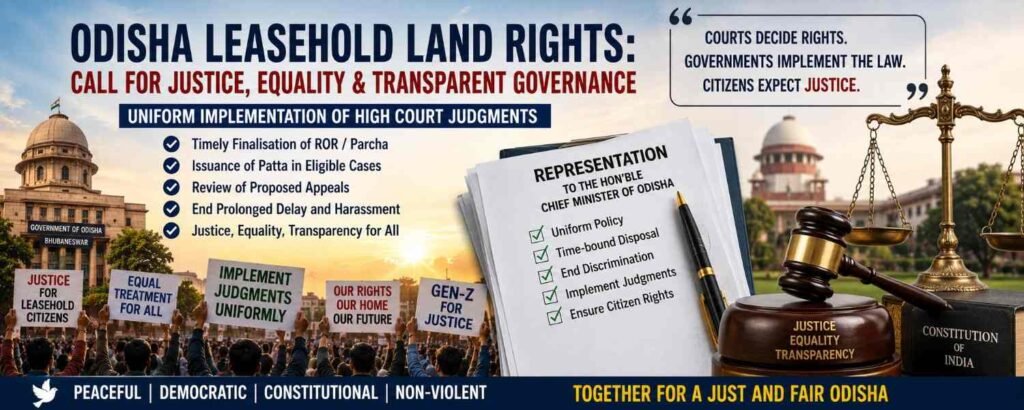
REPRESENTATION TO THE HON’BLE CHIEF MINISTER OF ODISHA
From:
Lokanath Mishra
Mobile: 9437324941
Email: jailoknathjee@gmail.com
To
The Hon’ble Chief Minister of Odisha
Government of Odisha
Bhubaneswar
Subject: Representation regarding the proposed challenge before the Hon’ble Supreme Court against judgments of the Hon’ble High Court of Odisha concerning regularisation/finalisation of leasehold lands — request for uniform implementation of High Court judgments and warning of a proposed peaceful and democratic Gen-Z movement against prolonged administrative delay and harassment of affected citizens
Hon’ble Chief Minister,
I respectfully submit this representation on behalf of the affected citizens who have been facing prolonged difficulties in obtaining regularisation, finalisation of Record of Rights and issuance of Patta in respect of leasehold lands, despite favourable judgments of the Hon’ble High Court of Odisha and despite the Government itself having implemented similar judgments in a number of cases.
The present representation is intended to draw Your Honour’s attention to a serious issue of consistency, fairness, transparency and administrative accountability in dealing with leasehold land cases.
- The emerging problem:
It is understood that in a number of individual cases, where the Hon’ble High Court of Odisha has passed directions concerning recording of rights, finalisation of Parcha/ROR and issuance of Patta in respect of leasehold lands, the Government authorities have taken steps to challenge such judgments before the Hon’ble Supreme Court.
At the same time, however, in several other cases involving substantially similar questions, the Government has accepted the judgments of the Hon’ble High Court and has proceeded to finalise the Parcha and issue Patta to the concerned persons.
This creates a serious question of uniformity and equality in administrative decision-making.
If a particular legal principle contained in a judgment of the Hon’ble High Court is acceptable to the Government and has been implemented in several cases by finalising Parcha and issuing Patta, it becomes difficult for ordinary citizens to understand why substantially similar judgments in other cases are proposed to be challenged before the Hon’ble Supreme Court.
The affected citizens naturally ask:
Why is the same principle accepted in some cases and challenged in others?
Why should similarly situated citizens receive different treatment?
Why should some citizens obtain Patta after implementation of the High Court’s judgment while others are compelled to wait indefinitely because the Government proposes to pursue further litigation?
These questions require a clear and transparent answer from the Government.
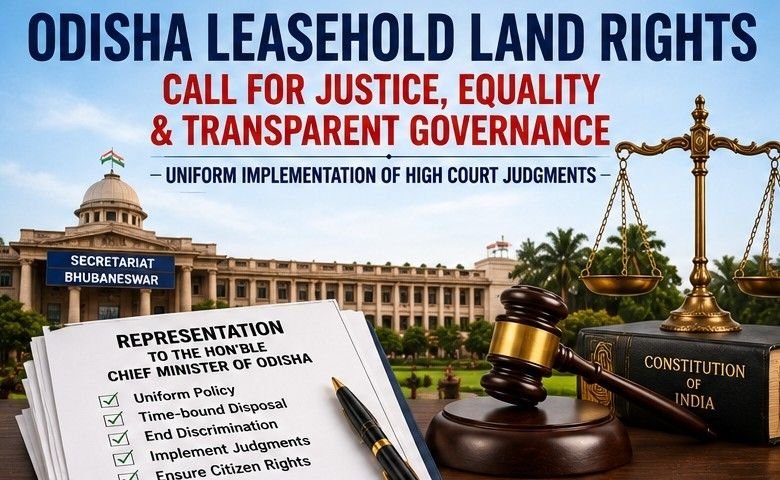
- Prolonged uncertainty is causing serious hardship:
Many leaseholders and their successors have been living on the concerned lands for several decades.
In numerous cases:
- the original lease was granted by the competent authority;
- the land has remained in the possession of the concerned families for decades;
- subsequent transactions were undertaken in accordance with the applicable rules and permissions;
- Government authorities have conducted surveys and physical verification;
- Draft Parcha/ROR has been prepared;
- judicial proceedings have taken place;
- the Hon’ble High Court has issued directions;
- and, in comparable cases, the Government itself has finalised Parcha and issued Patta.
Despite all these circumstances, some citizens continue to face uncertainty regarding their land rights.
They are repeatedly required to approach different offices and authorities.
Many of them are senior citizens.
Some have spent a substantial portion of their lives pursuing the same land matter.
The purpose of administration should be to resolve genuine grievances, not to keep citizens engaged in an endless cycle of applications, representations, appeals and litigation.
⸻
- Challenge before the Supreme Court should not become a means of indefinite delay:
I respectfully acknowledge that the State Government has the legal right to consider whether a judgment should be challenged before the Hon’ble Supreme Court, subject to law and the decision of the competent authority.
However, the exercise of such legal remedies should not become a mechanism for indefinitely postponing the legitimate rights of citizens, particularly where:
- the High Court judgment has already decided the issue;
- the judgment has not been stayed by a competent court;
- similar judgments have already been accepted by the Government;
- Parcha has already been finalised in similar cases;
- Patta has already been issued in comparable cases; and
- the concerned citizens have been suffering for years because of administrative delay.
The Government may, of course, obtain proper legal advice before taking any decision to file an appeal or Special Leave Petition.
But the citizens should also be entitled to know why a particular judgment is being challenged while another substantially similar judgment is being implemented.
⸻
- The Government has itself demonstrated that implementation is possible:
An important fact which deserves consideration is that the Government has, in several cases, accepted judgments of the Hon’ble High Court and has taken consequential steps.
In such cases, the Government has:
finalised the Parcha;
corrected the relevant land records; and
issued Patta to the concerned persons.
This demonstrates that implementation of the High Court’s decisions is administratively possible.
Therefore, where substantially similar facts and legal issues arise, the Government should adopt a consistent and transparent policy rather than subjecting one group of citizens to implementation while subjecting another group to prolonged litigation.
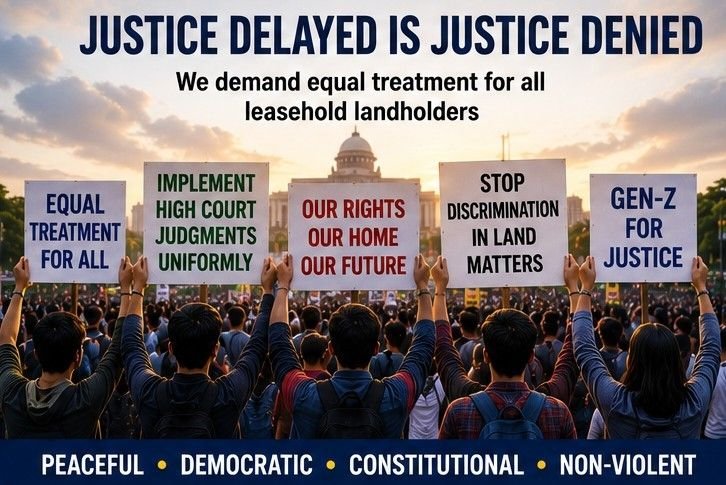
- The constitutional principle of equality requires consistency:
The Constitution guarantees equality before law and equal protection of the laws.
Administrative authorities are expected to act fairly, reasonably and consistently.
If similarly situated persons are treated differently without a reasonable and legally sustainable basis, it naturally creates a perception of discrimination and administrative unfairness.
The citizens are therefore entitled to request the Government to disclose the objective criteria on the basis of which:
- some High Court judgments are accepted;
- some are implemented;
- some Parchas are finalised;
- some Pattas are issued; and
- some judgments are proposed to be challenged before the Hon’ble Supreme Court.
There should be a uniform policy, rather than case-to-case uncertainty which leaves citizens guessing about their future.
⸻
- Alleged administrative harassment and unnecessary delay:
The affected citizens have a genuine grievance that repeated administrative proceedings and prolonged non-finalisation of leasehold rights are causing unnecessary hardship.
It is respectfully submitted that, from the perspective of an ordinary citizen, continuous postponement creates an impression that the administration is more interested in continuing litigation than in resolving the underlying problem.
I do not intend to attribute any improper motive to any individual officer.
However, when an issue remains unresolved for many years despite judicial decisions and despite similar cases being implemented, citizens are naturally entitled to question whether there is an unnecessary administrative delay or an avoidable policy of postponement.
The reasons for such differential treatment are best known to the concerned authorities.
The Government can remove such doubts by adopting complete transparency.
⸻
- A peaceful Gen-Z movement is proposed:
In view of the continuing difficulties faced by affected citizens, a peaceful, non-violent and constitutionally compliant Gen-Z movement is proposed to be initiated.
The proposed movement will not be directed against any individual officer or political party.
It will not promote violence, disorder or unlawful activity.
It will not seek to obstruct government offices.
Its objective will simply be to demand:
Justice, equality, transparency, uniform implementation of judicial decisions and time-bound disposal of genuine leasehold land cases.
The younger generation has the ability to use digital technology to collect information, understand Government notifications, study judgments, submit RTI applications, communicate with authorities and peacefully mobilise public opinion.
The proposed Gen-Z movement will therefore use constitutional and democratic methods rather than confrontation.
⸻
- The movement will include all generations:
Although it is described as a Gen-Z movement, the issue concerns all generations.
Young people may provide the organisational and technological support.
Middle-aged citizens may provide documentation and experience.
Senior citizens may provide historical records and information concerning old leases.
Thus, citizens from approximately 18 years to 100 years of age can participate in different ways, according to their ability and convenience.
No elderly person should be required to participate in physically demanding demonstrations.
Digital participation, submission of representations, collection of documents, RTI applications and legal awareness programmes can provide meaningful avenues of participation.
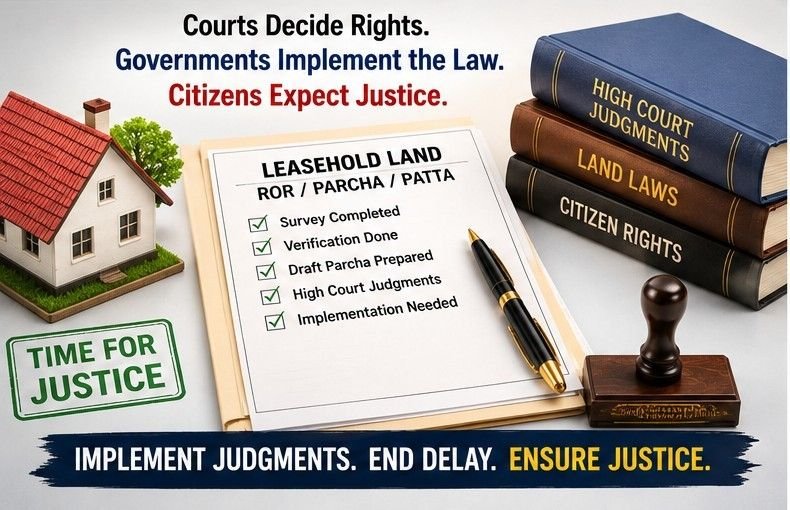
- Proposed demands of the movement:
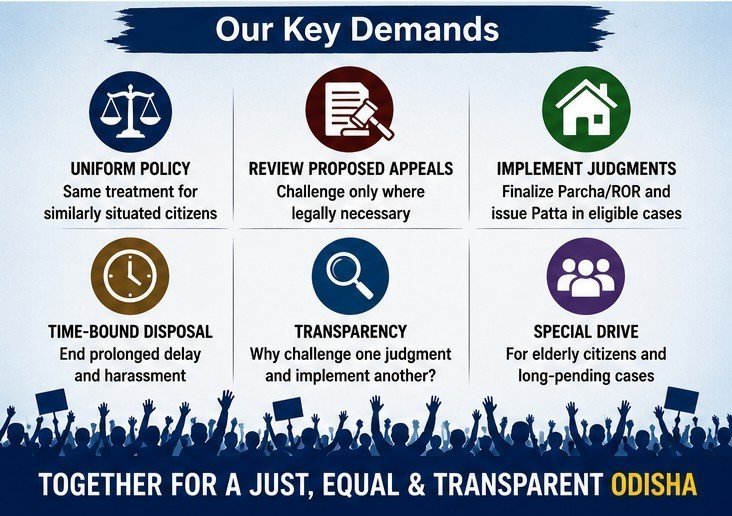
The proposed movement will seek the following:
(i) Uniform policy:
The Government should formulate a clear policy for dealing with leasehold land cases affected by judgments of the Hon’ble High Court.
(ii) Review of proposed appeals:
Before filing an SLP against a High Court judgment, the Government should examine whether substantially similar judgments have already been accepted and implemented.
(iii) Implementation where no stay exists:
Where a High Court judgment has attained finality, or where there is no stay against its operation, the Government should take appropriate consequential action in accordance with law.
(iv) Finalisation of Parcha:
Eligible cases should be processed and Parcha/ROR should be finalised within a reasonable and prescribed period.
(v) Issuance of Patta:
Where all legal requirements have been fulfilled, final Patta should be issued without unnecessary delay.
(vi) Transparency:
The Government should disclose the broad criteria used for deciding which High Court judgments are implemented and which are proposed to be challenged.
(vii) Time-bound disposal:
Long-pending leasehold land cases should be disposed of through a special time-bound drive.
⸻
- Appeal to the Hon’ble Chief Minister:
Hon’ble Chief Minister, the citizens do not wish to fight the Government.
They wish to seek justice from the Government.
They do not want unnecessary litigation.
They want their legitimate land rights to be settled according to law.
They do not oppose the Government exercising its lawful right to approach the Hon’ble Supreme Court.
But they respectfully request that such a remedy should be exercised uniformly, transparently and only after examining the consequences for similarly situated citizens.
If the Government has already accepted the legal principle in several cases, finalised Parcha and issued Patta, then the Government should carefully examine whether pursuing further litigation in substantially similar cases is genuinely necessary.
Otherwise, citizens may reasonably feel that they are being subjected to prolonged uncertainty for reasons which are not apparent to them.
⸻
- Final request:
In the circumstances, I respectfully request Your Honour to kindly consider:
- Reviewing the proposed policy of challenging High Court judgments concerning leasehold land before the Hon’ble Supreme Court, particularly where similar judgments have already been accepted and implemented;
- Directing the concerned Revenue Authorities to identify all pending cases involving similar legal and factual issues;
- Examining whether Parcha/ROR can be finalised and Patta issued in eligible cases in accordance with the applicable law and judicial directions;
- Ensuring that similarly situated citizens are treated uniformly and that no arbitrary distinction is made between cases;
- Issuing appropriate instructions for time-bound disposal of long-pending leasehold land cases;
- Ensuring that senior citizens and other vulnerable citizens are not compelled to undertake repeated visits to Government offices for matters which can be resolved administratively;
- Making the Government’s criteria for filing SLPs in such matters transparent, so that citizens can understand the basis of the decision; and
- Initiating a comprehensive review of old leasehold cases in Bhubaneswar and taking a policy decision capable of resolving the issue permanently rather than prolonging individual litigation.
Conclusion:
I respectfully submit that the proposed Gen-Z movement is not intended to challenge the authority of the elected Government.
It is intended to remind the Government of its responsibility towards ordinary citizens.
Courts decide rights.
Governments implement the law.
Citizens expect justice.
When a judicial decision is accepted and implemented in one case and substantially similar decisions are challenged in other cases, a legitimate question of consistency arises.
The Government has the opportunity to resolve this issue through a transparent, uniform and citizen-friendly policy.
I therefore earnestly request Your Honour to intervene before the proposed Gen-Z movement becomes necessary and to take appropriate steps for resolving the long-standing grievances of leaseholders through law, dialogue, transparency and administrative justice.
I remain hopeful that the Government of Odisha, under Your Honour’s leadership, will take a compassionate and principled view of the matter and ensure that ordinary citizens are not subjected to unnecessary and prolonged litigation.
Yours faithfully,
Lokanath Mishra
Mobile: 9437324941
Email: jailoknathjee@gmail.com
Date: 19.8.26.
Place: Bhubaneswar, Odisha
Copy for information and necessary action to-
- The Chief Secretary, Government of Odisha, Bhubaneswar.
- The Principal Secretary, Government of Odisha, Bhubaneswar.