
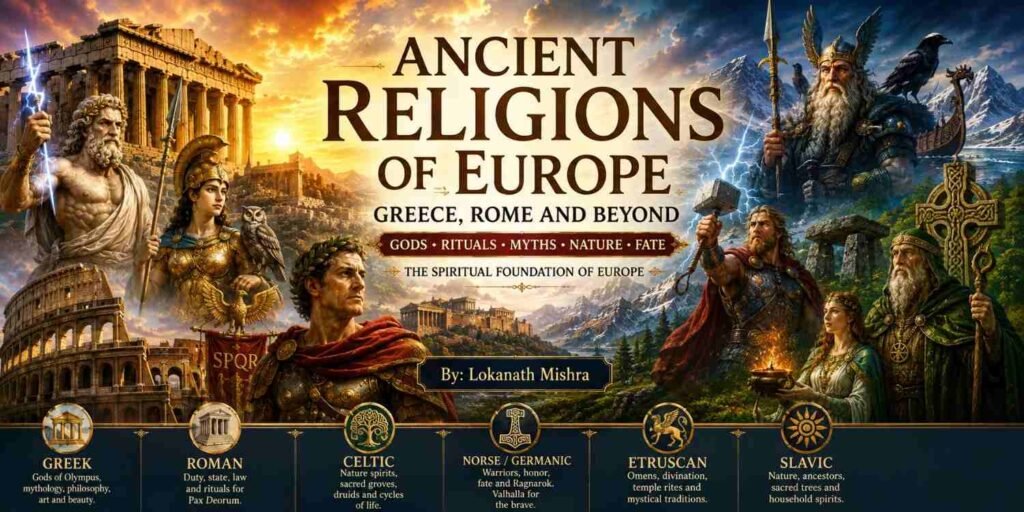
Ancient Religions of Europe: Greece, Rome and Beyond
By Lokanath Mishra
Europe’s ancient religions are not just stories of gods. They are the foundation of Western art. law. and culture.
The two most famous systems are Greek and Roman religion. But to understand Europe fully we must also look at Celtic. Norse. Etruscan. and Germanic traditions.
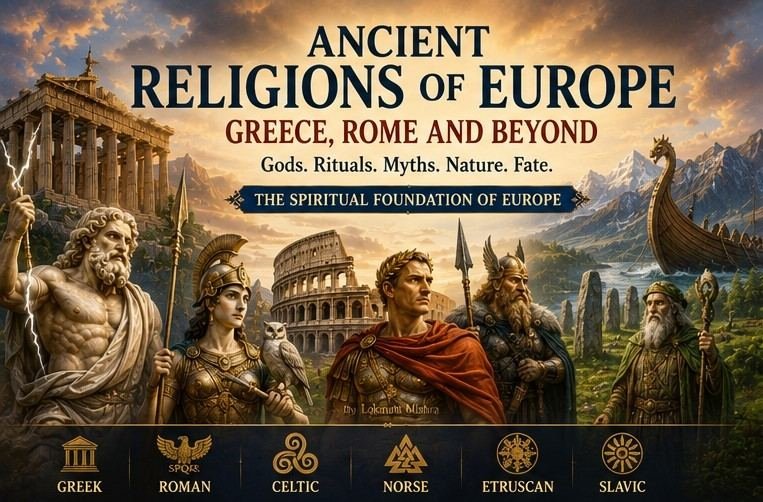
While they look similar on the surface. each had its own gods. rituals. and worldview.
Greece vs Rome: What Was Different:
Greek and Roman religion are often confused because Romans adopted most Greek gods. But they were not the same.
- Nature of the Gods:
Greek: Gods were very human. They had emotions. jealousy. love affairs. and personal stories. Zeus. Hera. Athena were like characters in drama.
Roman: Gods were more formal. abstract. and state-focused. Jupiter was not just a personality. He was the protector of Roman law. state. and army. Romans cared more about duty than drama. - Purpose of Religion:
Greek: Religion was about beauty. mythology. philosophy. and explaining nature. Temples were artistic and myths were told for entertainment and moral lessons.
Roman: Religion was about the state. Pietas = duty to gods. family. and Rome. Rituals were done correctly to keep Pax Deorum = peace with the gods. so Rome could win wars. - Mythology vs Ritual:
Greek: Rich mythology. Homer’s Iliad. Odyssey. and tragedies were sacred texts.
Roman: Very little original mythology. Romans borrowed Greek myths and gave Roman names. Zeus became Jupiter. Athena became Minerva. Aphrodite became Venus.
Romans focused more on priests. augurs. and public festivals than on storytelling. - View of Afterlife:
Greek: Afterlife was in Hades. mostly gloomy. Heroes could go to Elysium.
Roman: Similar to Greeks but more emphasis on honoring ancestors. Lares and Penates = household gods of ancestors were worshipped daily.
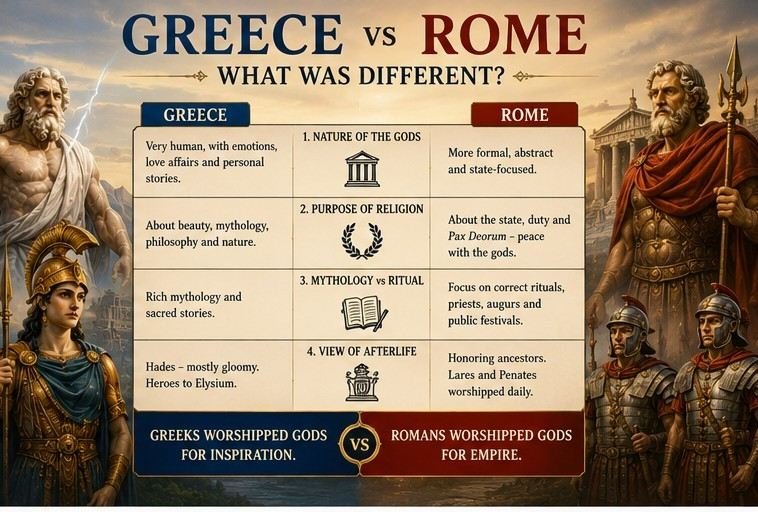
Summary: Greeks worshipped gods for inspiration. Romans worshipped gods for empire.
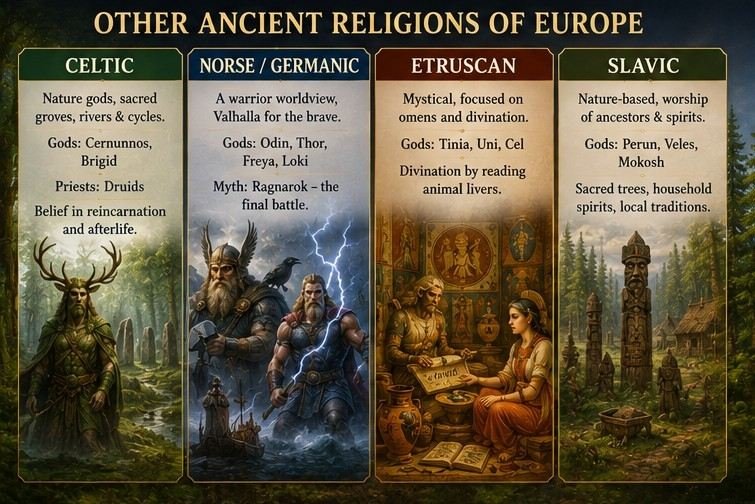
Other Ancient Religions of Europe:
- Celtic Religion:
Region: Gaul. Britain. Ireland.
Gods: Nature gods like Cernunnos = horned god of animals. Brigid = goddess of poetry and healing.
Key Features: No big temples. Worship happened in sacred groves. forests. and rivers.
Priests: Druids were scholars. judges. and healers. They believed in reincarnation and an afterlife.
Difference from Greece/Rome: Less anthropomorphic gods. More focus on nature spirits and cycles of seasons. - Norse/Germanic Religion:
Region: Scandinavia. Germany. England before Christianity.
Gods: Odin = wisdom and war. Thor = thunder. Freya = love. Loki = trickster.
Key Features: A warrior worldview. Valhalla was heaven for brave warriors who died in battle.
Myth: The world would end in Ragnarok. a final battle between gods and giants.
Difference from Greece/Rome: Darker tone. Fate was unavoidable. Gods themselves would die. More emphasis on honor and courage. - Etruscan Religion:
Region: Central Italy before Rome.
Gods: Tinia = sky god. Uni = goddess. Cel = earth goddess.
Key Features: Romans borrowed heavily from Etruscans. Temple design. divination by reading animal livers. and priesthood structure came from them.
Difference from Greece/Rome: More mystical and focused on omens. Etruscans believed gods gave humans a fixed lifespan. - Slavic Religion:
Region: Eastern Europe.
Gods: Perun = thunder god. Veles = god of earth and cattle. Mokosh = fertility goddess.
Key Features: Worship of ancestors. sacred trees. and household spirits.
Difference: Very local and nature-based. Later absorbed into Christianity as folk traditions.
Common Threads Across All European Ancient Religions:
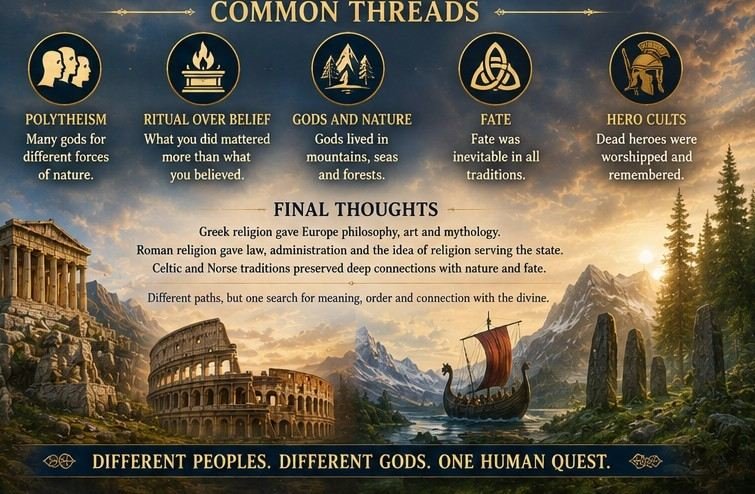
- Polytheism: All had many gods for different forces of nature.
- Ritual over Belief: What you did mattered more than what you believed. Correct sacrifice kept the world in order.
- Gods and Nature: Gods lived in mountains. seas. and forests. Olympus. Asgard. Sacred groves.
- Fate: All believed in fate. Moira in Greece. Fatum in Rome. Wyrd in Norse.
- Hero Cults: Dead heroes were worshipped. Achilles in Greece. Romulus in Rome. Sigurd in Norse.
Why These Differences Mattered:
The Greek system gave Europe philosophy. art. and mythology.
The Roman system gave Europe law. administration. and the idea of religion serving the state.
The Celtic and Norse systems gave Europe folklore. poetry. and a deep connection to nature that still survives in festivals today.
When Christianity spread. it absorbed many elements from all of them. Christmas trees from Germanic. Saints from Roman household gods. Church calendars from pagan festivals.
Final Thoughts:
To compare these religions is to see how different European peoples understood the same world.
Greeks asked: “What do the gods teach us about being human ?”
Romans asked: “How do the gods help us build an empire ?”
Celts and Norse asked: “How do we live in harmony with nature and fate ?”
All of them together created the spiritual foundation of Europe.
And many of their stories. symbols. and festivals still live with us today.
If you visit Greece. you will see the beauty of Greek gods.
If you visit Rome. you will see the power of Roman order.
If you go to Ireland or Norway. you will still feel the whispers of druids and Vikings in the landscape.
Europe’s ancient faiths were different. but they all searched for the same thing: meaning. order. and connection with the divine.