
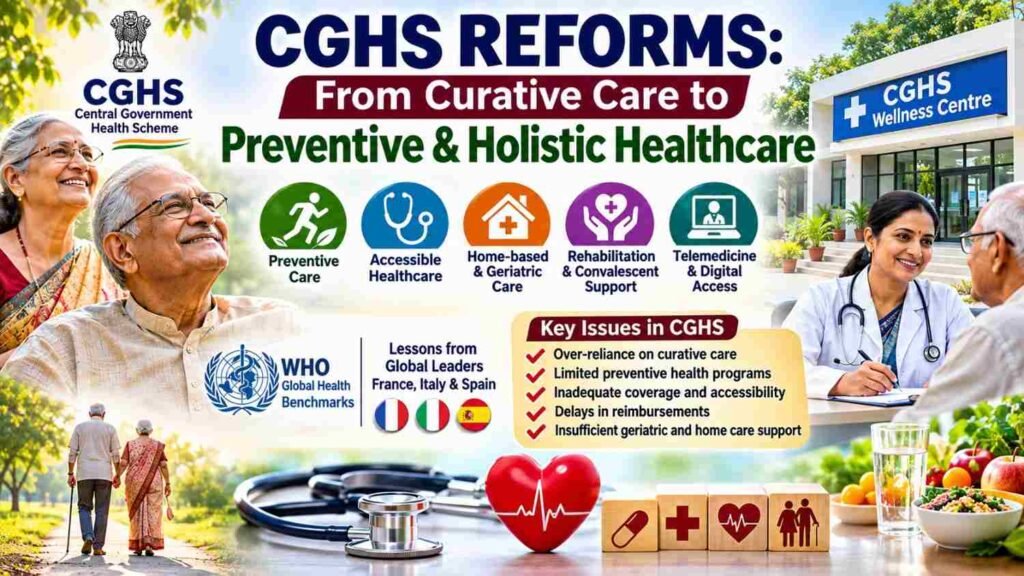
Reimagining Preventive and Holistic Public Healthcare in India : A Critical Evaluation of the Central Government Health Scheme (CGHS) Through the Lens of Global Health System Efficiency:
By Lokanath Mishra, Chief Adviser, AIPACBIC:
Abstract
Healthcare evaluation metrics globally have shifted from measuring isolated tertiary hospital infrastructure toward assessing holistic, population-wide health outcomes and financial efficiency. Landmark benchmarking by the World Health Organization (WHO) across 191 member states demonstrated that top-performing health systems—led by France, Italy, and Spain—succeed not merely through curative medical facilities, but via universal coverage, preventive medicine, nutritional security, lifestyle regulation, and robust convalescent social support. Applying this holistic framework to India’s Central Government Health Scheme (CGHS) exposes deep structural deficiencies. Designed primarily as a curative, episodic, and fragmented reimbursement model for a narrow demographic of central government employees and pensioners, CGHS lags behind global benchmarks in preventive care, outpatient accessibility, domiciliary support, and administrative efficiency. This article argues that CGHS, in its current operational form, represents an underperforming healthcare model that requires urgent structural reform to transition from reactive disease management to comprehensive, efficient, and preventive healthcare delivery.
- Introduction: Redefining Healthcare Beyond Hospital Walls
A foundational misconception in public policy is equating healthcare quality strictly with the availability of tertiary hospitals, advanced diagnostic machinery, and specialist consultations. In its seminal assessment of global health systems (The World Health Report 2000 and accompanying technical paper Measuring Overall Health System Performance for 191 Countries, Tandon et al., WHO Paper 30), the World Health Organization evaluated 191 member states not by the peak clinical care accessible to an elite minority, but by average population-level outcomes, fairness in financial contribution, and overall system efficiency—defined as health outcomes achieved per unit of expenditure.
The WHO framework establishes that genuine healthcare encompasses upstream determinants: eradicating communicable diseases, ensuring population nutrition, discouraging adverse lifestyle choices, and providing seamless continuity of care. Under these criteria, France ranked first globally in overall efficiency, followed closely by Italy (second) and Spain (seventh), whereas high-spending curative models such as the United States ranked 37th.
When India’s flagship employee healthcare program, the Central Government Health Scheme (CGHS), is evaluated against these internationally validated benchmarks, its limitations become starkly evident. Established in 1954 to provide comprehensive medical care to central government employees, pensioners, and their dependents, CGHS remains tethered to an outdated, curative-heavy, and bureaucratically cumbersome architecture. Far from exemplifying an efficient public health model, CGHS exhibits systemic inefficiencies that compromise patient outcomes, inflate administrative friction, and neglect preventive health. - Lessons from Global Leaders: The French Model of Health Efficiency
France’s top ranking in the WHO efficiency index illustrates how structural design drives superior outcomes relative to expenditure:
Bullet Universal and Seamless Access: Healthcare coverage is universal for all residents, eliminating the sharp disparities between covered and uncovered populations and streamlining provider networks without fragmented empanelment bottlenecks.
Bullet Integration of Curative and Domiciliary Care: In major French urban centres, medical infrastructure extends beyond clinic walls through accessible physician house calls (SOS Médecins and primary care home visits), reducing unnecessary emergency room congestion and supporting elderly or mobility-impaired patients.
Bullet Social and Convalescent Support: Recovery from severe pathologies such as oncology or major cardiac events is treated as an integral phase of clinical care. Patients receive generous, legally protected paid sick leave and rehabilitative support, recognizing that premature return to work undermines clinical recovery.
Bullet Upstream Preventive and Nutritional Policy: France embeds public health into daily civic life—from state-regulated, dietitian-designed, nutritious school meals to strict public health measures discouraging tobacco use, excessive alcohol consumption, and ultra-processed diets.
In contrast, systems like the United States (ranked 37th, narrowly ahead of Slovenia and Cuba despite vastly higher per-capita expenditure) demonstrate that high spending on specialized hospital care fails to yield top population outcomes when primary care, preventive infrastructure, and administrative simplicity are neglected. - Structural and Operational Deficiencies of CGHS
Measured against the WHO’s multidimensional standards, CGHS performs poorly across several critical axes, rendering it an inefficient and inequitable healthcare mechanism that demands immediate overhaul.
3.1. Over-Reliance on Curative Care and Neglect of Prevention
CGHS operates predominantly as a sickness-response mechanism rather than a health-maintenance system. While beneficiaries visit CGHS Wellness Centres for routine drug refills or referral slips, structured preventive screenings, personalized lifestyle modification programs, and clinical nutrition services are largely absent. Non-communicable diseases (NCDs) such as Type 2 diabetes, hypertension, and cardiovascular disorders account for the majority of CGHS expenditure, yet the scheme invests minimally in upstream interventions—such as workplace dietary reform, mandatory annual preventive health audits, or tobacco/alcohol cessation clinics—that global leaders use to compress morbidity.
3.2. Chronic Financial Friction and Out-of-Pocket Expenditure
A primary metric of WHO health system performance is protection against financial hardship and efficiency of expenditure. Although CGHS is designed as a cashless or reimbursable scheme, beneficiaries—particularly senior pensioners—frequently incur substantial out-of-pocket expenditure (OOPE). CGHS package rates for procedures and diagnostics at empanelled private hospitals remain chronically outdated relative to market inflation. Consequently, private hospitals routinely refuse cashless admission to CGHS cardholders, cite bed unavailability, or levy hidden co-payments. Simultaneously, delayed reimbursements from the government to empanelled hospitals have led to recurring standoffs and suspension of cashless services across major Indian cities.
3.3. Bureaucratic Gatekeeping and Fragmented Primary Care
Unlike the seamless primary care networks in France or Spain, accessing specialist care under CGHS involves rigid bureaucratic gatekeeping. Beneficiaries must physically visit overcrowded Wellness Centres to obtain referral memos for empanelled hospitals, often enduring long queues for brief consultations that function primarily as clerical routing exercises. Furthermore, unlike major French cities where domiciliary physician visits are established practice, CGHS lacks a functional home-healthcare framework. Bedridden, post-operative, or frail geriatric pensioners must either arrange private transport at personal expense or forego timely medical review.
3.4. Geographic Exclusion and Inequity
While WHO’s top-ranked nations guarantee universal healthcare access regardless of postal code, CGHS infrastructure is heavily skewed toward Tier-1 and select Tier-2 cities (approximately 80 cities nationwide). Retired central government employees residing in smaller towns or rural districts face severe access barriers, often traveling hundreds of kilometres to the nearest Wellness Centre or empanelled facility, defeating the principle of equitable healthcare delivery.
3.5. Weak Integration of Convalescent and Rehabilitative Care
In top-performing European systems, recovery from catastrophic illness (such as cancer) is supported by integrated rehabilitative pathways, psycho-oncology, and flexible convalescent leave. Under CGHS, once acute inpatient hospitalization concludes, post-discharge rehabilitation, palliative care, and home-based physiotherapy remain fragmented and poorly covered, leaving families to navigate recovery independently.
- Roadmap for Immediate Structural Reform
To transform CGHS from a sluggish, curative reimbursement bureaucracy into an efficient, outcome-driven healthcare model aligned with WHO benchmarks, policymakers must execute five immediate reforms: - Shift from Episodic Dispensing to Preventive Health Management: Mandate annual risk-stratified preventive health check-ups for all beneficiaries, integrating clinical nutritionists, physiotherapists, and lifestyle counsellors directly into CGHS Wellness Centres.
- Dynamic Indexation of CGHS Package Rates and Real-Time Claims Settlement: Link CGHS procedural and diagnostic tariffs to medical inflation indices with automatic biennial revisions, paired with an automated, time-bound digital clearinghouse to eliminate hospital payment backlogs and enforce strict penalties on hospitals denying cashless care.
- Institutionalize Domiciliary and Tele-Health Services for Geriatric Beneficiaries: Introduce structured home-visit protocols by empanelled primary care physicians and nurses for pensioners aged 75 and above or those with mobility-limiting conditions, supported by tele-consultations and doorstep medicine delivery.
- Decentralize Access via Universal Health Portability: Integrate CGHS with broader national digital health infrastructure (such as the Ayushman Bharat Digital Mission) and expand cashless empanelment to accredited district hospitals across non-CGHS towns so rural pensioners receive local care.
- Expand Coverage for Post-Acute Rehabilitation and Convalescent Support: Explicitly incorporate post-oncology rehabilitation, palliative care, mental health counselling, and home-based nursing into standard CGHS benefit packages.
- Conclusion
The World Health Organization’s assessment of 191 health systems offers an unambiguous lesson: superior healthcare is defined not by isolated clinical excellence or expenditure volume, but by universal accessibility, preventive focus, nutritional and lifestyle stewardship, and administrative efficiency. Judged against these criteria, the Central Government Health Scheme is a structurally flawed model that prioritizes reactive, hospital-centric treatment over holistic well-being, burdens beneficiaries with bureaucratic hurdles and out-of-pocket costs, and fails to deliver value for public expenditure. Without immediate, systemic restructuring toward preventive, domiciliary, and financially streamlined care, CGHS will continue to underperform both for its beneficiaries and as a benchmark for Indian public healthcare.
References
Bullet Tandon, A., Murray, C. J. L., Lauer, J. A., & Evans, D. B. (2000). Measuring Overall Health System Performance for 191 Countries (GPE Discussion Paper Series: No. 30). World Health Organization. https://www.who.int/healthinfo/paper30.pdf
Bullet World Health Organization. (2000). The World Health Report 2000 – Health Systems: Improving Performance. WHO Press.
Bullet Ministry of Health and Family Welfare, Government of India. Annual Reports and Operational Guidelines of the Central Government Health Scheme (CGHS)