
To:
Smt. Droupadi Murmu, Hon’ble President of India , NewDelhi.
Cc: Shri Jagat Prakash Nadda, Hon’ble Union Minister of Health and Family Welfare; Smt. Anupriya Patel & Shri Prataprao Ganpatrao Jadhav, Hon’ble Ministers of State for Health and Family Welfare; Smt. Punya Salila Srivastava, IAS, Secretary, Department of Health and Family Welfare; Director General / Director, Central Government Health Scheme (CGHS)
Subject: Representation for Urgent Structural Overhaul and Modernization of the Central Government Health Scheme (CGHS) Based on Global Health System Efficiency .
Respected Madam,
On behalf of the All India Pensioners Association of CBIC (AIPACBIC), I submit this urgent representation drawing your kind attention to the pressing need for comprehensive structural reform and immediate improvement of the Central Government Health Scheme (CGHS).
While CGHS was envisioned in 1954 as a flagship healthcare safety net for central government employees, pensioners, and their dependents, its current operational framework lags severely behind modern, outcome-driven public healthcare standards.
- Insights from Global Health System Benchmarks (WHO Assessment)
As established by the World Health Organization (WHO) in its landmark evaluation of 191 member states (Measuring Overall Health System Performance for 191 Countries, WHO Paper 30), true healthcare excellence is not measured merely by the presence of tertiary hospitals, but by average population-level health outcomes, fairness in financial contribution, and overall system efficiency—the health outcomes achieved per rupee spent.
Top-performing nations such as France (ranked 1st globally in overall efficiency), Italy (2nd), and Spain (7th) succeed because their systems prioritize:
Bullet Universal, seamless access without bureaucratic bottlenecks.
Bullet Preventive healthcare, nutritional stewardship, and active discouragement of lifestyle-related diseases.
Bullet Domiciliary care (such as physician house calls in major cities) to support elderly and mobility-impaired patients.
Bullet Strong convalescent and rehabilitative support during recovery from serious illnesses like cancer. - Critical Deficiencies in the Current CGHS Framework
Evaluated against these benchmarks, CGHS currently functions as an outdated, reactive, and bureaucratically cumbersome reimbursement model that fails its beneficiaries—particularly senior pensioners—in several critical ways:
Bullet Neglect of Preventive Care: CGHS remains overwhelmingly curative and episodic, functioning largely as a medicine-dispensing and referral mechanism while investing minimally in preventive screenings, clinical nutrition, and lifestyle management for non-communicable diseases.
Bullet Outdated Package Rates and Financial Hardship: Because CGHS procedural and diagnostic tariffs have not kept pace with medical inflation, empanelled private hospitals routinely deny cashless admission, cite artificial bed shortages, or force beneficiaries to pay substantial out-of-pocket expenses. Furthermore, chronic delays in settling hospital dues frequently trigger standoffs and suspension of cashless services.
Bullet Rigid Bureaucratic Gatekeeping and Lack of Domiciliary Care: Beneficiaries are forced to stand in long queues at overcrowded Wellness Centres merely to obtain referral memos. Unlike progressive global systems, CGHS lacks structured home-visit care, leaving bedridden and frail geriatric pensioners without accessible medical attention.
Bullet Severe Geographic Inequity: With CGHS facilities concentrated in roughly 80 cities, central government pensioners residing in smaller towns and rural districts face acute exclusion and must travel long distances for basic medical care.
Bullet Fragmented Post-Acute Rehabilitation: Coverage for post-hospitalization recovery, palliative care, home nursing, and rehabilitative therapies after major illnesses remains inadequate. - Five-Point Roadmap for Immediate CGHS Improvement
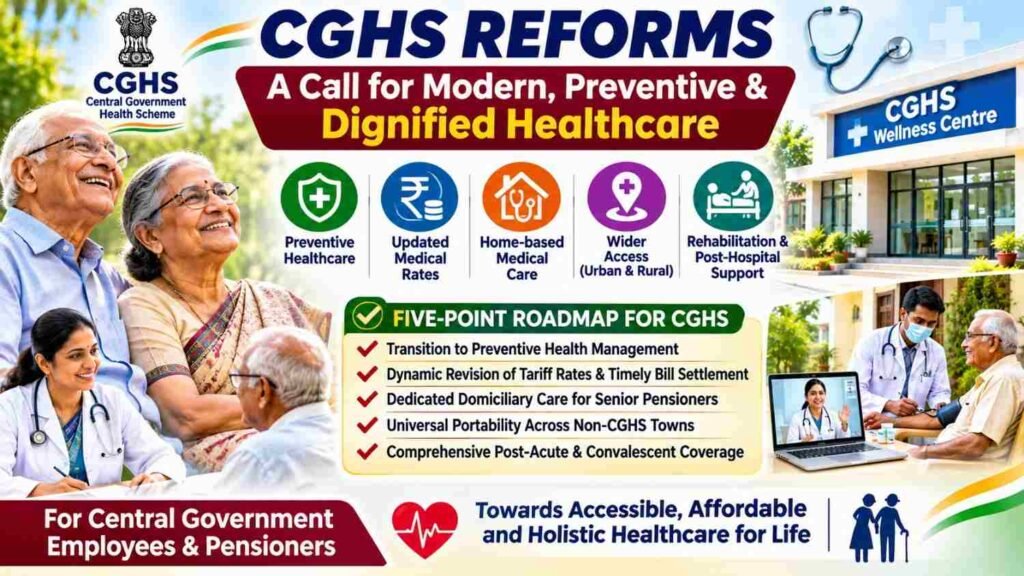
To transform CGHS into an efficient, humane, and preventive healthcare model worthy of its beneficiaries, we earnestly urge the Government of India to implement the following measures immediately: - Transition to Preventive Health Management: Mandate annual preventive health check-ups and integrate clinical nutritionists, physiotherapists, and lifestyle counsellors directly into CGHS Wellness Centres.
- Dynamic Indexation of Tariff Rates and Automated Bill Settlement: Revise CGHS package rates immediately to reflect current medical costs, institute automatic biennial rate revisions, and establish a time-bound digital clearinghouse to clear pending hospital dues and enforce strict penalties on empanelled hospitals that deny cashless treatment.
- Institutionalize Domiciliary Care for Senior Pensioners: Launch dedicated home-visit services by empanelled doctors and nurses for beneficiaries aged 75 years and above or those who are bedridden, backed by tele-consultation and doorstep medicine delivery.
- Universal Portability Across Non-CGHS Towns: Integrate CGHS fully with the Ayushman Bharat Digital Mission and empanel accredited district hospitals in non-CGHS districts so rural pensioners receive cashless care locally.
- Comprehensive Post-Acute and Convalescent Coverage: Include post-oncology rehabilitation, palliative care, mental health support, and home-based nursing within standard CGHS entitlements.
We earnestly request Your Excellency to intervene and direct the Ministry of Health and Family Welfare to initiate time-bound reforms so that lakhs of serving employees and senior pensioners who have dedicated their lives to the nation receive dignified, efficient, and genuinely holistic healthcare.
Thanking you,
Yours faithfully,
Lokanath Mishra
Chief Adviser, AIPACBIC
Mobile: 9437314941
Date: 22 November 2026
Copy to:
- Shri Jagat Prakash Nadda, Hon’ble Union Minister of Health and Family Welfare, Government of India, New Delhi. Wikipedia
- Smt. Anupriya Patel, Hon’ble Minister of State for Health and Family Welfare, Government of India, New Delhi. Wikipedia
- Shri Prataprao Ganpatrao Jadhav, Hon’ble Minister of State for Health and Family Welfare, Government of India, New Delhi. Wikipedia
- Smt. Punya Salila Srivastava, IAS, Secretary, Department of Health and Family Welfare, Ministry of Health and Family Welfare, New Delhi. Wikipedia
- The Director General / Director, Central Government Health Scheme (CGHS), Ministry of Health and Family Welfare, New Delhi.