
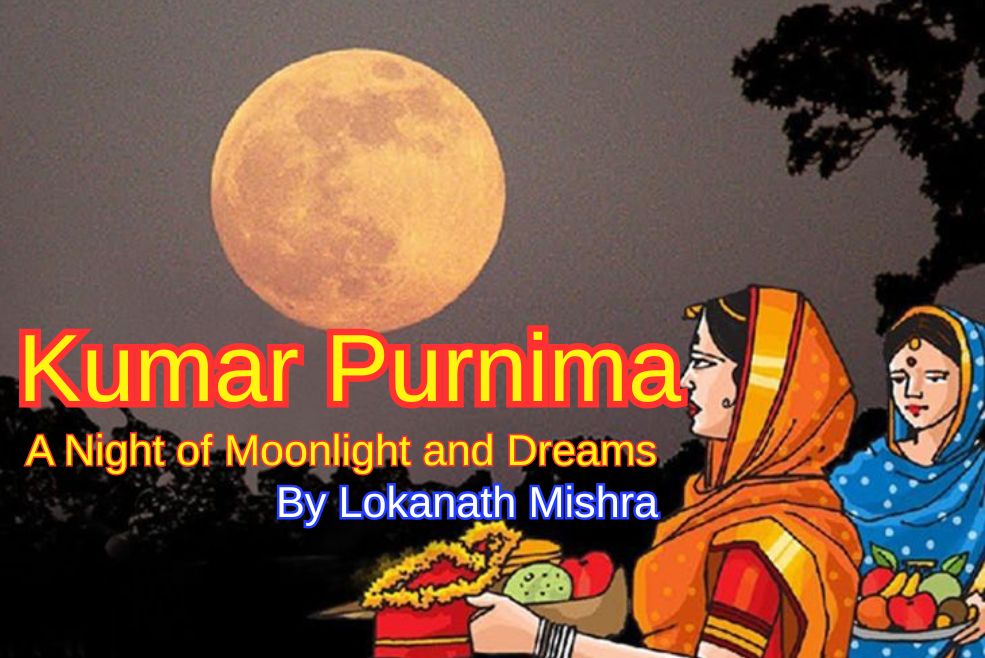
Kumar Purnima – A Night of Moonlight and Dreams
By Lokanath Mishra
The autumn skies over Odisha were clear, painted in hues of gold and saffron as the sun began its slow descent. It was Ashwina Purnima, the full moon day of autumn, when the entire state blossomed with quiet anticipation. This was no ordinary full moon—it was Kumar Purnima, the day when maidens across the land would fast, sing, and pray for a bright future and an ideal life partner, as handsome and noble as Kumar Kartikeya, the warrior son of Shiva.
The Morning Rituals

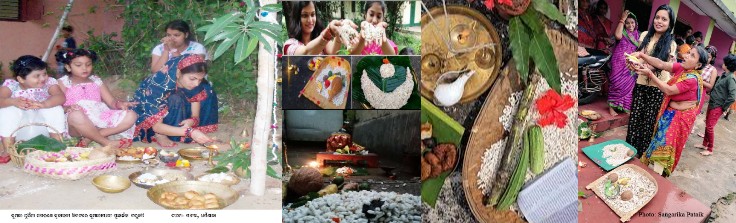
Before dawn, the villages and towns stirred awake. In a small courtyard of a traditional Odia household, a group of young girls, their faces glowing with excitement, had already bathed and dressed in freshly starched cotton sarees. Their bangles jingled as they carried kula—bamboo baskets filled with puffed rice, ripe bananas, cucumbers, coconut, and betel leaves. The air smelled of fresh sugarcane, jaggery, and flowers plucked in the cool night air.
Standing in the open courtyard, they faced the rising sun and performed the Janhi Osa, offering the fried paddy and fruits with folded hands. Their whispers of prayer filled the dawn air:
“O Surya Narayan, bless us with radiance, beauty, and a bright path ahead.”
From house to house, the ritual was the same—maidens offering devotion to the sun before beginning their fast that would last until moonrise.
The Festive Day
As the day wore on, the courtyards buzzed with preparation. Married women decorated the doorsteps with jhoti chita (traditional rangoli-like motifs made with rice paste). The air was alive with the sounds of conch shells and bells as households prepared for the Gajalaxmi Puja which also began on this day.
For the unmarried girls, however, the hours seemed to move slowly. They busied themselves with traditional songs, tales of Kartikeya’s valor, and playful games. The fast was strict, but their minds were filled not with hunger but with hope—for fortune, love, and a husband as radiant as the moon they would worship that night.
The Evening Moon Worship

By twilight, the world seemed washed in silver. The Sharad Purnima moon, full and luminous, rose gently into the autumn sky. Its light flooded the courtyards, bathing every corner in a serene glow.
The maidens now gathered again, dressed in colorful silk sarees, adorned with flowers in their hair. Each carried her kula, filled anew with puffed rice, fruits, betel nuts, and sugarcane. At the center of the courtyard, near a tulsi plant, offerings were placed. The ritual of Chandra Puja began.
They prepared the sacred dish Chanda Chakata—a mixture of puffed rice, jaggery, fruits, and curd. With folded hands, they lifted their eyes to the glowing orb above and prayed:
“O Chandra Deva, bless us with charm and grace. O Kumar Kartikeya, may we find partners as noble as you.”
One by one, they placed their offerings before the tulsi plant, symbolically offering them to the moon. The fast was then broken with the first taste of the Chanda Chakata, sweet and cool under the night sky.
The Celebration of Joy
But Kumar Purnima was not only about prayers—it was also about laughter. Once the rituals ended, the courtyards echoed with the sound of folk songs and playful games. Girls formed circles under the moonlight, clapping their hands in rhythm as they sang traditional verses that had been sung for generations. Some played puchi, a popular Odia game, while others teased one another about who might find the most handsome husband.
The silvery night seemed endless, as if time itself had slowed to honor the festival.

The Temple at Puri
While the celebrations were mostly private, the holy city of Puri witnessed its own grandeur. In the sanctum of the Jagannath Temple, the divine game of dice—pasa khela—was enacted between Mahalaxmi and Madan Mohan (a form of Vishnu). This playful pastime of the deities marked the auspiciousness of the night.
Though Kumar Purnima was not a large public festival within the temple walls, the spiritual connection ran deep. The blessings of Jagannath, Balabhadra, Subhadra, and Mahalaxmi seemed to flow outwards into the city and across the villages of Odisha, where every maiden looked to the moon and dreamed.
The Significance of the Moon
For the young women, the moon was more than a celestial body—it was a symbol of love, beauty, and destiny. Just as the moonlight illuminated even the darkest corners of the earth, they prayed for a husband who would bring radiance and happiness into their lives.
That night, under the silver beams of the Sharad Purnima moon, Odisha became a land of whispered prayers, youthful laughter, and celestial blessings.
✨ Thus, Kumar Purnima remains one of Odisha’s most cherished festivals—not with grand processions or temple chariots, but with quiet devotion, moonlit prayers, and the dreams of maidens for a future as bright as the autumn moon
The Divine Journey of Lokanath Mishra
A Story of Dvapar Yuga in Prose ( part-10-B)
Understanding Shraddha and Pinda Daan : A Journey of Honoring Ancestors
When I initially commented I clicked the “Notify me when new comments are added” checkbox and now each time a comment is added I get three emails with the same comment. Is there any way you can remove me from that service? Appreciate it!