
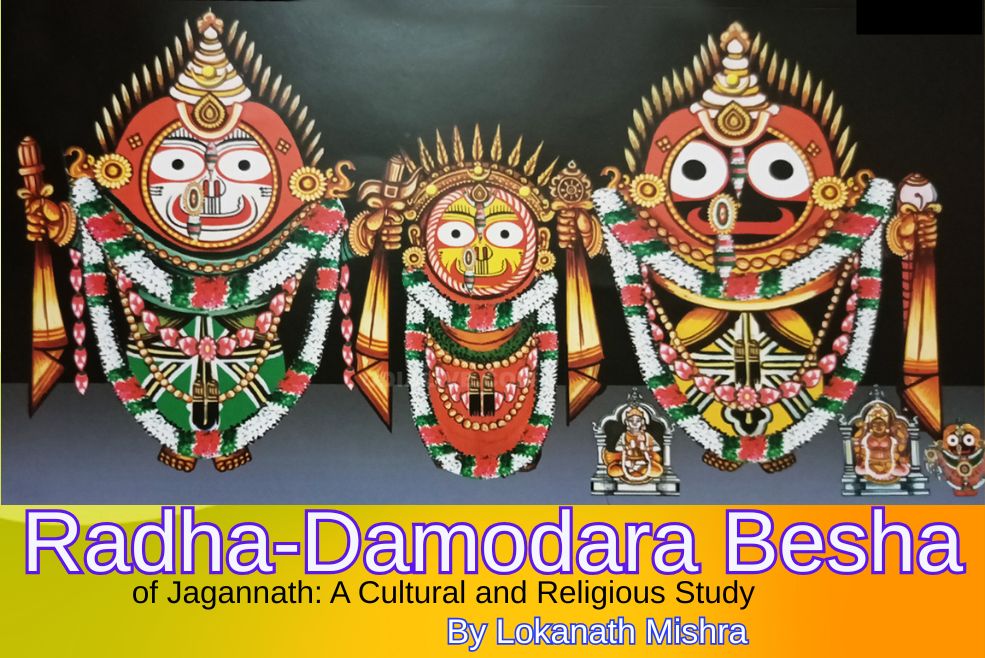
Radha-Damodara Besha of Jagannath: A Cultural and Religious Study
By Lokanath Mishra
Introduction
The ritual costumes (beshas) of Lord Jagannath in the Puri Shrimandir form a vital component of the temple’s liturgical and cultural practices. Among them, the Radha-Damodara Besha occupies a special place, observed annually during the autumnal months of Ashwina and Kartika. This attire not only represents a unique devotional synthesis of Vaishnavite traditions but also reflects the theological intersections of Krishna’s Damodara-lila and Radha’s eternal association with Him.
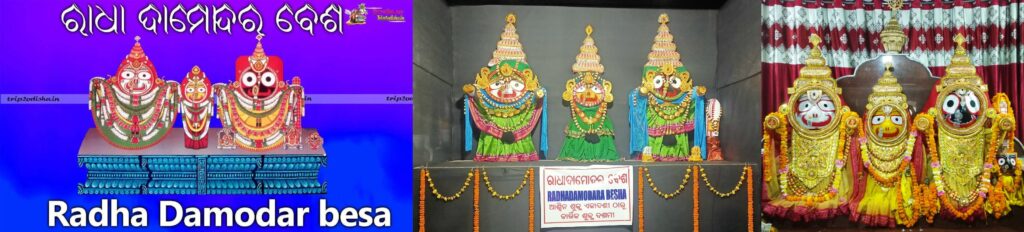
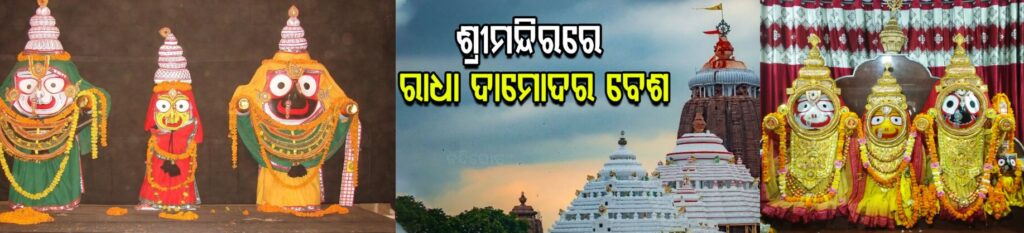
The Radha-Damodara Besha is performed from Ashwina Shukla Ekadashi (the eleventh day of the bright fortnight of Ashwina) until Kartik Shukla Dashami (the tenth day of the bright fortnight of Kartika). Thus, it spans an entire lunar month, with a temporary suspension during the Panchuka period of Kartika (the last five days), when other prescribed attires are observed.
Etymology and Theological Significance
The term Damodara derives from two Sanskrit roots: dama (rope) and udara (belly). This epithet of Krishna is closely associated with the Damodara-lila, narrated in the Bhagavata Purana (10th Skandha, Chapter 9). According to the episode, Yashoda tied the mischievous child Krishna with a rope around His waist to a mortar, after which He dragged it between two arjuna trees, thereby liberating Nalakuvara and Manigriva, the sons of Kubera, from Narada’s curse. The epithet “Damodara” thus symbolizes both Krishna’s subjugation to maternal affection and His cosmic power in delivering the cursed beings.
The inclusion of Radha in this attire represents a theological synthesis, wherein Jagannath embodies not merely Krishna but Krishna in union with His supreme consort. The appellation Radha-Damodara thereby integrates Radha’s devotional primacy, as emphasized in the Nimbarka Sampradaya, with Krishna’s childhood play (lila) as Damodara.
Historical Context and Origins
The precise origins of the Radha-Damodara Besha in Puri remain uncertain, as temple records do not furnish a definitive chronology. However, several scholarly traditions suggest possible sources:
1. Nimbarka Influence: Acharya Nimbarka (c. 7th–8th century CE), who emphasized the dual worship of Radha-Krishna, is believed to have influenced this tradition. His disciples are known to have propagated Radha-Damodara worship in Odisha, where syncretic Vaishnavite practices were already flourishing.
2. Jayadeva’s Contribution: The 12th-century poet Jayadeva, author of the Gita Govinda, resided in Puri for some time. His compositions strongly emphasize Radha’s central role in Krishna devotion, and his personal association with the Radha-Damodara cult has been documented in devotional accounts.
3. Temple Legends: Oral traditions record various episodes, including visions of Radha-Damodara in the Yamuna witnessed by Akrura, or miraculous manifestations in the Shrimandir (e.g., the tale of Jagannath’s hair appearing in a garland offered during Radha-Damodara Besha). These narratives, while not historically verifiable, contribute to the attire’s sacral legitimacy.
Ritual Performance and Ornamentation
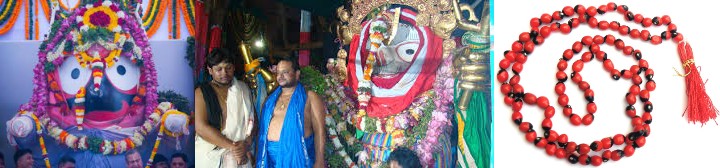
The Radha-Damodara Besha is performed after the Mangala Arati and Abakash rituals at night, continuing until Bala Bhoga in the morning. During this period, the deities Jagannath and Balabhadra are decorated in elaborate ornamentation, combining both golden jewelry and floral adornments.
Gold Ornaments Used
• Three ghagada-mali (heavy necklaces).
• Three odiayani (waist ornaments).
• Three forehead ornaments representing the sun and moon.
• Two silver chandrikas (crests) adorning the hair.
• Two tilakas.
• Four golden nalibhujas (armlets).
• Four kuntalas (hair curls).
• Two tadagis (head ornaments).
Floral Ornaments
• Guna, chita, and adhara mala (garlands).
• Decorative bamboo and cane crests placed in the hair.
Other Adornments
• Earrings, waist belts, and silk garments.
• Phuta, sirika-pata, paharaṇa, bangles, adhara-bala, and uttariya.
• Golden ropes tied around the deities’ waists, symbolizing Krishna’s Damodara pastime.
The attire also incorporates color-coded silk garments for each day of the week, reinforcing symbolic associations:
• Sunday: Red (nali).
• Monday: White with black spots.
• Tuesday: Checkered (barapatiya).
• Wednesday: Blue.
• Thursday: Yellow.
• Friday: White.
• Saturday: Black.
Ritual Calendar
During the Kartik Panchuka (the last five days of Kartika), the Radha-Damodara Besha is temporarily suspended. Instead, five alternate attires are performed:
1. Lakshmi-Narayan Besha.
2. Bankachuda Besha.
3. Trivikrama Besha.
4. Lakshmi-Narasimha Besha.
5. Rajarajeshwar Besha.

This variation underscores the plurality of Vishnu’s manifestations celebrated within Jagannath worship.
Broader Cultural Practices
The Radha-Damodara Besha is not limited to Puri alone. At Kantilo Nilamadhava, considered an Adipeetha of Jagannath culture, this attire is also observed for a full month during Kartika, suggesting its diffusion into regional liturgical practices.
Women devotees in Odisha observe the Rai-Damodara Vrata during Kartika, worshipping Radha (Rai) and Damodara together. This domestic ritual practice parallels and complements the temple attire, reinforcing the integration of Radha-Damodara devotion into both public and private spheres.
Mythological and Devotional Narratives
Several narratives are associated with the Radha-Damodara Besha, contributing to its symbolic richness:
• The Tale of Narayan Mahapatra: A priest once discovered strands of hair within a garland offered to Jagannath during Radha-Damodara Besha. This was interpreted as evidence of the Lord manifesting hair for His devotee, since Radha-Damodara iconography often depicts Krishna with locks of hair.
• The Legend of Rai: According to another tradition, an elderly Badapanda priest could no longer serve due to age. His daughter Rai, a devout worshipper of Krishna, wished to marry the Lord Himself. Although Jagannath explained that He was already united with Lakshmi, He eventually accepted Rai’s devotion, granting her recognition outside the temple precincts. This story explains why Radha-Damodara worship often occurs beyond the temple, integrating folk devotion with temple ritual.
• Akrura’s Vision: In the Bhagavata Purana, Akrura, on his journey to Mathura, had a vision of Radha and Krishna in the waters of Yamuna. This vision is often invoked in explaining the Radha-Damodara motif.
Conclusion
The Radha-Damodara Besha represents a complex convergence of theology, ritual, and cultural identity in Jagannath worship. By integrating Krishna’s Damodara-lila with Radha’s devotional primacy, the attire symbolizes both Vaishnavite philosophical traditions and Odia cultural distinctiveness.
Beyond its ritual function, the Besha reinforces key theological principles: Krishna’s subjugation to love (bhakti), Radha’s indispensable role in divine play, and the embodiment of Vishnu’s cosmic power in Jagannath. Its observance across Puri and regional centers like Kantilo Nilamadhava, along with parallel domestic practices such as Rai-Damodara Vrata, demonstrates the deep penetration of Radha-Damodara devotion into Odia religiosity.
Thus, the Radha-Damodara Besha is not merely a ritual costume but a living tradition — a synthesis of liturgy, legend, and love that continues to define the devotional identity of Jagannath culture.
Pingback: Lakshmi Puja and the Grandeur of Gajalaxmi Puja in Dhenkanal - UniverseHeaven