
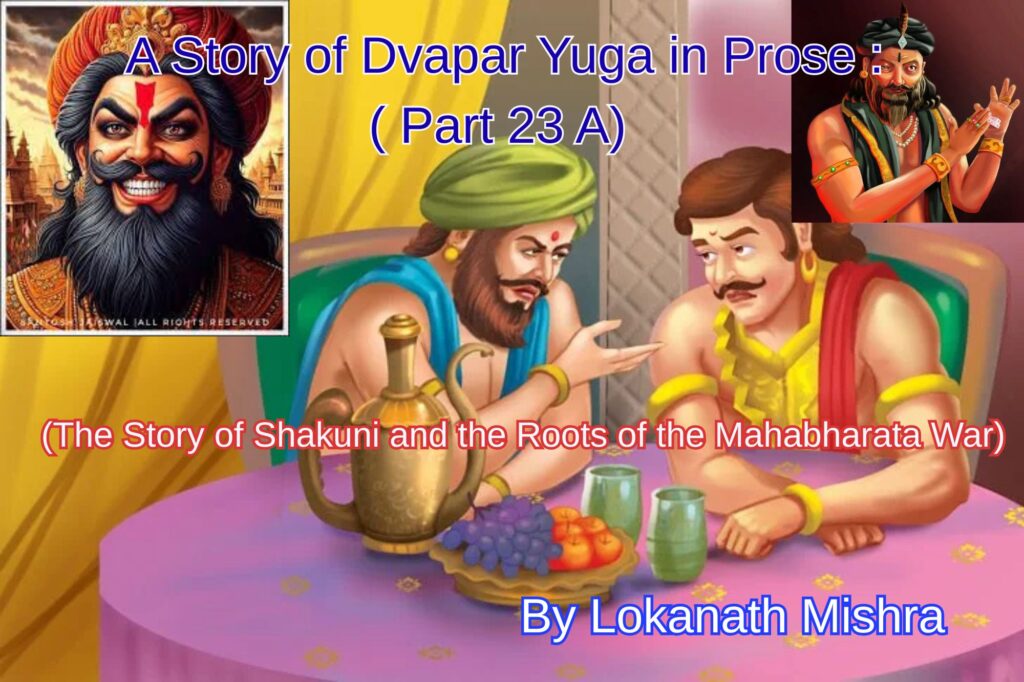
A Story of Dvapar Yuga in Prose ( Part :23 A)
By Lokanath Mishra
(The Story of Shakuni and the Roots of the Mahabharata War)
Jarāsandha repeatedly attacked Mathurā at regular intervals, and each time he returned defeated after losing several commanders and soldiers. During this same period, many significant events were unfolding around Hastināpur—events that were gradually drawing the future of India toward another great war. Among these events, the arrival of Shakuni, prince of Gandhāra, as the chief minister of Hastināpur, was particularly noteworthy.

Every day, the five Pandava brothers attended the royal court of Hastināpur. Duryodhana addressed each of them mockingly—calling Yudhishthira “the son of Dharma,” Bhima “the son of the Wind,” Arjuna “the son of Indra,” and the twins “the sons of the Ashvinis.” The other Pandavas swallowed this poison of humiliation silently, but Bhima was cast in a different mould. One day, instead of attending the Kuru court, he stayed home and lay fasting.
A day passed. Then two. Seeing her son—who normally demanded food six times a day—lie unfed, Kunti grew anxious. She sought Vidura’s advice to break Bhima’s pride and anger. Vidura too was displeased by Duryodhana’s arrogance and misbehavior. So he revealed to Kunti the secret of Gandhāri’s marriage to the Sahada tree. He said, “The tree died after her symbolic marriage, and according to customs, Gandhāri became a widow—though later she did marry Dhritarāshtra.”
This was enough for Bhima.
The next day, when Duryodhana called out mockingly, “Come, O son of the Wind,” Bhima retorted sharply, “Yes, I am here—O son of the Sahada Tree!”
That single phrase—Golaka-putra—became, after the dice game, the very foundation upon which the Mahabharata war ultimately stood.
When Duryodhana insisted repeatedly, his mother Gandhāri herself narrated the story of the Saal tree marriage. According to Dhritarāshtra’s horoscope, he was destined to be a Brahmarākshasa (a cursed, demonic spirit), and before marrying Gandhāri, more than a hundred and eight maidens had died. Gandhāri herself was the eighty-first princess in her line, and even twenty princes who came to marry her had died untimely deaths. So, on Vyāsa’s advice, she was first symbolically married to a Sahada tree. After the marriage, the tree caught fire and perished. Only then was Gandhāri wedded to Dhritarāshtra.
After hearing this, Duryodhana, afraid of Bhima’s mockery, refused to attend court. He came to regard the Gandhāra dynasty as the root cause of his humiliation.
On the borders of Gandhāra stood a mountain of iron-hard stone. Duryodhana deployed five hundred masons there and had them construct a prison carved into the mountain—though from outside, it looked like a beautiful palace. Inside, however, it was a dungeon built from the heart of the rock. It had space for ninety-nine people, with only one door and a tiny window. The construction was done secretly at night, and workers were ordered never to leave the site until the work was complete.
When the preparations were done, Duryodhana, accompanied by an armed escort, travelled to Gandhāra. There, under the pretext of showing them the newly built palace, he lured King Subala, his hundred sons, and relatives inside. Once they entered, he locked the door from outside and sealed it.
By Duryodhana’s order, the food given to the prisoners was gradually reduced. Finally, it was reduced to a portion meant for only one person. Starving and desperate, the sons and relatives of King Subala began dying before his eyes. Some, maddened by hunger, chewed their own hands and feet, tearing flesh to survive. This horrifying scene was witnessed by Subala’s eldest son—Shakuni.
When the food ration reached only a single meal a day, King Subala summoned his remaining sons. He said, “Only one among us must survive—one who can avenge this terrible massacre.” None answered. Subala continued, “The cleverest among you must be the one. So I give you a test.” Bones from the dead lay scattered around. He pulled a thread from his torn garment and instructed them to pass it through the hollow of a dead man’s hand bone. None dared attempt it. Shakuni stepped forward.
He examined the bone and saw that ants were entering through the holes to feed on the marrow. He tied a grain of food to one end of the thread and placed it near the ants’ trail. A single ant grasped the grain and carried it through the hole inside, pulling the thread after it.
Subala said, “From now on, whatever food comes, Shakuni alone shall eat.”
One by one, the Gandhāra royals perished helplessly. Only King Subala and Shakuni survived till the end, like living ghosts in the dungeon. One day Subala said, “My son, I will die soon. Before I go, tell me—how will you take revenge for this cruel annihilation?”
Shakuni replied, “Father, you must already have a plan. Tell me, and if I survive, I will take such terrible revenge that even in heaven you will find peace.”
Subala said, “On the first day after we were imprisoned, I reached my hand through the small window and called Duryodhana. When he came, I asked him the reason for imprisoning us so brutally. He said, ‘Why was my mother married to a saal tree? Should I tolerate Bhima calling me son of the saal tree? For attaching such disgrace to the Kuru dynasty, you must suffer!’
Duryodhana is proud and arrogant. The Pandavas are his chief rivals, and Bhima his greatest enemy. That information alone should be enough for you.”
Shakuni asked, “You have given me strategy—now give me a weapon.”
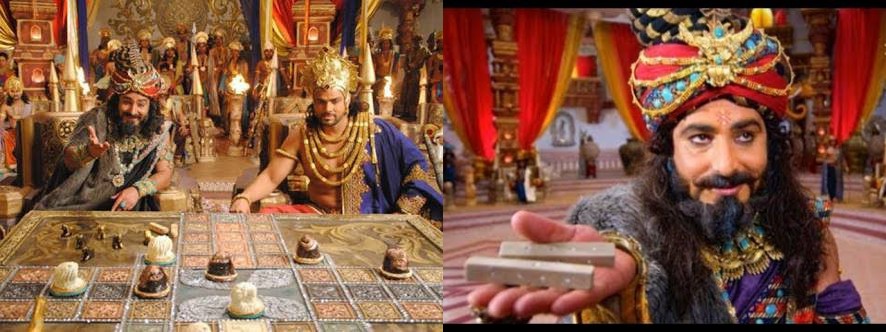
King Subala replied, “After my death, take the bones of my skilled right hand and make two dice sticks. From the bones of my left hand, carve sixteen dice. Craft them with thirty cuts—whichever number you call shall fall. This will be your greatest weapon in the future war.”
Shakuni asked, “How will your bones carry such power?”
Subala told his story. In his youth he had been addicted to dice and lost everything—even his kingdom. He attempted to drown himself in the Ganga, but his obsession with the game stopped him. He undertook severe penance to win a boon from the Goddess Ganga. After years, she appeared and granted him enchanted dice that would never lose. After regaining his kingdom and riches, three years later he returned them to the Goddess. Pleased, she told him, “The bones of the hand that played with these dice will forever retain their power.” Subala ended softly, “And so, my son…” But before finishing, he collapsed and died.
Shakuni held the corpse for a while. Not a single tear came—his grief had long dried into something far more dangerous. He looked across the dungeon. The scattered bones seemed like half-formed bodies crying out, “Revenge! Revenge!”
He knew the food supply would soon stop. Each day he smeared half his allotted food onto the prison wall. For seven days no food came—only water. Shakuni soaked the dried food scrapings and survived on them. After his father’s corpse decayed, Shakuni scraped the flesh from the bones with his long-grown nails. He carved dice-sticks and dice from the bones, sharpening them against the stone walls.
Life in the dungeon became unbearable—foul smells, skeletons everywhere, thin air, dim light, sleepless nights full of nightmares. Each morning he rushed to the small window for a breath of fresh air and a sliver of light.
Then one day, a bright possibility entered through that same window. The maid who brought water shouted, “Whoever you are inside, take this water from my hands—for today is the last time you shall receive it.”
And Shakuni realized—
the moment of escape was near,
and the moment of vengeance had begun.
( to be continued)
Pingback: A Story of Dvapar Yuga in Prose (Part 23 B) - UniverseHeaven