
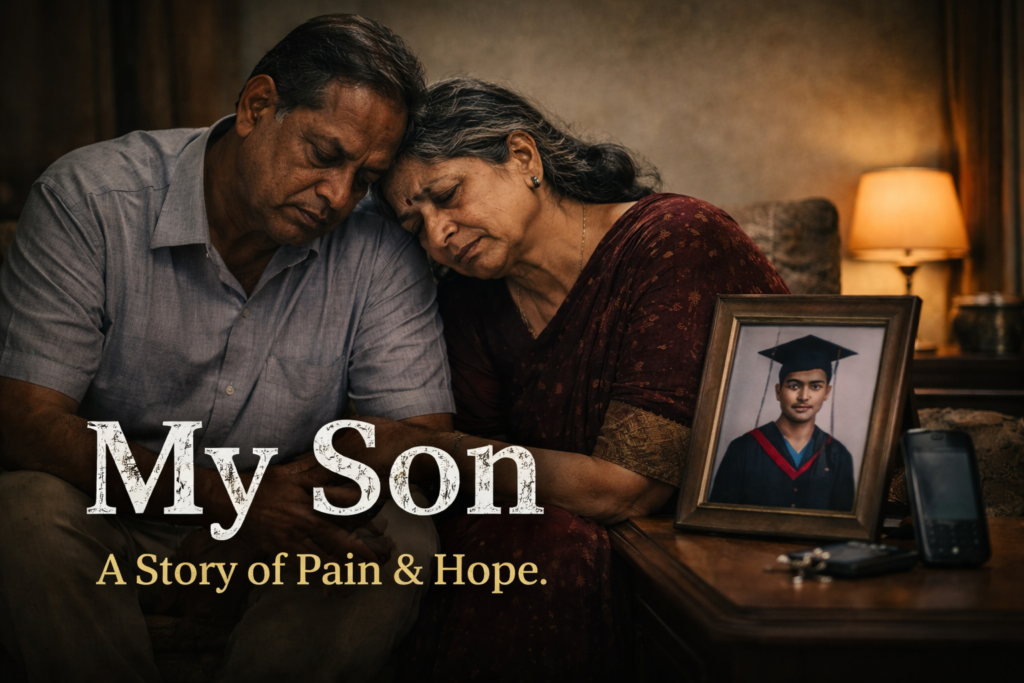
My Son
By Lokanath Mishra
We are not dramatic people.
My husband still wakes up at 5:30 every morning. I still boil milk the same way I did when our son was small—careful not to let it spill. Habits don’t die just because hope is tired.
Our son, Raghav, used to call every night at 9:42 pm.
Never 9:40. Never 9:45.
“Have you eaten?” he would ask us first.
He got married last year.

We liked her. Truly. She touched our feet, called me Maa, helped in the kitchen when she visited. When they moved to another city, we told ourselves this is how life goes. Children grow outward.
At first, his calls became shorter.
Then irregular.
Then missed.
“Work pressure,” she said when I asked.
“New responsibilities,” she said when I worried.
Parents learn to doubt themselves before doubting others.
The day his phone went unreachable, I told myself the network must be down.
The second day, I told myself he must be busy.
By the fifth day, I stopped telling myself anything.
My elder son went to their flat.

She opened the door wearing headphones.
Music playing.
She smiled politely.
“He didn’t tell you?” she said.
“Tell us what?” my son asked.
“He left.”
Left where?
Why?
When?
She didn’t know.
Or didn’t want to know.
Both sound the same after a point.
The cupboard still had his clothes.
His toothbrush was dry.
His office bag was missing.
The police spoke softly to us, the way people do when they don’t expect miracles.

Later, neighbours told us things we never wanted to hear.
Late nights.
Loud laughter.
Another man’s bike.
She said our son was controlling.
She said she felt suffocated.
She said she was a victim.
We are old.
We don’t understand these words anymore.
We only know this:
If your house feels like a prison, you don’t let the jailer disappear without a question.
It has been eight months.
Every time the phone rings, my heart still reaches my throat before my hands do.
Every unknown number feels like God clearing His throat.
His room in our house is untouched.
Bedsheet folded.
Shoes aligned.
People tell us to move on.
Parents don’t move on.
They just learn to sit with the waiting.
Every night before sleeping, I charge my phone fully.
Not because I expect a call.
But because if my child ever needs me—
even after disappearing from the world—
I don’t want my phone to be dead.
Here is a more legally grounded version, restrained, procedural, and ending in quiet suspense, written entirely from the parent’s perspective:
We filed the missing person report on the seventh day.
The police officer was polite. He asked us to sit. He asked for Aadhaar details, photographs, last known location, phone numbers, bank statements. He spoke in a practiced voice, the kind that doesn’t rise or fall with emotion.
“Adults can leave voluntarily,” he reminded us.
“Yes,” we said. “But adults also tell someone.”
Our son had not.
His wife was called to the station.
She said there had been arguments.
She said he was “emotionally distant.”
She said he once mentioned feeling “trapped.”
The officer wrote everything down.
Then he asked one question that changed the room’s temperature.
“Did he leave his phone behind?”
Yes.
Did he take his wallet?
No.
ATM withdrawals after that day?
None.
Office resignation?
Sent from his laptop at home.
The officer looked up.
Laptops do not resign on their own.
They sealed the flat for two days.
Checked the CCTV in the building.
There was footage of our son leaving once.
There was no footage of him returning.
There was also no footage of him carrying luggage.
Neighbours were questioned.
One heard raised voices the night before.
Another heard crying.
Another said a man visited often, late at night.
The wife denied everything.
Said the neighbours were “judgmental.”
Said we were “harassing” her.
Her lawyer used those words.
We learned new phrases:
Voluntary disappearance.
No prima facie evidence.
Marital discord.
We learned how loneliness looks on paper.
After three months, the police froze his bank account.
After four months, they accessed his email.
After five months, they retrieved deleted chats.
We were not allowed to read them.
We were only told this:
“There are inconsistencies.”
The officer advised us to be patient.
Cases like this take time.
Sometimes people come back.
Sometimes they don’t.
Last week, we received a call.
They have found a phone.
Not his current one.
An old handset, registered in his name.
It was switched off.
The SIM last pinged a tower near the highway.
The same highway that runs past the city limits.
Tomorrow, we are to go to the station again.
They said it may be nothing.
They said it may help close certain possibilities.
I have ironed my saree.
My husband has arranged all the documents neatly in a file.
We have not told anyone.
We have learned that hope is a dangerous thing—
especially when the law finally starts asking
the right questions.
Here is the final twist, subtle, legally plausible, and leaving the truth just out of reach:
At the police station, they did not make us wait long.
The phone was placed on the table inside a transparent evidence pouch. Scratched screen. Cracked back. Ours. We recognised it immediately—not by the model, but by the small dent on the side. He had dropped it years ago while getting off a bus.
The officer turned it on.
It did not unlock.
“We recovered this from a private service centre,” he said. “Someone tried to replace the motherboard.”
“Someone?” I asked.
He nodded. “The request came from the same city. Paid in cash.”
Then he paused.
“The technician remembered because the woman insisted the data be erased before repair.”
My husband’s hand tightened around the file.
The officer continued, carefully.
“There was one thing we recovered. A draft message. Not sent.”
He read it aloud.
Maa, if you don’t hear from me tomorrow, please don’t believe what they say.
There was no timestamp.
No recipient saved.
Just those words.
The room went quiet.
“Legally,” the officer said, “this changes the nature of the case.”
From missing person
to suspected abetment.
We were told not to contact the wife.
We were told the flat would be searched again.
We were told to prepare ourselves.
Outside the station, my phone rang.
An unknown number.
I did not answer.
The call came again.
And again.
Then a message appeared.
Please stop this. He left because of YOU.
I showed it to the officer.
He took the phone from my hand and said only this:
“We were hoping she would contact you.”
That night, for the first time in months, I did not charge my phone out of habit.
I charged it because the law had finally opened a door—
and whatever was waiting on the other side
was no longer allowed to stay hidden.
Here is the concluded ending—clear, legally grounded, emotionally restrained, and closed without sensationalism, the way real cases often end:
Six months later, the case file was no longer thin.
The police did not call it a confession.
They called it a sequence of admissions.
The financial trail spoke first.
The cash payment at the service centre.
The ride-hailing records deleted but retrieved.
The CCTV angle that had once seemed useless—now matched with timestamps.
Then the contradictions hardened.
Her statements changed.
Not dramatically.
Just enough.
Arguments became “discussions.”
A visit became “an accident.”
The night of his disappearance shifted by two hours.
In court, the judge did not ask about love.
He asked about facts.
Why the phone was erased.
Why the resignation mail was sent from a shared device.
Why there was no missing person complaint filed by the spouse.
The charges were framed.
Not for murder.
Not yet.
For abetment to disappearance
For destruction of evidence
For criminal intimidation through digital communication
The words sounded clinical.
But to us, they meant this:
Our son did not simply walk away.
The investigation continues.
Legally, he is still missing.
Emotionally, he is no longer erased.
The flat has been sealed.
The spare key submitted as evidence.
Her social media accounts are quiet now.
As for us—we attend every hearing.
We sign every document.
We answer every call.
The law cannot promise us a reunion.
It can only promise pursuit.
And so we wait.
Not in denial.
Not in silence.
But with the certainty that whatever happened to our child
has a name now.
And names have consequences.
Here is the concluded ending, narrated with restraint, factual tone, and finality—no sensationalism, just truth settling heavily:

Finally the call came at 6:18 a.m.
A forest range officer had found human remains during a routine patrol—shallow soil disturbance, torn fabric, a wristwatch still intact. The location was forty kilometres from the city, beyond the highway where the old phone last pinged.
We were taken there later that day.
The forest was quiet in the way only forests are—indifferent, ancient, unmoved by human secrets.
The police did not ask us to identify the body by the face.
There was no face left to identify.
They showed us the watch.
The belt buckle.
A ring engraved with his initials.
DNA confirmation followed within days.
Cause of death: blunt force trauma.
Time of death: the same night he “left voluntarily.”
The investigation moved quickly after that.
Confronted with evidence—location data, recovered chats, financial transfers, and the draft message—she broke.
Not immediately.
Not fully.
But enough.
Her boyfriend had been visiting the flat regularly.
Our son had discovered the truth.
There was an argument in a park in evening .
Then another man joined.
Then violence that was not planned—but also not stopped.
They drove him out that night from the park .
Not to a hospital.
Not to safety.
To the forest.
The court called it common intention.
The judgement did not use emotional words.
It did not mention parents.
It did not mention betrayal.
It simply stated:
“The accused, acting in concert, caused the death of the deceased and attempted to destroy evidence thereafter.”
Life imprisonment for both.
When the judge finished reading, the room was silent.
No cries.
No victory.
Justice is not loud.
It arrives late, sits briefly, and leaves behind paperwork.
We brought our son home.
What was left of him.
His room is no longer locked.
The waiting has ended.
We still keep the phone charged.
Not because we expect a call—
—but because some habits are built on love,
and love does not disappear,
even when people do.
The law closed the case.
We closed the door.
My dear Sir Loknath Mishra ji
the narration is simply superb
with out any masala (spicy) but it’s heart touching.
The writer used very simple words but they made my heart heavy when reading line by line.
Sir my Question is, is it a friction
or real story why because it appears to be real as these kind of crime by wife and her boyfriend are apear frequently in the crime news. I placed myself in the victims FATHER 😭
Friction.
Theses are my honest n true feelings 🙏🙏