
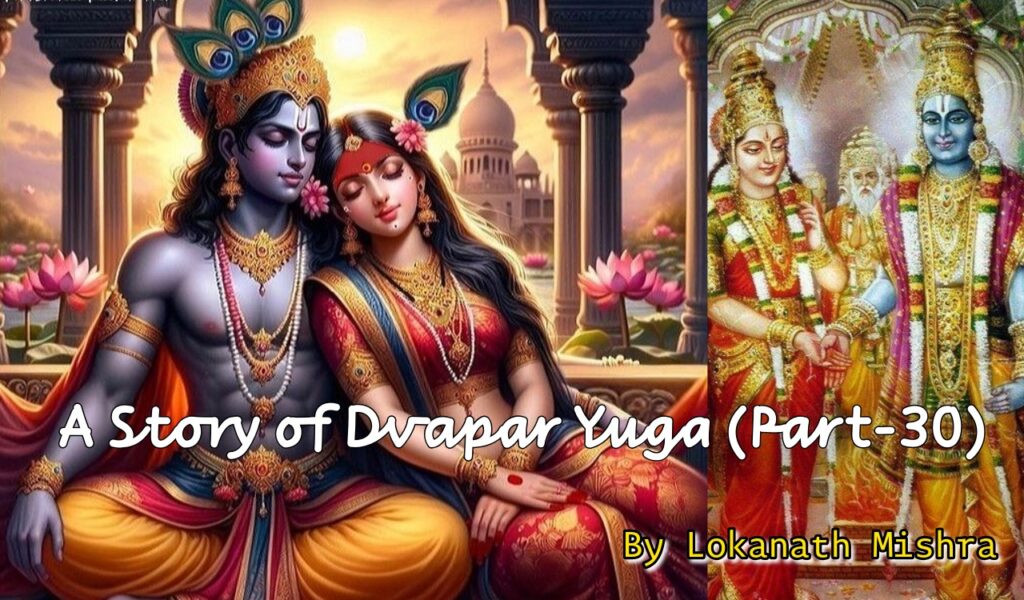
A Story of Dvapar Yuga ( part-30)
By Lokanath Mishra
Pradyumna, Māyāvatī (Rati), and the Fall of Śambara Asura**
In the mysterious nether realm known as Pātāla Purī, beneath the worlds of gods and humans, stood the magnificent palace of the mighty demon king Śambara Asura. Within this palace lived a young prince named Ananga, raised as Śambara’s own son. Ananga had now grown into a radiant youth, blessed with extraordinary beauty, strength, and charm.
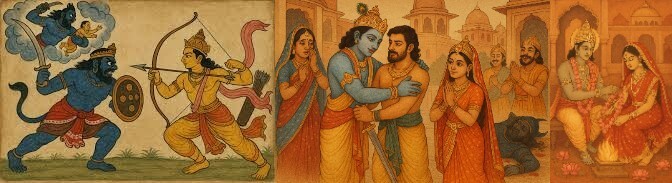
Unknown to the demon king and even to Ananga himself, this youth was none other than Pradyumna, the son of Śrī Kṛṣṇa and Queen Rukmiṇī, and the rebirth of Kāmadeva, the god of love.
Māyāvatī – The Silent Witness of Destiny
From infancy, Ananga had been nurtured by Māyāvatī, the chief attendant of the palace. She had rescued him when he was miraculously discovered alive inside a great fish after being cast into the sea by Śambara Asura.
Though she cared for him with utmost devotion, Māyāvatī forbade the child from calling her “Mother.” She instructed him gently but firmly:
“Do not call me ‘Mother’, my child.
Call me only ‘Māyā’.”
Obediently, Ananga addressed her as “Māyā, Māyā.”
Yet in his heart, he always revered her with the respect due to a mother.
What Ananga did not know was that Māyāvatī was actually Rati, the eternal consort of Kāmadeva. After Kāmadeva had been reduced to ashes by Lord Śiva’s fiery wrath, Rati had lived for ages in sorrow, awaiting the rebirth of her beloved. When she learned through Devarṣi Nārada that Kāmadeva would be reborn as the son of Kṛṣṇa, she took birth as Māyāvatī to reunite with him at the proper time.
Thus, destiny placed husband and wife together—but bound them in the illusion of a mother–son relationship.
The Inner Conflict of Rati
As Ananga entered youth, his divine beauty began to shine forth unmistakably. His form carried the radiance of Kāmadeva himself—well-proportioned limbs, a glowing face, and an aura that stirred the heart.
For Māyāvatī, this became a source of unbearable suffering.
She stood before her long-awaited husband, yet could not embrace him. She served him daily, spoke to him kindly, guided him, and protected him—while suppressing the love that had waited across lifetimes.
Despite her efforts, her inner emotions began to reveal themselves unconsciously—through affectionate glances, tender speech, and unguarded gestures. The discipline of centuries trembled before the power of reunion.
Pradyumna’s Disturbance
Pradyumna was not blind to these changes.
He noticed the unusual warmth in Māyāvatī’s behavior and felt deeply troubled. To him, she was a mother figure. Any suggestion of desire within such a bond appeared unnatural and disturbing.
Gradually, discomfort turned into aversion. His mind recoiled from what he perceived as moral disorder, and resentment began to grow.
One day, Māyāvatī lost all restraint. Overwhelmed by emotion, she tried to express her affection openly. Alarmed and shaken, Pradyumna stepped back in fear and spoke harshly:
“I believed you to be my mother!
But today I see behavior fit for a woman of desire.
This terrifies me.
Tell me—why do you act in this way?”
The Revelation of Truth
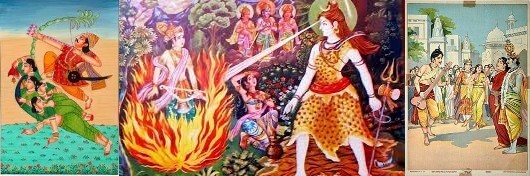
Māyāvatī then spoke the truth that would shatter illusion.
With folded hands and tear-filled eyes, she said:
“You are not my son.
You are my husband.
You are Kāmadeva himself—reborn as Pradyumna.”
She narrated the ancient history:
how Kāmadeva was burned to ashes by Śiva,
how he remained formless as Ananga,
how he was destined to be reborn from Rukmiṇī’s womb,
and how Śambara Asura, fearing prophecy, abducted the infant and cast him into the ocean.
She explained how Nārada had revealed all secrets to her and guided her to protect and train Pradyumna.
Stunned, Pradyumna asked:
“How do you know all this?”
Māyāvatī replied by explaining Nārada’s role in unfolding divine destiny.
She also revealed a grave truth:
“Śambara’s affection for you is false.
He knows his death will come at your hands.
By keeping you close in illusion, he hopes to delay fate.”
Preparation for the Final Battle
Pradyumna hesitated.
“If this is true, how can I raise my weapon against the man who raised me as a father—unless he attacks first?”
Māyāvatī replied calmly:
“That moment will surely come.
But before that, you must master all forms of māyā-warfare.
Śambara remains undefeated because of illusion alone.
Learn from me the science to destroy illusion with truth.”
Accepting her guidance, Pradyumna abandoned all hesitation and trained rigorously. Māyāvatī taught him every mystical art—how to counter invisibility, false forms, fear-creating illusions, and phantom armies.
The Wrath of Śambara
One day, Śambara witnessed Pradyumna and Māyāvatī speaking intimately. Enraged, his jealousy and fear burst forth. Accusing Māyāvatī of betrayal, he attacked her violently and threatened to kill her.
Seeing her being dragged away before his eyes, Pradyumna could no longer remain silent.
He seized his mace and challenged Śambara to battle.
The duel shook Pātāla Purī.
When physical combat failed, Śambara vanished into the sky and attacked invisibly, releasing torrents of arrows. Pradyumna neutralized every illusion effortlessly.
Desperate, Śambara unleashed terrifying beings—demons, serpents, ghosts, and monstrous creatures—by the thousands.
Pradyumna destroyed them all using divine weapons and finally rose into the sky. With a single, decisive strike, he severed Śambara’s head, ending the reign of illusion forever.
Return to Dvārakā
With the demon slain, the righteous minister Bhadrāsura was crowned king of the nether realm.
Pradyumna and Rati then mounted Śambara’s celestial aircraft and flew to Dvārakā.
Their beauty was so extraordinary that the people mistook them for Kṛṣṇa and Rukmiṇī, or even for Indra and Indrāṇī. Only after Nārada’s testimony did the truth emerge.
Pradyumna was reunited with his parents. Rukmiṇī embraced her lost son with tears of joy. With great celebration, Pradyumna and Rati were married, restoring divine harmony.
Dvārakā rejoiced—for love had regained form, truth had conquered illusion, and destiny had fulfilled itself.
⸻
( to be continued)
Pingback: A Story of Dvapar Yuga in Prose (Part-31 A) - UniverseHeaven