
Death Is an Illusion : A Modern Near-Death Experience in the Light of the Bhagavad Gita
By Lokanath Mishra
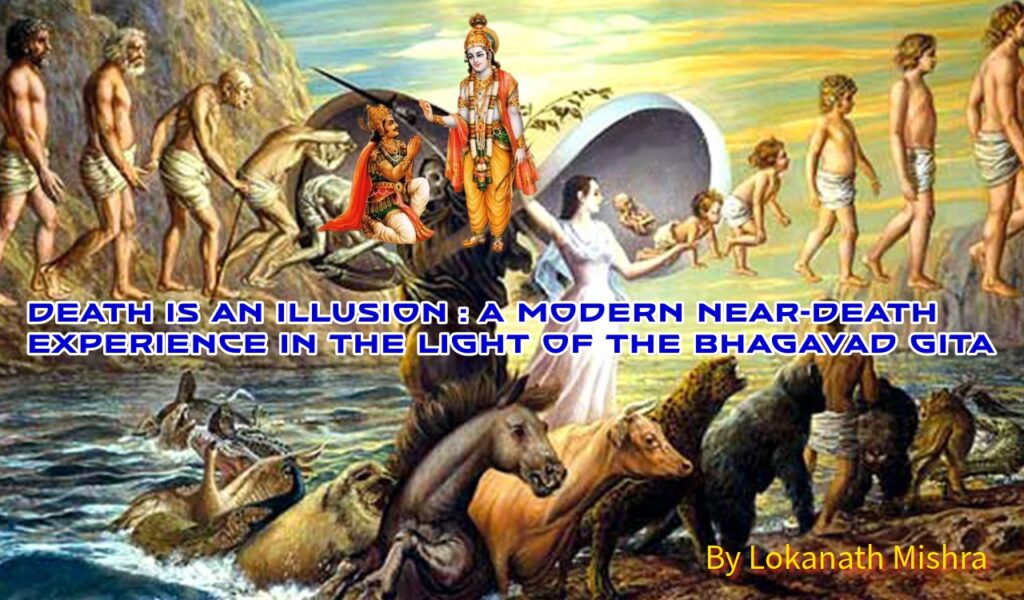
Death has always remained one of humanity’s greatest mysteries. Across civilizations, religions, and philosophies, thinkers have tried to understand what happens when life appears to end. A recent near-death experience (NDE) narrated by Brianna Lafferty, a woman from Colorado, USA, has once again brought this timeless question into global discussion. Interestingly, her experience strongly resonates with the ancient wisdom of the Bhagavad Gita, which proclaimed thousands of years ago that death is not the end of existence, but merely a transition.
A Modern Experience Beyond Death
Brianna Lafferty, who suffered from myoclonus dystonia, was medically declared dead for nearly eight minutes. During this period, her heart stopped, and doctors believed life had ceased. However, what she experienced internally was profoundly different from what medical science defines as death.
She described feeling her spirit rise above her physical body, hearing a voice gently asking, “Are you ready?”, after which everything went dark. Although clinically dead, she states that her consciousness never vanished. Instead of pain or fear, she experienced a deep calm, clarity, and an overwhelming sense of peace. She reported no human form, no bodily limitations, and no suffering—only awareness and serenity.

Her realization was striking:
“Death is an illusion; the soul never dies. Our consciousness always lives, and our true identity simply changes from one form to another.”
This statement mirrors, almost word for word, the core teaching of the Bhagavad Gita.
The Gita’s Teaching on Death and the Soul
In the Bhagavad Gita, Lord Krishna explains to Arjuna the eternal nature of the soul (Ātman). In Chapter 2, Verse 20, Krishna declares:
“The soul is never born, nor does it ever die. It is unborn, eternal, everlasting, and primeval. It is not destroyed when the body is destroyed.”
This verse directly aligns with Brianna’s realization that while the body ceased to function, her awareness remained alive. The Gita clearly separates the physical body, which is temporary, from the soul, which is eternal.
Further, in Chapter 2, Verse 22, Krishna compares death to changing clothes:
“As a person discards worn-out garments and puts on new ones, so the soul abandons old bodies and enters new ones.”
Brianna’s description of losing her human form but remaining conscious strongly reflects this idea—identity does not end; it simply transforms.
Timelessness and the Power of Consciousness
One of the most profound aspects of Brianna’s experience was her sense that time did not exist, yet everything functioned in perfect order. She also stated that thought itself had creative power in that realm.
This aligns with Chapter 8, Verse 6 of the Gita:
“Whatever state of being one remembers at the time of death, that state one attains.”
The Gita emphasizes that consciousness, not the physical brain, determines experience beyond the body. In higher states of existence, thought is instantaneous and reality is shaped by awareness—exactly as Brianna described.
Peace Beyond Pain: A State Described in the Gita
Brianna spoke of a deep, indescribable peace and a divine presence filled with unconditional love. She felt completely alive, free from fear, pain, or anxiety.
The Bhagavad Gita describes such a state in Chapter 6, Verses 20–23, where Krishna explains the joy of transcendental consciousness:
“In that state, one experiences boundless inner joy through spiritual realization. Established in that reality, one never departs from the truth and considers no greater gain beyond it.”
This peace is not dependent on the body or senses—it is the natural state of the soul when freed from material limitations.
Science and the Border Between Life and Death
Modern science is now cautiously exploring what ancient scriptures boldly declared. Studies on near-death experiences suggest that as death approaches, the brain may replay significant life events—often described as life flashing before one’s eyes. Additionally, recent research by scientists from the University of Calgary speaks of Ultra-Weak Photon Emission (UPE)—a faint light emitted by living beings that ceases at death.
While science observes the mechanism, the Gita explains the meaning behind it. The light that disappears from the body is not destroyed; it simply withdraws, just as the soul leaves the physical frame.
Conclusion: Ancient Wisdom, Modern Validation
Brianna Lafferty’s experience does not stand in opposition to science or spirituality—it bridges them. What she experienced intuitively and emotionally was articulated philosophically by the Bhagavad Gita thousands of years ago.
The Gita teaches us that death is not a tragedy, but a transition; not darkness, but transformation. Consciousness does not end with the heartbeat—it transcends it. As Krishna reminded a grieving Arjuna on the battlefield of life, so too does modern experience remind us today:
We are not bodies having a spiritual experience; we are eternal souls temporarily inhabiting bodies.
In this light, death is not something to fear—it is merely a doorway.
Fitment Factor, Pension Revision and Constitutional Mandate : Why the 8th Pay Commission Must Deliver Substantive Justice to Pensioners ?
ବାସି ରଥ