
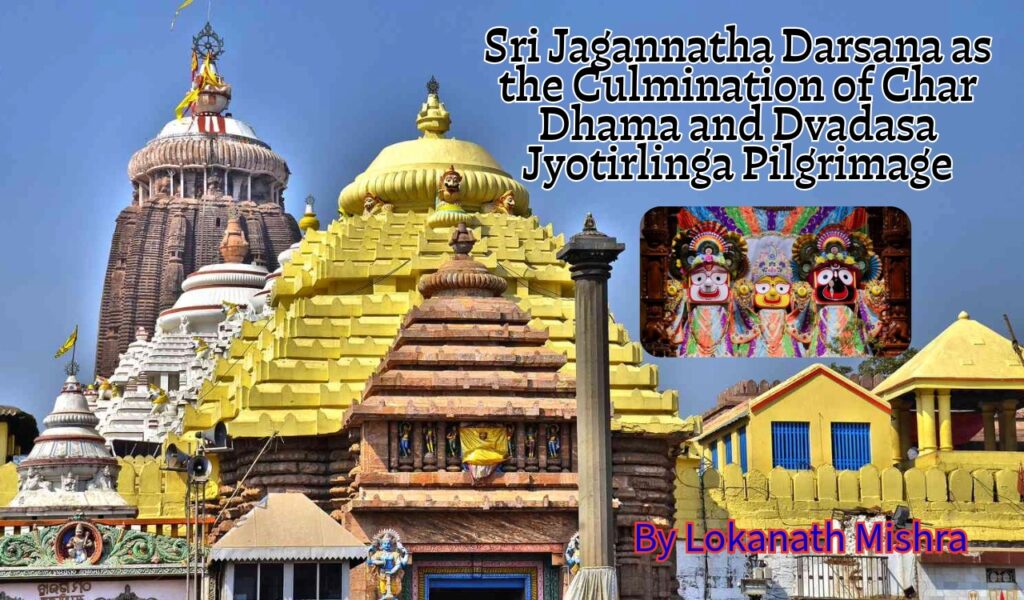
**Sri Jagannatha Darsana as the Culmination of Char Dhama and Dvadasa Jyotirlinga Pilgrimage:
By Lokanath Mishra:
A Puraṇic and Experiential Study**
Abstract
Hindu Puraṇic literature assigns a unique and conclusive role to Sri Jagannatha of Puri (Puruṣottama Kṣetra) in the framework of tirtha-yatra. While the Char Dhama and Dvadasa Jyotirlinga pilgrimages are widely regarded as supreme acts of religious merit, texts—especially the Skanda Puraṇa (Utkala Khaṇḍa)—assert that these pilgrimages attain spiritual completion (purṇata) only after darsana of Lord Jagannatha.
This article presents a documented pilgrimage undertaken in February 2026 and analyzes its ritual sequence—Somnatha Sandhya Arati, Jagannatha darsana, Mahaprasada seva, Brahmaṇa bhojana, and Prasada distribution—in light of authoritative Hindu scriptures and lived religious practice.

- Introduction
The institution of tirtha-yatra occupies a central place in Hindu religious life. The Char Dhama—Badrinatha, Dvaraka, Ramesvaram, and Puri—and the Dvadasa Jyotirlingas are traditionally understood as the highest pilgrimage circuits within Sanatana Dharma. However, Puraṇic literature does not treat these pilgrimages as isolated acts; rather, it presents them as parts of a larger sacred continuum, culminating in Sri Jagannatha darsana.
The Skanda Puraṇa, the most extensive of the Mahapuraṇas, explicitly situates Puruṣottama Kṣetra as the locus where all tirthas converge. This article examines both the textual foundations and the ritual enactment of this belief through a contemporary pilgrimage experience.
- Somnatha Jyotirliṅga and the Commencement of Completion
On 9 February 2026, after witnessing the Sandhya Arati at Somnatha Jyotirliṅga, the pilgrimage covering Char Dhama and Dvadaśa Jyotirliṅga reached its penultimate stage. Somnatha, regarded as the first among the Jyotirliṅgas, symbolizes the eternal witness (adi-sakṣi) of Siva-tattva.
The Siva Purāṇa states:
“सोमनाथः स्वयं शम्भुः साक्षी कालस्य नित्यशः।”
(Siva Puraṇa)
Yet, Vaiṣṇava-Purāṇic tradition emphasizes that Śiva ultimately leads the devotee toward Viṣṇu:
“वैष्णवानां यथा शम्भुः।”
(Padma Puraṇa)
Thus, Somnatha marks not an end, but a transition toward Vaiṣṇava fulfillment, culminating in Jagannatha.

- Puruṣottama Kṣetra in the Skanda Purāṇa
The Skanda Puraṇa (Utkala Khaṇḍa) repeatedly asserts the supremacy of Purī:
“सर्वतीर्थमयं क्षेत्रं पुरुषोत्तमसंञ्ज्ञितम्।”
This declaration establishes Puri as a meta-tīrtha, containing the spiritual potency of all other sacred places. Furthermore:
“चारुधामेषु यत् पुण्यं जगन्नाथे ततः अधिकम्।”
Accordingly, Char Dhama and Jyotirliṅga pilgrimages are considered incomplete without Jagannatha darsana.
- Nīlakaṇṭha Mahādeva and Ritual Entry into the Kṣetra
Upon arrival at Purī late at night, Jalābhiṣeka was performed at Nīlakaṇṭha Mahādeva Temple on the following day. The Skanda Purāṇa identifies Nīlakaṇṭha Śiva as the Kṣetrapāla of Puruṣottama Kṣetra:
“नीलकण्ठः स्वयं शम्भुः क्षेत्रपालो जगन्नृपः।”
This reflects the Purāṇic principle that Śiva grants access to Viṣṇu’s supreme abode, reinforcing the harmony between Śaiva and Vaiṣṇava traditions.
- Darśana of the Chaturdhā Mūrtis and the Theology of Time
Darśana of Śrī Jagannātha, Balabhadra, Subhadrā, and Sudarśana was obtained before the Garbhagṛha at precisely five hours and five minutes.
The Brahma Purāṇa emphasizes the salvific power of timely darśana:
“काले दर्शनमात्रेण मुक्तिः स्यादचिरेण वै।”
Jagannātha is understood as Kāla-svarūpa Brahman, where time, ritual, and grace converge.
- Mahāprasāda, Brāhmaṇa Bhojana, and Ritual Hierarchy
Following darśana, Mahāprasāda was offered with dakṣiṇā to a Brāhmaṇa at Ānanda Bāzār, who completed his bhojana swiftly due to hunger. Only after this did the devotees partake of Mahāprasāda.
The Skanda Purāṇa unequivocally states:
“महाप्रसादं यो विप्राय ददाति श्रद्धयान्वितः
स सर्वपापविनिर्मुक्तो विष्णुलोकं स गच्छति॥”
Feeding a hungry Brāhmaṇa is equated with direct service to Viṣṇu, reinforcing the ethical dimension of Jagannātha worship.

- Baisi Pahācha, Yamashilā, and Liminal Ritual Space
Mahāprasāda was offered at Baisi Pahācha, both before and after Yamashilā, as prescribed in the Skanda Purāṇa:
“बैसी पहीचायां दत्तं पिण्डदानं महाफलम्।”
Yamashilā signifies the end of Yama’s jurisdiction, where Jagannātha’s grace alone governs liberation (mokṣa).
- Prasāda Distribution and Social Extension of Grace
The Skanda Purāṇa further instructs:
“स्वजनानां च मित्राणां प्रसादवितरणं कुर्यात्।”
In compliance with this injunction, Prasāda Seva is scheduled at Siddha Mahāvīra Temple on 22 February 2026, extending Jagannātha’s blessings to friends and relatives and transforming personal pilgrimage into communal dharma.
- Conclusion
This study demonstrates that Śrī Jagannātha darśana functions as the ritual, theological, and experiential completion of Char Dhāma and Dvādaśa Jyotirliṅga pilgrimages. Purāṇic authority, when enacted through lived practice—Mahāprasāda seva, Brāhmaṇa bhojana, and Prasāda distribution—reveals Jagannātha worship as the synthesis of bhakti, karma, and mokṣa.
As the Skanda Purāṇa declares:
“जगन्नाथस्य दर्शनं सर्वधर्मफलप्रदम्।”
The pilgrimage thus culminates not merely in darśana, but in service, sharing, and surrender—the highest ideals of Sanātana Dharma.
Omkareshwar Temple — The Divine Form of Shiva
Gangeshwar Mahadev Temple, Diu : A Sacred Abode of Lord Shiva
A Brief but Memorable Sojourn in Diu
Pingback: Mahabharata : (A Story of the Dvapara Yuga in Prose) - UniverseHeaven Mahabharata Swayamvara Story: Vyasa's Visit & Draupadi's Contest | Part 34