
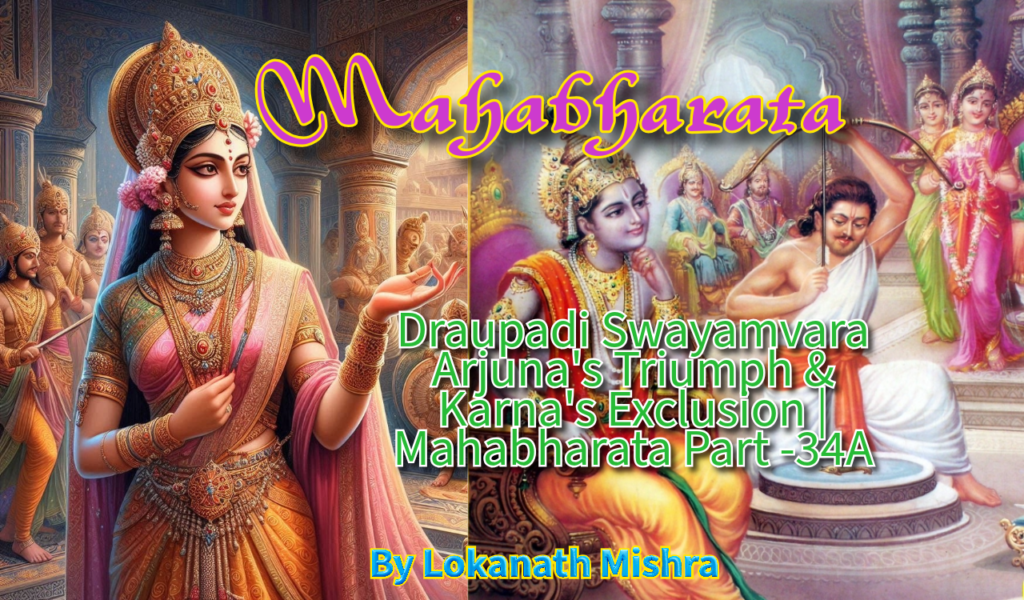
Mahabharata (A Story of the Dvapara Yuga in Prose) Part – 34 A
Draupadi’s Swayamvara : When Destiny Revealed the Hidden Heroes
By Lokanath Mishra
(Based on Sarala Mahabharata and modern critical scholarship)
The Assembly of Kings
The royal court of Panchala shimmered like a celestial arena. Kings from every corner of Bharata-varsha had assembled—mighty conquerors, seasoned warriors, men whose names inspired fear and reverence alike. Thrones of gold and ivory lined the vast hall, while sages, seers, and divine beings occupied seats befitting their spiritual stature.
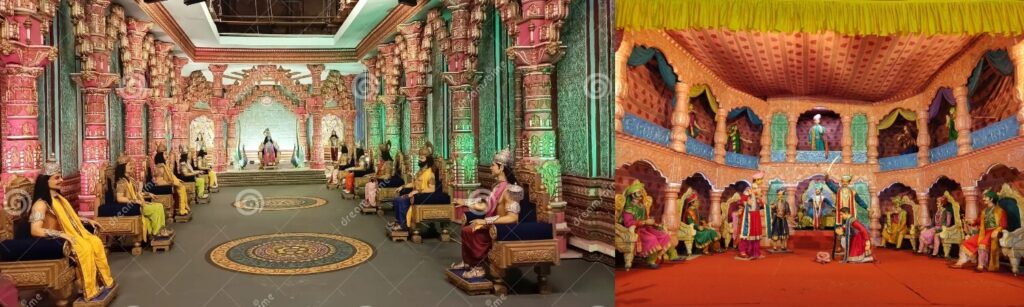
At the center of this grandeur sat King Drupada, grave and resolute. This was no ordinary swayamvara. Though organized for his daughter Draupadi, it was not an occasion of free choice. Instead, it was a test of destiny, concealed beneath the appearance of an archery contest.
Above the assembly hung the challenge.
A massive wheel, armed with countless sharp blades, spun relentlessly in midair. Upon its summit rested a golden fish. Below it, placed on the ground, stood a vessel filled with clear water—its surface trembling, reflecting the spinning fish like an illusion.
Drupada announced the rule:
The archer must stand upon the platform,
string the mighty bow,
look only at the fish’s reflection in the water,
and pierce the left eye of the fish while the wheel continued to spin.
A hush fell over the court.
The Kings Step Forward—and Fall
Jarāsandha of Magadha
The first to rise was Jarāsandha, famed for his colossal strength. He strode forward with confidence, grasped the bow, and attempted to string it. The bow resisted him like a living force. Veins bulged, muscles strained—but the string would not yield.
Murmurs spread through the assembly.
Defeated by the bow itself, Jarāsandha stepped back, humiliated.
Shishupala of Chedi
Shishupala followed, scoffing at the challenge. He managed to string the bow but failed to steady his aim. His arrow flew wide, missing the target entirely. Laughter rippled through the hall, and Shishupala withdrew in rage.
Other Kings
One after another, kings of Anga, Vanga, Kalinga, Avanti, and Sindhu tried their skill.
Some failed to lift the bow.
Some lifted it but could not string it.
Some shot arrows that shattered against the spinning wheel.
With every failure, pride crumbled, and the realization dawned that this contest was not meant for ordinary warriors—even kings.
Karna’s Moment—and His Exclusion
At last, Karna rose.
Silence gripped the hall.
The son of the Sun approached the bow with calm dignity. He lifted it effortlessly. He strung it without strain. The assembly held its breath.
Here, modern critical research offers clarity.
According to the BORI Critical Edition and early manuscript traditions, Draupadi does not insult Karna, nor does she publicly reject him on the basis of caste. That dramatic episode belongs to later retellings and folk traditions.
Instead, what occurred was procedural—and far more tragic.
Before Karna could release the arrow, King Drupada intervened.
The rules of the swayamvara restricted participation to those of established royal lineage. At that moment in history, Karna—despite being a king by valor—was publicly known as the son of a charioteer.
Thus, he was formally barred from completing the attempt.
Karna stood still. His face revealed neither anger nor despair. Slowly, he lowered the bow and returned to his seat in silence.
But in that silence, destiny hardened.
The Unexpected Challenger
After the greatest kings of the age had failed, an astonishing request arose—from the Brahmin section.
A young Brahmin stepped forward.
Protests erupted.
“How can a Brahmin wield weapons?”
“This contest is for kings!”
Yet Drupada, bound by his proclamation, allowed the attempt.
The Brahmin was Arjuna, concealed beneath destiny’s veil.
Arjuna’s Triumph
Arjuna approached the bow.
He lifted it with ease.
He strung it smoothly.
Standing firmly upon the platform, he gazed only into the water. The spinning wheel vanished from his awareness. The reflected fish steadied within his vision.
The arrow flew.
A sharp metallic sound echoed through the hall.
The fish’s left eye shattered.
For a moment, time itself seemed to pause.
Then astonishment swept the assembly like a storm.
Draupadi rose without hesitation and placed the garland around the Brahmin’s neck.
The swayamvara was won.
The Wrath of the Kings
Victory by a Brahmin was unbearable.
Duryodhana rose in fury. Shishupala shouted accusations. Weapons were drawn. The royal court transformed into a battlefield.
“This victory is invalid!”
“A Brahmin cannot claim a Kshatriya bride!”
The attack began.
Bhima and Arjuna Unleash Their Power
Before Draupadi could be harmed, Bhima stepped forward.
With bare hands, he seized charging warriors and hurled them aside like broken reeds. Kings famed for their strength fell helplessly before him.
Beside him stood Arjuna. His arrows flew with flawless precision—disarming, disabling, subduing—never killing, yet utterly decisive.
Together, the brothers repelled the combined assault of enraged kings.
At that moment, Krishna smiled. Balarama watched in thoughtful silence.
The truth was undeniable.
These were no ordinary Brahmins.
Defeated and humiliated, the kings withdrew.
Return to Kunti—and Destiny Speaks
Arjuna returned to the potter’s hut with Draupadi. At the door, he called out,
“Mother, see what we have brought today.”
Without looking up, Kunti replied,
“Share it equally among yourselves.”
The words struck like thunder.
Bound by dharma, the command could not be undone. Thus unfolded the most debated marriage in epic history—Draupadi becoming the wife of all five Pandavas, sanctioned later by Vyasa as divine destiny, rooted in her past birth and cosmic design.
K
Conclusion: A Turning of the Wheel
Draupadi’s swayamvara was not merely a contest of archery.
It was the moment when:
• Exiled princes stepped back into history
• Hidden identities shattered illusions
• Karna’s tragedy deepened
• Bhima’s wrath found its direction
• Arjuna’s destiny was revealed
• And Draupadi became the axis around which the Mahabharata would turn
From this day onward, the path to Kurukshetra was irreversible.
Based on Sarala Mahabharata & Interpreted through modern critical editions and recent scholarly research
( to be continued)!
Mahabharata ( A Story of Dvapar Yuga in Prose) Part 33B
Mahabharata : (A Story of the Dvapara Yuga in Prose)