
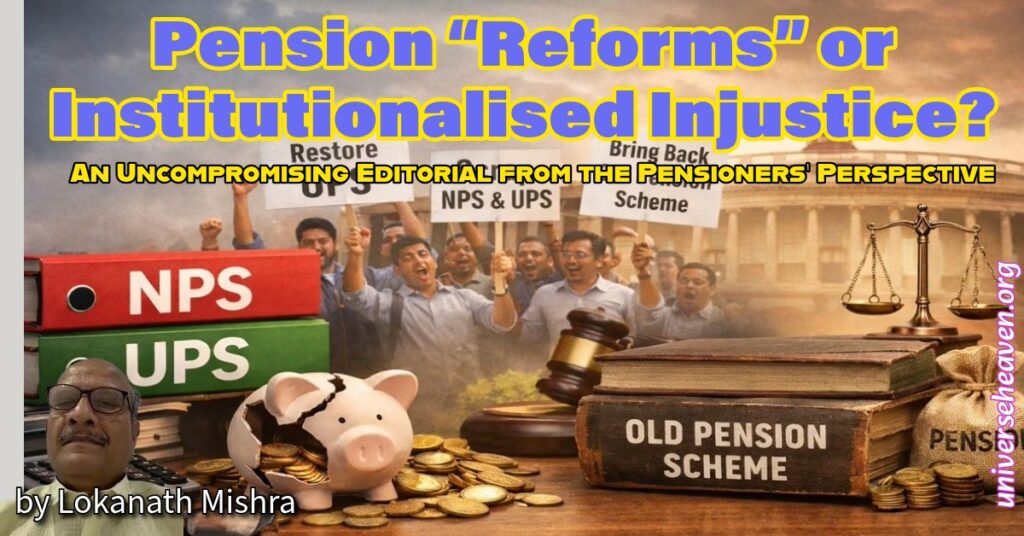
Pension “Reforms” or Institutionalised Injustice? — An Uncompromising Editorial from the Pensioners’ Perspective:
By Lokanath Mishra, The Chief Adviser, The All India Pensioners Association of CBIC:
The latest official narrative branding the transition from the Old Pension Scheme (OPS) to the National Pension System (NPS), and now to the so-called Unified Pension Scheme (UPS), as a “positive update” is not merely misleading—it is deeply insensitive to the lived realities of millions of pensioners.
This is not reform. This is a calibrated withdrawal of responsibility, wrapped in bureaucratic language and presented as progress.
The Blunt Truth: Pension is a Right, Not a Policy Experiment
For decades, the OPS stood as a solemn assurance—a guaranteed, dignified post-retirement life for those who devoted their entire working years to the service of the State.
The shift to NPS shattered that assurance.
• It replaced certainty with speculation
• It replaced dignity with dependence on markets
• It replaced a right with a financial gamble
And now, UPS is being projected as a corrective measure. Pensioners’ associations categorically reject this claim.
UPS is not a solution—it is a strategic distraction.
Validation Clause: Legal Power Without Moral Legitimacy
Perhaps the most disturbing aspect of the government’s approach is its reliance on validation clauses to retrospectively amend pension rules, effectively neutralizing judicial scrutiny and employee protections.
Let it be stated unequivocally:
A government that alters pension rights through validation clauses cannot claim to deliver justice to poor senior citizens.
Such actions raise serious concerns:
• They undermine the rule of law by overriding legitimate expectations
• They erode trust between the State and its employees
• They weaponize legislative power against a vulnerable, aging population
This is not governance. This is institutional coercion disguised as reform.
UPS: A Hollow Construct Without Guarantees
The government claims UPS introduces “defined benefits.” Where are these guarantees?
• No statutory assurance comparable to OPS
• No clarity on inflation indexation
• Continued dependence on market-linked corpus
• Annuity-based payouts subject to external financial institutions
In reality, UPS remains firmly anchored within the NPS architecture, inheriting all its uncertainties.
Calling UPS a defined-benefit scheme is not reform—it is semantic manipulation.
The Fiscal Argument: A Convenient Excuse
The repeated invocation of the Comptroller and Auditor General (CAG) to highlight the “fiscal burden” of OPS is both selective and disingenuous.
Pensioners’ associations strongly contest this narrative:
• Governments routinely absorb massive fiscal expenditures elsewhere without hesitation
• Pension is a predictable, long-term liability—not an unforeseen shock
• The same State that demands sacrifice from retirees shows no comparable restraint in other financial priorities
Fiscal prudence cannot become a pretext for social abdication.
Digitalization: Cosmetic Efficiency, Substantive Neglect
The government highlights digital initiatives—Bhavishya, Digital Life Certificates, online annuities—as evidence of reform.
Let there be no confusion:
Digitization of a flawed system does not make it just.
•   A faster process does not compensate for an inadequate pension
•   Online systems do not eliminate financial insecurity
•   Technology cannot replace guaranteed income
This emphasis on digitalization is a classic case of administrative overreach masking policy failure.
Statistical Claims vs Ground Reality
The data presented in the Rajya Sabha response attempts to paint a reassuring picture.
But pensioners’ associations ask:
• Does “no delay in annuity payment” mean the pension is sufficient?
• Does the small NPS pensioner base validate the system—or simply reflect its infancy?
• Where is the long-term evidence of sustainability and adequacy?
Numbers can be arranged. Hardship cannot be hidden.
Judicial Decisions Must Apply In Rem, Not Selectively
An equally critical issue, often ignored by policymakers, is the non-uniform implementation of judicial decisions in service matters.
Pensioners’ associations assert:
Any court judgment on service or pension matters must be implemented in rem—that is, uniformly applicable to all similarly placed employees and pensioners—not confined only to the petitioners.
Selective implementation:
• Forces similarly placed retirees into avoidable and repetitive litigation
• Creates artificial inequality among identically situated pensioners
• Burdens elderly citizens with legal and financial hardship
A welfare State cannot compel its senior citizens to fight identical battles individually for relief already settled by courts.
The Unmistakable Demand: Restore OPS
Across the country, from grassroots associations to national federations—including the All India Pensioners’ Association of CBIC—the demand is consistent, clear, and uncompromising:
Restore the Old Pension Scheme.
Not modify. Not repackage. Not rebrand.
Restore.
Because:
• Pension is deferred wage
• Pension is social security
• Pension is dignity
Conclusion: A Crisis of Policy and Conscience
The current trajectory of pension policy reveals a troubling reality:
• NPS represents a retreat of the State from its obligations
• UPS is an inadequate and ambiguous compromise
• Validation clauses expose a willingness to override fairness through legal technicalities
Most importantly:
A government that changes the rules after the game has begun, shields those changes through validation clauses, and denies uniform application of judicial relief, forfeits its moral authority to speak of justice—especially to its poorest and most vulnerable senior citizens.
This is not merely a policy disagreement.
This is a question of justice, credibility, and the very character of governance.
Until the guaranteed protections of OPS are restored, these so-called reforms will remain what they truly are:
An institutionalized denial of rightful pension security, imposed upon those who can least afford to fight it.
Sudhakar.Rachapudi999@gmail.com
I totally agree that OPS is the right one wher the senior citizens are happy n living independently without dependency.
“DEPENDENCY IS NOTHING BUT
SLAVERY ~
Sudhakar.Rachapudi999@gmail.com
I totally agree that OPS is the right one wher the senior citizens are happy n living independently without dependency.
“DEPENDENCY IS NOTHING BUT
SLAVERY ~