
A Story of Dvapar Yuga in Prose (Part-27)
By Lokanath Mishra
( Mahabharata)
Parashurama had already resolved to keep his word. There was no room left for reconsideration. He therefore sent Amba to Bhishma, accompanied by his two sons, Neelaram and Raghuram, with explicit instructions that she be married to Bhishma. The two brothers reached Hastinapura, met Bhishma, and conveyed Parashurama’s command:
“O revered one, obeying Parashurama’s order, you must marry this maiden Amba.”
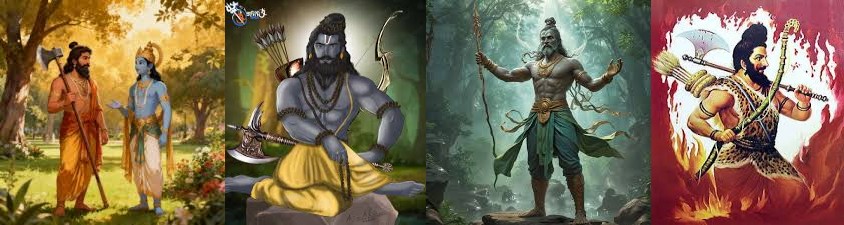
Bhishma replied firmly,
“Has Parashurama not heard of my vow? I have renounced marriage forever. I do not fear Parashurama. Go and tell him that he may marry this maiden to anyone else he chooses.”
Disappointed and crestfallen, the two brothers returned with the sorrow-stricken princess Amba.
Amba wept bitterly, her heart overwhelmed with anguish. When Parashurama learned that his command had been disobeyed, his rage knew no bounds. Assuming a fearsome, destructive form like a blazing inferno, Parashurama marched straight to Bhishma’s hermitage.
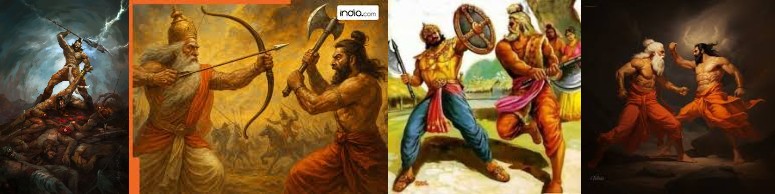
Burning with fury, Parashurama confronted Bhishma:
“By what audacity have you dared to defy my command? I know very well that you yourself abducted this maiden. Now marry her, or be prepared to face the wrath of Parashurama!”
Sage Parashara also warned Bhishma about Parashurama’s unmatched might and advised him to reconsider his decision in view of the grave circumstances. Parashara cautioned:
“Do not provoke him into conflict. Even a mere glance of his anger can sever a head.”
Yet Bhishma remained unmoved, undeterred even before the legendary warrior who had annihilated the Kshatriyas of the earth twenty-one times. Bhishma declared boldly:
“O Parashurama, why should I fear you? What power of yours do you wish to display before me?”
Enraged, Parashurama charged forward wielding his axe. Bhishma rushed at him as well, snatched the axe from his hand, and struck him forcefully. Blood gushed from Parashurama’s nose with a single blow. Sage Parashara intervened at once, stepping between them and restoring calm.
Parashurama then sought forgiveness from Amba and urged her to return to her father’s kingdom. But within Amba’s heart, waves of despair and torment surged violently. How could she return to her parental home in disgrace? Even her tears had dried up—she no longer had the strength to weep. In place of sorrow, a terrifying desire for vengeance took root within her.
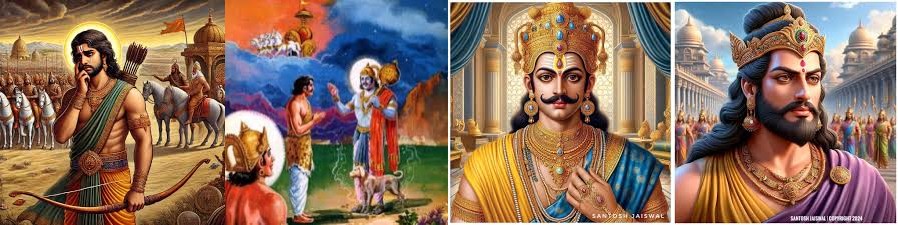
She went to the sacred confluence at Triveni (Prayag), bathed in the holy waters, and worshipped Lord Madhava (Krishna). With folded hands, she prayed:
“If you truly are the remover of the world’s sorrows,
If you truly grant the deepest desires of the heart,
Then in my next birth, let my vow of vengeance be fulfilled.”
She proclaimed her terrible resolve:
“Let the sin of Bhishma’s death fall upon me.
I cast this body away, bearing witness before the guardians of all directions.
I am but a woman, not a warrior—
How else could I defeat Bhishma across lifetimes?
Such is his pride in his strength and virtue—
Let my very form in the next birth cause Ganga’s son to drop his weapons.”
She prayed further:
“In my next birth, let it be so that merely upon seeing me, all of Bhishma’s power fades, and he becomes incapable of lifting arms.”
Having spoken these words, Amba immersed herself in the waters at Prayag and ended her life.
Later, Ambika and Ambalika were married to King Vichitravirya. In due course, Ambika gave birth to Dhritarashtra, Ambalika to Pandu, and from Ambika’s maidservant was born Vidura.
Bhishma himself took responsibility for imparting knowledge of scriptures and warfare to Dhritarashtra, Pandu, and Vidura. When they reached maturity, the question arose as to who should ascend the throne of Hastinapura. Although Dhritarashtra was the eldest, he was blind, and therefore Pandu was declared king.
Later events—how Pandu, sensing his brother’s dissatisfaction and ambition for the throne, chose exile—have already been described earlier.
Transition to the Hastinapura Episode:
Now let us return to the earlier times of Hastinapura.
Dhritarashtra requested the Pandavas to reside in Indraprastha. Yudhishthira, the eldest, obeyed his uncle’s command and lived there with his mother and brothers. At that time, no final decision had yet been made regarding the rightful claimant to the throne of Hastinapura.
Elders and wise men like Bhishma, Vidura, and Bhurishrava considered Yudhishthira to be the most deserving. The arrogance and insolence of Duryodhana had earned him little support from the people. Meanwhile, Shakuni had already assumed the role of chief minister of Hastinapura.
Shakuni’s foremost objective was to secure the throne for Duryodhana—completely and without obstacles. His very first scheme was ruthless: if necessary, the Pandavas must be eliminated.
The Conspiracy Begins:
It was past midnight. In a private chamber, Duryodhana, Dushasana, and Shakuni were deep in secret deliberations. A guard brought in a Brahmin and shut the door behind him.
Shakuni introduced him:
“This is Purochana Pandit. He lives outside the city, and no one in the capital knows him. He is not merely a skilled cook but also possesses extraordinary expertise in construction.”
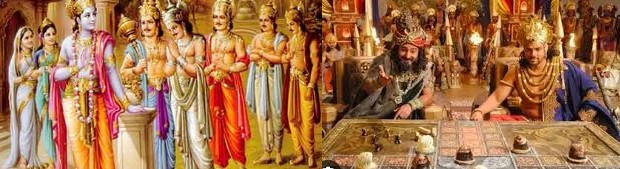
Offering him a seat, Shakuni said,
“Sit, Purochana. We have been expecting you. Tell us—what plan have you devised?”
Purochana sat cautiously and replied:
“I do not know how much you already know about me. First, assure me of my safety. Then you shall witness my abilities. I can kill a man without effort, wipe out an entire family on command, and with your permission, destroy a whole village within a single watch of the night.”
Dushasana laughed mockingly:
“It seems exaggeration is your nature. Speak within your limits. Have you ever seen Bhima?”
Purochana answered calmly:
“Forgive me—am I to fight him directly? Tell me plainly what you want. One man, or the entire family?”
Duryodhana growled:
“Uncle, to be honest, I wish I could see the corpse of that foolish giant right now!”
Shakuni interrupted:
“No, O jewel of the Kuru clan. If Bhima alone dies, sympathy will flow toward Yudhishthira. Wisdom lies in sending all of them across at once. Purochana, reveal your plan. Remember—their deaths must appear accidental. And if you are caught, you alone will bear the blame. If you ever reveal our involvement, your family will not even receive your body for last rites.”
Purochana replied:
“I have a method to kill them all together. A house must be built using lac, ghee, dry straw, and animal fat—materials that ignite instantly. First, these must be secretly collected and stored at a deserted location. Provide me with loyal laborers and an isolated site.”
After much discussion, it was decided that the house of lac would be built at Varanavata. Purochana would stay in Hastinapura for a few days to arrange materials and labor, under the guise of being appointed as a royal cook.
The very next morning, Purochana assumed his duties in the royal kitchen.
The Poisoning of Bhima:
At Indraprastha, the Pandavas frequently went hunting. One day, they brought back a slain rhinoceros. Yudhishthira said to Bhima:
“Brother, take this rare delicacy to Hastinapura and present it to Dhritarashtra.”
Despite his reluctance, Bhima entered Hastinapura with the heavy carcass carried by two attendants.
Sanjaya and Vidura informed Dhritarashtra:
“Yudhishthira has sent this as a token of love and devotion. Bhimasena offers his salutations.”
Dhritarashtra summoned Duryodhana and said:
“Son, Vrikodara has brought a rhinoceros. Take him with you. Today we shall feast together in the pleasure garden by the Yamuna.”
Duryodhana’s eyes gleamed—opportunity had arrived unbidden. Embracing Bhima, he took him to his chambers and instructed Purochana to prepare lavish dishes and sweets for the garden feast, deliberately saying aloud:
“My brother Bhimasena has come. He loves sweets. Prepare them exceptionally well.”
That hint was sufficient for Purochana.
The feast was prepared on time. Duryodhana showed unusual affection, seating Bhima beside him, with Dushasana on the other side. Unknown to Bhima, deadly poison had been mixed into the sweets and drinks prepared exclusively for him.
Bhima devoured everything with gusto, unaware that no one else was being served the same dishes. He drank the poisoned beverage eagerly and lay back contentedly, rubbing his stomach.
But soon the lethal poison began its work.
His body weakened rapidly. Foam mixed with venom flowed from his mouth. His speech became incoherent, his eyelids drooped, his skin turned blue, and within moments, the mighty Bhima collapsed unconscious.
Feigning laughter, Duryodhana said loudly:
“Bhima has eaten so much that he has fallen asleep! Take him to his chamber.”
Under Duryodhana’s orders, Dushasana and his brothers hid Bhima’s body until nightfall. Later, following Shakuni’s advice, they carried the unconscious body to a secluded ghat on the Yamuna and cast it into the deep waters.
Unbeknownst to them, powerful serpent maidens dwelled beneath those waters—thus setting the stage for Bhima’s survival and destiny yet to unfold.
( to be continued)