
A Story of Dvapar Yuga in Prose (Part-12 E)
By Lokanath Mishra
The Divine Sports of Krishna with the Gopis
Krishna Chandra used to perform various kinds of divine sports (līlās) with the Gopis.
He would engage them in different ways, bewildering and delighting them through his playful tricks.
Every day he discovered new means to tease the cowherd maidens.
In such mischief, the Gopis too found hidden joy.

The days of stealing butter had long passed — now Gopinath stole hearts instead.
Pointing toward the dark-hued Shyama, one friend would whisper to another:
“Look, dear companion, that flute-player! Is he not the thief of our hearts and minds, the wish-fulfilling gem himself?”
The chief weapon of this stealer of hearts was his enchanting flute.
According to the Harivamsha,
“Brahma had given him a wondrous flute, blessed with the sound of nectar.”
Hearing that melody, the Gopis would lose their composure and cry out,
“Who plays such divine notes that the very Kadamba forest seems to tremble in joy?”
The main place of the Rasa-leela was a grove adorned with many flowering trees and fruit-laden vines.
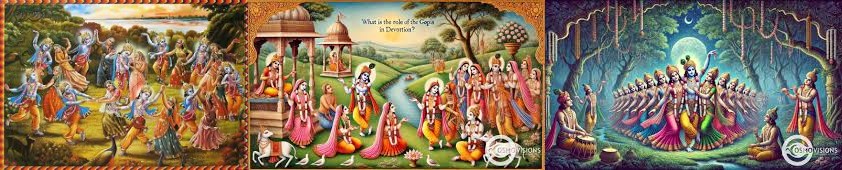
That day, Shyamasundar was instructing his father Nanda in matters of politics.
He said,
“Father, it has been decided that you must pay King Kamsa an annual tax of one lakh gold coins.
But our income is limited.
By selling curd, milk, and ghee, how much can we possibly earn?
The taxes we collect from the cowherds are not sufficient.
If we make use of the three ferry ghats along the Yamuna and levy a toll upon the goods carried by the Gopis and Gopas traveling to Mathura,
our royal treasury will flourish.”
How could simple-hearted Nanda understand such cunning reasoning?
He agreed.
At the main ghat where the Gopis would pass, Shri Krishna himself took charge of collecting the toll.
Thus, the Gopis became the victims of Krishna’s so-called official oppression.
The dark-blue Shyama would insist mischievously,
“Pay this much tax for that, and that much for this!”
Fearing that the curd might turn sour if they delayed too long in argument,
the Gopis submitted to whatever Krishna demanded.
Returning from Mathura, they would again pay the promised toll at the ghat.
Their boat would carry them across the Yamuna, drifting into a secluded place —
and there, the divine couple, Srimati and Sripati, would engage in their pastimes, unbounded in joy.
Sometimes Krishna would make Radha taste the sweetness of separation,
and at times, Radha too would make Krishna feel the same.
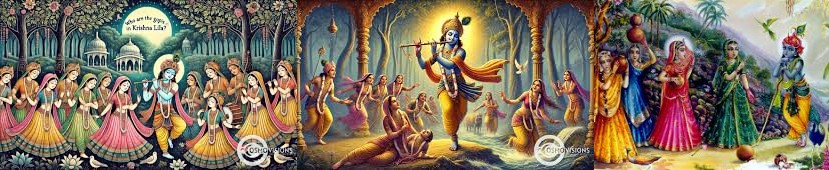
At the ferry ghat, Srimati Radharani also fell victim to Kanha’s playful torment.
Finding her alone, Krishna would seize the end of her garment and prevent her from passing.
Radha would protest, saying:
“When you set up your toll booth,
I shall pay you with affection, O precious one — now release me!
I am the daughter-in-law of King Vrishabhanu —
do you think I am like the others?
You clutch my scarf and make mischief —
have you no fear of scandal?
At home I have a cruel sister-in-law and a harsh mother-in-law!
O lifter of Govardhan, do not behave like a robber —
I shall not come this way again!
And if I do, never again will I make this mistake —
next time I shall bring all my friends along!”
Yet, despite such humble pleading, could that playful prince ever let her go easily?
The talk of Radha and Krishna’s Rasa-leela spread throughout Vrindavan.
Chandrasena’s mother Jatila and her sister Kutila left no opportunity to slander Radha.
Even the other Gopis, though themselves immersed in the same divine love,
spread such tales out of envy.
In truth, they only gave form to their own jealousy.
Many Gopis and Gopas would sit waiting along the path by which Radha went to the Yamuna,
watching for her with curious eyes.
At last, Radha stopped going to the river altogether.
One day, as usual, her friends came to call her to the Yamuna,
but Radha said,
“No, dear companions, do not ask me to go to the Yamuna anymore.
That mischievous Shyama tormented me so much there!
I can no longer endure the words and taunts along the path.”
Lalita said, “Will you not even go to bathe?
You must go to the Mathura market someday — he will be sitting there on his boat.
What will you do then? Come now, enough excuses — let us go!”
Radha replied,
“Ah, friend, why should only Radha be branded unchaste when everyone else goes to the Yamuna?
Listen — yesterday, when I went with my water pot,
just as I reached the edge of the village,
I saw him!
My eyes fell upon his peacock plume shining in the sunlight —
I turned and fled, yet could I truly escape?
‘Just one glance, dear friend, just one glance…
And all of Braj Bazaar began to buzz with gossip —
I looked but once!’
Truly, had that dark Kanhaiya caught hold of me,
who knows what might have happened!
‘I dared not go near that sleek, dark moon —
I merely looked, dear friend, only once!’
In this Braj, are there not enough liars and tale-bearers?
Someone might go and tell King Kamsa falsehoods —
and he would send soldiers to punish me!
‘If Kamsa’s officers come,
will they not punish even the innocent, dear friend — though I merely looked once?’”
Lalita turned to Vishakha and said, “Come, friend, she will not come today.”
But just then, from afar, drifted the tender, honey-sweet melody of Mohan’s flute.
Radha smiled faintly and said,
“If you all insist so much, then very well — just for today, I shall go.”
She went inside to fetch her water pot,
while Lalita, Vishakha, and the other companions exchanged glances, their eyes sparkling with delight.
( to be continued)