
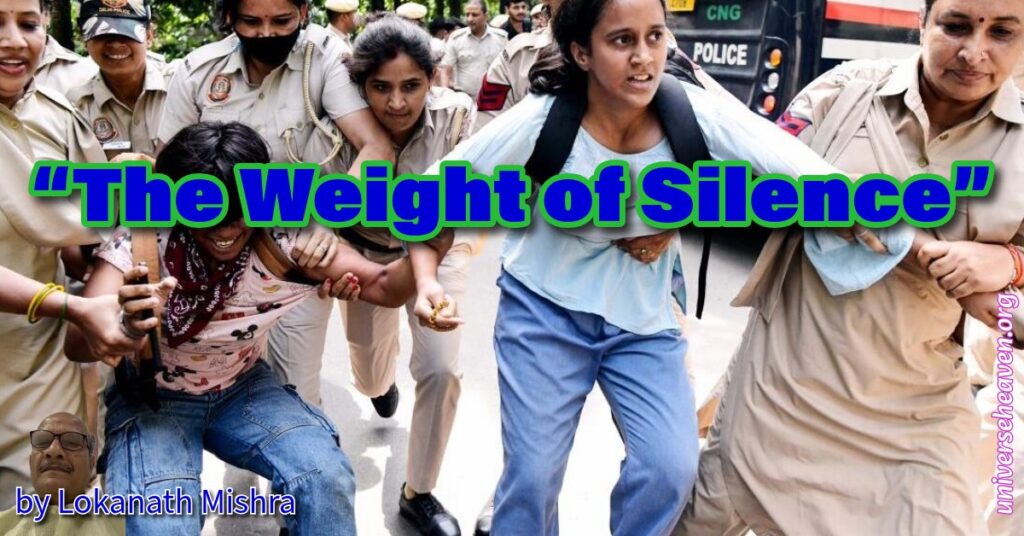
“The Weight of Silence”
By Lokanath Mishra
The day Aarav Sen stopped believing in fairness was not the day he was arrested.
It was the day he realized no one wanted to listen.
Aarav was a third-year engineering student at Meridian Institute of Technology in Jaipur. He wasn’t a topper, not a rebel either—just someone who loved circuits, played late-night football in the hostel grounds, and laughed too loudly at bad jokes.

For five months, his world had quietly revolved around one person—Riya Malhotra.
They had become friends the way most college students do: shared assignments, endless chai breaks, late-night chats about exams, fears, and future plans. There was nothing dramatic, nothing scandalous. Just companionship.
Until one day, without warning, Riya stopped replying.
No explanation. No closure.
Aarav stared at his phone for days, re-reading their last conversation, trying to find where things had gone wrong.
He sent a message:
“Did I do something?”
No reply.
Another:
“At least tell me if you’re okay.”
Still nothing.
After a week, he stopped trying.
Or at least, he tried to stop trying.

A month later, whispers began.
At first, they were faint—two girls whispering in the corridor, a group of boys going silent when Aarav entered the lab.
Then came the stares.
Then the accusations.
“Aarav sends obscene messages.”
“He calls her repeatedly.”
“He threatened her.”
Each rumor hit harder than the last.
Aarav brushed it off initially. “People exaggerate,” he told his roommate, Kunal.
But then the Head of Department called him.

The faculty chamber felt suffocating.
Riya sat in one corner, her eyes lowered. Her parents stood beside her, their faces filled with anger. The Head of Department and the disciplinary committee had already formed their opinion.
“Aarav,” the HOD said sternly, “we have received serious complaints against you.”
“Sir, what complaints?” Aarav asked, his voice steady but his hands trembling.
“Harassment. Threats. Obscene letters and messages.”
Aarav blinked. “That’s not true.”
Riya’s father threw a stack of printed letters on the table.
“Read them!”
Aarav picked one up.
The handwriting looked strangely familiar—but the words were vile. Filthy. Violent.
His stomach twisted.
“I didn’t write this,” he whispered.
“Enough,” the HOD snapped. “We will not tolerate such behavior in this institution.”
“No inquiry?” Aarav asked, his voice cracking. “No verification? Just like that?”
“You will sign a written confession,” the HOD said coldly. “Or face suspension and further action.”
“I won’t confess to something I didn’t do.”
That was the moment everything collapsed.
By evening, Aarav was suspended from the institute.
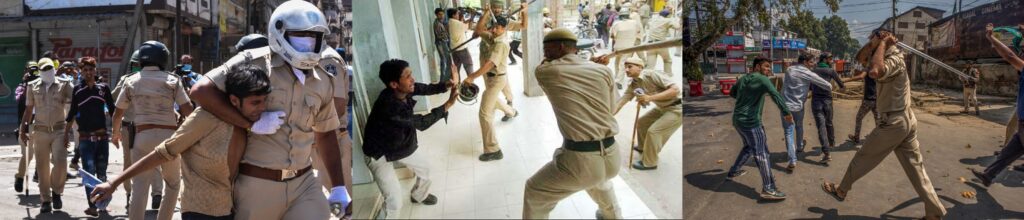
The police came the next day.
They didn’t ask questions.
They didn’t listen.
They took him.
At the station, the air smelled of sweat and judgment.
“So,” the officer said, leaning back, “you think you’re innocent?”
“I didn’t do anything,” Aarav replied.
A slap came before he could finish.
“You boys always say that.”
Another officer threw the letters on the table. “Explain these.”
“I didn’t write them!”
“You expect us to believe that?”
Hours blurred into insults, threats, and humiliation.
By night, Aarav understood something terrifying:
Truth didn’t matter.
Narrative did.
And his had already been written.
The charges were severe.
Under laws meant to protect, he was already condemned.
His parents rushed from lawyer to lawyer, their savings draining faster than hope.
Relatives advised silence.
“Don’t fight too much.”
“Think about your career.”
“Settle the matter quietly.”
But what career?
Aarav’s name had already been stained.

After weeks, he got bail.
He returned home, but not to normalcy.
His hostel room was gone.
His friends were distant.
His world had shrunk into silence.
Sleep became an enemy.
Every night replayed the same question:
Why?

One evening, Aarav recorded a video.
Not out of courage.
Out of desperation.
He sat in front of his phone, eyes hollow but voice firm.
“I didn’t do this,” he said. “I don’t know why I’m being accused. But I want the truth to come out.”
He uploaded it.
At first, nothing happened.
Then slowly, people began watching.
Some believed him.
Most didn’t.
But the silence cracked.
Meanwhile, something strange was happening.
Letters were still arriving at Riya’s home.
Even after Aarav’s arrest.
Even after he had briefly left the city.
Even when he had no way of sending them.
The police noticed inconsistencies.
Patterns that didn’t fit.
Handwriting that felt… too consistent.
Too familiar.
Surveillance was placed.
Days passed.
Letters arrived.
But no one delivered them.
That was the first crack.
Forensic analysis followed.
Dozens of letters.
Compared against Riya’s college assignments.
Stroke by stroke.
Curve by curve.
The truth, when it emerged, was not dramatic.
It was quiet.
And devastating.
Riya had written them.
All of them.

During questioning, her composure broke.
The story unraveled.
It wasn’t hatred.
It wasn’t revenge in the usual sense.
It was something smaller.
Something more human.
And more dangerous.
Jealousy.
After blocking Aarav, she had seen him talking to another girl in the campus café.
That was enough.
Anger turned into impulse.
Impulse into a plan.
A plan into a lie.
And the lie… into a storm that swallowed everything.
“I just wanted to scare him,” she said.
But fear had already changed sides.
When the truth came out, reactions were complicated.
Some were shocked.
Some stayed silent.
Some moved on quickly.
But for Aarav, nothing went back.
Not really.

The institute never publicly apologized.
The authorities never admitted their mistakes.
The same corridors that once echoed with laughter now felt like strangers.
And society?
It simply found a new story.
Months later, Aarav stood outside the closed gates of the campus.
Kunal stood beside him.
“It’s over,” Kunal said quietly.
Aarav shook his head.
“No,” he replied. “It’s not.”
“What do you mean?”
Aarav looked at the building.
“I was innocent,” he said. “But I had to prove it.”
He paused.
“And even after proving it… people still doubt.”
The silence was heavy.
“Do you hate her?” Kunal asked.
Aarav thought for a long moment.
“I don’t know,” he said finally. “But I hate how easily truth was ignored.”
That night, Aarav wrote in his notebook:
“Justice is not just about finding the truth.”
“It is about how many lives are broken before the truth is found.”
And somewhere in the same city, Riya sat alone.
Not as a victim.
Not as a villain.
But as a reminder.
That sometimes, the most dangerous lies…
are the ones people are ready to believe.
End.