
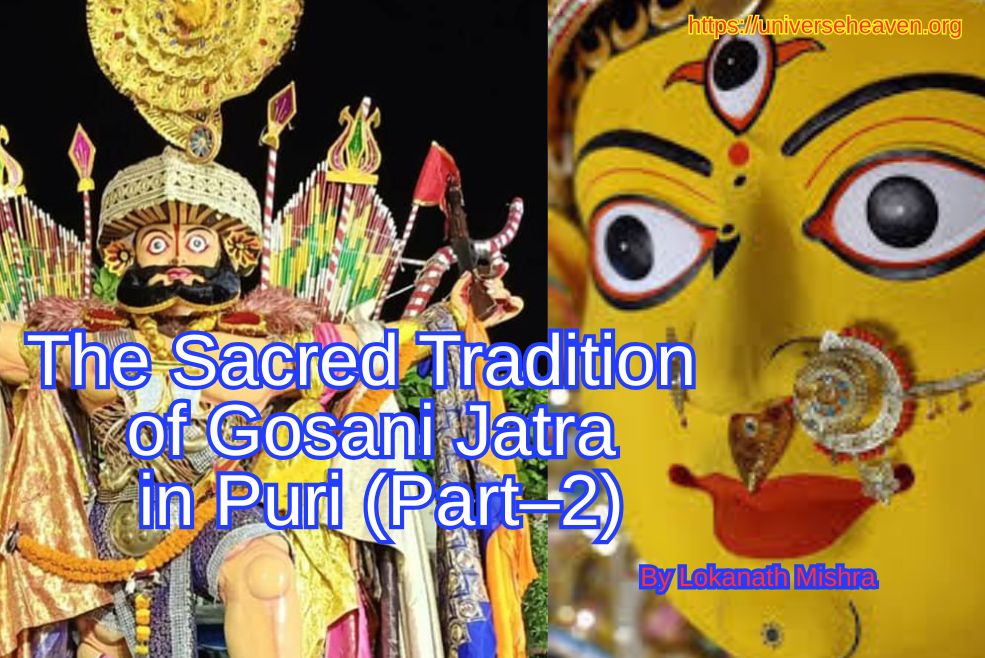
The Sacred Tradition of Gosani Jatra in Puri (Part–2)
By Lokanath Mishra
Sampati Tradition
At Markandeswar Sahi, the ritual worship of Sampati, along with his Banara Sena (monkey army), is carried out in the Panda Jega. This tradition carries echoes of the Ramayana, where Sampati, the elder brother of Jatayu, aids Lord Rama in his quest.
In the Gosani Jatra, the clay images of Sampati and his army are worshipped alongside the Gosanis, reinforcing the theme of divine allies who protect dharma. The presence of Sampati in the Durga Puja context beautifully merges the Vaishnava narrative of Rama with the Shakta worship of the Goddess, symbolizing that all divine forces unite in the eternal struggle against adharma (evil).

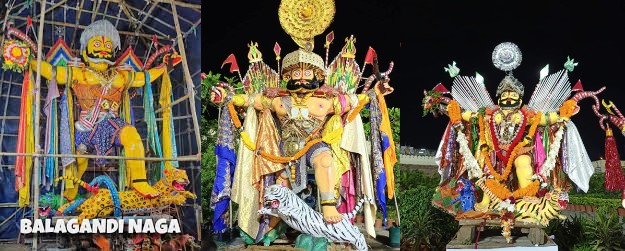
Nāga Medha Tradition
One of the most distinctive features of Puri’s ritual life is the Nāga Medha, which exists in two parallel forms —
• as a dance tradition in the Sahi Yatra (celebrated in Chaitra, after Rama Navami), and
• as clay idols worshipped during the Gosani Jatra in Ashwin.

This dual expression makes it unique to Puri.
• During Sahi Yatra (Chaitra): Nāga Medha performers wear tall wooden or bamboo headgear painted with serpentine designs, decorated with colored paper and ornaments. They dance through the streets to the beats of mridanga, jhanja, and the conch. Their vigorous movements, spins, and leaps make the serpent motifs appear alive, dramatizing the fierce power of the serpent as a protector of the Goddess. Alongside them, Devi Medha dancers also perform, enacting the martial valor of Shakti’s companions.
• During Gosani Jatra (Ashwin): The Nāga takes a different form. Instead of dancers, clay statues of Nāga Medha are sculpted and worshipped. These idols, decorated with traditional ornaments, stand in the sahis beside the Gosani idols, reminding devotees of the martial and protective aspects of Shakti that had earlier been performed through the Sahi Yatra dances.
Spiritually, the Nāga Medha represents protection, renewal, and martial preparedness. Serpents (nāga) are ancient symbols of divine guardianship in Indian tradition — protectors of treasures, rivers, and cosmic energy. In Puri, their presence in both the Chaitra Sahi Yatra and the Ashwin Gosani Jatra demonstrates how seasonal festivals are interlinked, weaving a continuous cycle of devotion throughout the year
Budha-Budhi Dance (Cartoon Dance)

If the Nāga Medha expresses ferocity, the Budha-Budhi Nacha adds humor and humanity to the Gosani Jatra.
• Performers don large, exaggerated masks of an old man (Budha) and old woman (Budhi), with wide eyes, long noses, and playful toothless smiles.
• To the rhythm of drums, they dance, quarrel, joke, and act out witty skits. Their exaggerated gestures and comic dialogues make the audience laugh, creating a lighthearted atmosphere amidst the grandeur of the Goddess worship.
• Beyond entertainment, the Budha-Budhi embody a deeper meaning. They represent the ordinary folk — the aged villagers, the householders, the human side of society that coexists with the divine. Their presence reminds devotees that festivals are not only for gods, kings, and priests but also for common people.
Spiritually, the Budha-Budhi performance grounds the divine in the everyday, showing that laughter, simplicity, and human relationships also have a sacred place in the cosmic order.
Unity of Folk and Divine
Together, the traditions of Sampati, Nāga Medha, and Budha-Budhi Nacha add a folk dimension to the otherwise solemn worship of the Gosanis. They show that the Gosani Jatra is not just about clay idols or rituals, but about an entire cultural ecosystem where:
• Martial valor (Nāga and Devi Medha) expresses Shakti’s warrior aspect.
• Mythic allies (Sampati and Banara Sena) connect the Shakta festival with Ramayana’s Vaishnava narrative.
• Humor and humanity (Budha-Budhi dance) bring balance and joy to the celebration.
Thus, the Gosani Jatra becomes a living synthesis of Shakti devotion, folk culture, and social participation. It reminds devotees that the Goddess is present not only in the temple and sacred clay forms but also in the rhythms of dance, the laughter of villagers, and the unity of community life.
✨ In this way, the Gosani Jatra of Puri reflects the cosmic completeness of devotion — fierce and gentle, sacred and playful, divine and human — all woven into one tapestry of faith.
( to be continued)
Lakshmi Puja and the Grandeur of Gajalaxmi Puja in Dhenkanal
The Sacred Tradition of Gosani Jatra in Puri (Part 1)
ହବିଷିଆଳୀ ବ୍ରତ
Pingback: The Sacred Tradition of Gosani Jatra in Puri (Part–3) - UniverseHeaven