
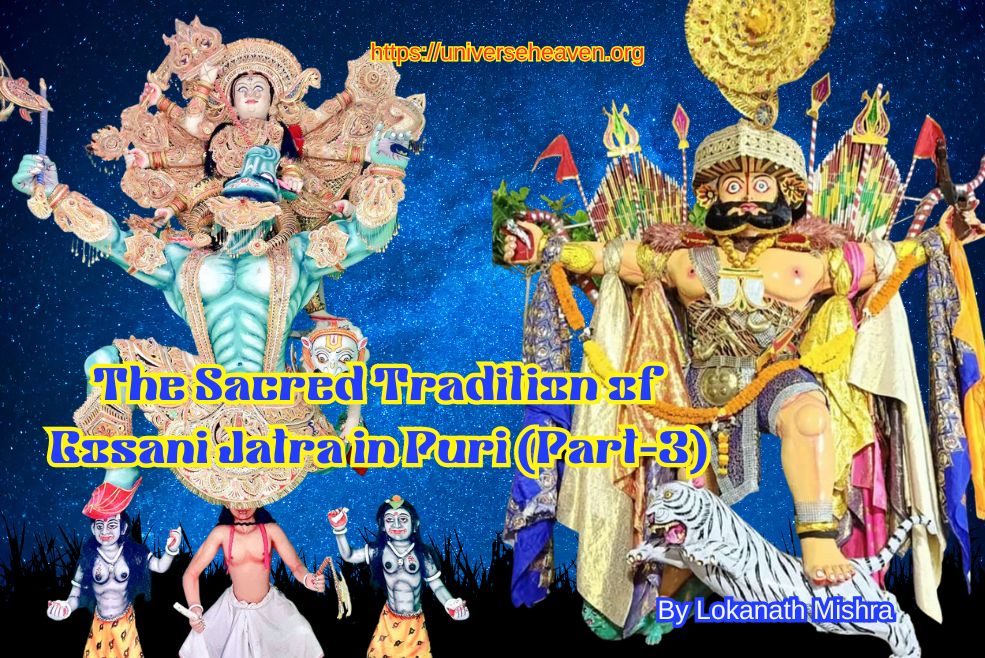
The Sacred Tradition of Gosani Jatra in Puri (Part–3)
By Lokanath Mishra
Other Prominent Gosanis
Alongside Kakudikhai, Barabati, Jahnikhai, Shunya, and Kantakadhi, several other Gosanis hold deep spiritual importance:
Maa Panapriya Gosani (Baseli Sahi)
• Sculpted originally by the one-eyed artisan Kanapuria, she is worshipped with great devotion.
• The Goddess holds Mahishasura by the ear, while her lion bites his thigh — a vivid portrayal of dharma overpowering evil.
• Special offerings include pana bhoga (sweet beverage), which gave her the affectionate name Panapriya (“beloved of pana”).
• Before immersion, she receives khandua cloth from the Jagannath Temple — symbolizing her acceptance into the Jagannath cult.

Maa Bhogajaga Gosani (Near Jagannath Temple)
• Closely linked with the Bhogmandap of Jagannath, her idol is about 10 feet tall.
• She stands majestic on her lion, pressing Mahishasura down with divine ease.
• She is offered temple prasada and is adorned with Jagannath’s own armlets (bahuti).
• Her worship signifies the sharing of Jagannath’s bhoga with Shakti, highlighting the unity of Vaishnavism and Shaktism in Puri.
Maa Chakrakoti Gosani (Harachandi Sahi)
• Said to have been introduced by the Queen of Cooch Behar, her worship blends royal patronage with local tradition.
• Dark-faced, eight-armed, and terrifyingly beautiful, she represents the Kali aspect of Durga.
• Her immersion on Ekadashi is preceded by offerings of Jagannath’s prasada and sacred khandua, signifying her inseparable connection to the Lord.
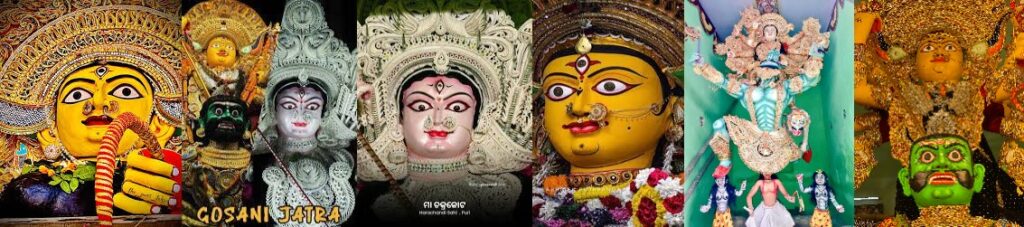
Maa Goudabada Sahi Gosani:
• A relatively less-known Gosani, but one of deep local reverence.
• Her idol embodies youthful energy (bala) and feminine grace, hence the affectionate name Gelabai.
• People believe she protects households and children from illness.
• Gelabai’s worship emphasizes the domestic and nurturing role of the Mother Goddess within community life.
Maa Guida Sahi Gosani:
• Worshipped in Guida Sahi, she is remembered as a fierce guardian deity.
• Her rituals are accompanied by traditional mridanga and ghanta recitations, blending martial ferocity with devotional fervor.
• Locals regard her as a protectress of cattle and fields, tying her identity to agrarian prosperity.
The Grand Gathering of the Gosanis
On Ekadashi tithi after Vijaya Dashami, Puri witnesses one of its most enchanting spectacles: the Maha Milana of the Gosanis.
From every sahi (locality), the clay idols of the Gosanis — fierce, beautiful, and richly adorned — are brought in colorful processions to the Bada Danda (Grand Road), the sacred path where Lord Jagannath Himself travels during the Rath Yatra.
The Gosanis assemble either before the Lion’s Gate (Singhadwara) of the Jagannath Temple or at Saradhabali Maidan. For devotees, it is a rare moment of sarva-devi darshan — a vision of all forms of the Goddess in one place.
As conch shells blow and cymbals resound, people bow with folded hands, praying for strength, protection, and prosperity. It is believed that even Jagannath, seated within the temple, accepts this offering of Shakti through His eternal consort, Maa Bimala.

Immersion at Musa Nadi
After midnight darshan, the Gosanis are taken in procession for their bisharjan (immersion) at Musa Nadi (the River of Rats), a branch of the Bhargavi near Puri.
• Symbolism of Musa Nadi: Local tradition says that long ago, rodents troubled the people, and the Devi promised to subdue them. Thus, immersion in Musa Nadi symbolizes the destruction of pestilence, negativity, and hidden evils that infest life.
• Spiritually, the return of the clay idols to the waters signifies the cosmic cycle of creation and dissolution — the Goddess manifests for nine nights, blesses her devotees, and then dissolves back into the elements, only to re-emerge again the following year.
• The late-night immersion, lit by torches and accompanied by devotional chants, is a moving scene — reminding the people of impermanence, renewal, and the eternal motherhood of Shakti.
Spiritual Significance of Gosani Bisharjan
The immersion of the Gosanis is more than ritual — it embodies a profound philosophy:
• Unity in Diversity: Each Gosani is unique — in form, myth, and ritual — yet all dissolve in the same river, symbolizing that all aspects of Shakti return to the same cosmic source.
• Cycle of Time: From Sahi Yatra in Chaitra to Gosani Jatra in Ashwin, the Goddess accompanies the people across the seasons, reaffirming that the divine is always present in every rhythm of life.
• Integration of Traditions: Vaishnavite Jagannath, Shakta Bimala, Shaiva traditions, and local folk culture converge — showing Puri as a living sacred mosaic.
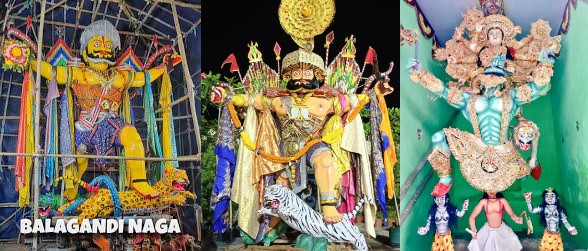
• Balance of Fierce and Gentle: The ferocity of Mahishasuramardini, the humor of Budha-Budhi, the martial Nāga Medha, and the nurturing forms like Gelabai — together present the totality of divine motherhood.
Conclusion
The Gosani Jatra of Puri is not merely a festival of clay idols and immersion — it is a cosmic drama of Shakti, staged on the sacred soil of Jagannath Dham.
Here, the Mother Goddess descends in multiple forms — fierce and tender, royal and rustic, cosmic and domestic. She accepts offerings, blesses her devotees, unites with Lord Jagannath through Maa Bimala, and then returns to the eternal waters of Musa Nadi.
For the people of Puri, the festival is a reminder that the Goddess is both protector and nurturer, both destroyer of evil and mother of the universe.
Thus, Gosani Jatra stands as a shining testimony to Odisha’s spiritual synthesis — where folk and classical, Vaishnava and Shakta, humor and ferocity, all merge into one eternal celebration of Devi Mahamaya, the cosmic mother of all.
🙏 Jai Maa Gosani. Jai Jagannath.
The Sacred Tradition of Gosani Jatra in Puri (Part–2)
The Sacred Tradition of Gosani Jatra in Puri (Part 1)
ହବିଷିଆଳୀ ବ୍ରତ
Pingback: A Story of Dvapar Yuga in Prose (Part- 12-C) - UniverseHeaven
Pingback: The Magical Well of Lord Ganesha — The Story of Kanipakam Temple - UniverseHeaven
Pingback: A Story of Dvapar Yuga in Prose ( part-17) - UniverseHeaven