
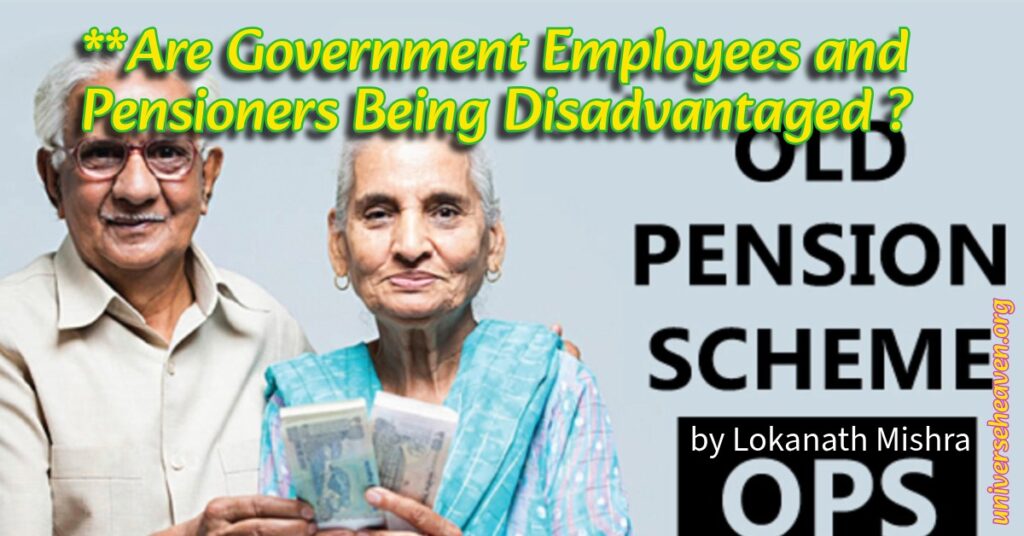
**Are Government Employees and Pensioners Being Disadvantaged?
By Lokanath Mishra.
A Critical and Ground-Level Assessment of Policy Decisions in India**
Introduction
In recent years, dissatisfaction among government employees and pensioners has steadily intensified under the Union Government led by Narendra Modi and the Bharatiya Janata Party (BJP).
This dissatisfaction is not merely rhetorical or politically motivated—it is rooted in lived experiences of financial insecurity, administrative indifference, and prolonged legal struggles, particularly affecting retirees and family pensioners who are most vulnerable.
While the government justifies its policies on grounds of fiscal discipline, administrative efficiency, and long-term sustainability, employee organizations strongly contest this narrative. They argue that these policies systematically shift the burden of economic adjustment onto employees and pensioners, many of whom are now struggling to maintain dignity and financial stability, especially in periods of economic stress and inflation.
This article presents a detailed, critical, and evidence-based examination of the major policy decisions that have contributed to the widespread dissatisfaction.

- Litigation Policy: Institutionalizing Delay and Inequality
One of the most serious grievances is the government’s consistent and aggressive litigation policy in service matters.
Even when employees win cases before the Central Administrative Tribunal (CAT) or High Courts, government departments routinely challenge these judgments up to the Supreme Court of India, often irrespective of the merit or settled legal position.
Ground Reality
• Favorable judgments are rarely implemented universally (in rem)
• Benefits are granted only to petitioners (in personam)
• Similarly placed employees and pensioners are forced to file fresh cases
Consequences
• Elderly pensioners must engage in costly and exhausting litigation
• Years of delay in receiving rightful dues
• Unequal treatment among identically placed individuals
Legal Contradiction
This practice directly conflicts with Article 14 of the Constitution of India, which mandates equality before law and prohibits arbitrary discrimination.
Core Criticism
Employee associations argue that:
• Once a legal issue is settled, it should be applied uniformly
• Government should act as a model employer, not a compulsive litigant
• Forcing pensioners into repeated litigation amounts to administrative injustice
- Abolition of Old Pension Scheme (OPS): From Security to Uncertainty
The 2004 abolition of OPS and introduction of the National Pension System (NPS) marked a fundamental shift from social security to financial risk transfer.
Structural Difference
• OPS: Guaranteed, defined benefit
• NPS/MPS: Market-linked, uncertain returns
Expanded Criticism
• Pension is no longer a right, but a financial outcome
• Employees bear market risks without financial literacy or control
• No guaranteed minimum pension for dignified survival
Intergenerational Inequality
• Pre-2004 employees enjoy secure pensions
• Post-2004 employees face uncertain futures
Recent Developments
Even modifications introduced in 2023–24 have failed to restore confidence, as they do not fundamentally address insecurity.
Evidence of Dissatisfaction
• Multiple states revisiting OPS
• Continuous protests and representations by employee unions
This reflects a deep perception that economic reforms have been implemented at the cost of employee welfare.

- 7th Central Pay Commission: Inadequate Compensation
The implementation of the 7th Central Pay Commission further intensified dissatisfaction.
Key Concern: Fitment Factor (2.57)
Employees widely consider this factor inadequate and unjustified, especially when compared to:
• Rising inflation
• Increased cost of living
• Expanding job responsibilities
Impact Analysis
• Real income growth remained modest
• Pay compression reduced incentives
• Middle-level employees felt disproportionately affected
Underlying Issue
The perception is that fiscal conservatism was prioritized over fair compensation, weakening morale within government services.
- DA/DR Freeze During COVID-19: A Permanent Financial Loss
During the COVID-19 pandemic, the government froze DA/DR from January 2020 to June 2021.
Critical Concern
• The freeze was not temporary in effect, because
• Arrears were never restored
Real Impact
• Permanent reduction in lifetime earnings and pension
• Severe hardship during a time of:
• Medical crisis
• Rising household expenses
Comparative Concern
In some cases, such as directions involving state employees (e.g., West Bengal), courts emphasized payment obligations—raising questions of parity and fairness.
Core Argument
Employees argue that:
• DA/DR is not a bonus but inflation compensation
• Denial of arrears amounts to forced financial sacrifice without consent
- The 2025 Pension Validation Act: Legalizing Differentiation
The Validation of CCS Pension Rules via the Finance Act 2025 represents a major structural and legal intervention.
Legal Foundation
Based on Article 309 of the Constitution of India, allowing regulation of service conditions.
Critical Concerns
• Retrospective effect from 1 June 1972
• Legal backing for categorization of pensioners
• Potential override of past judicial interpretations
Why It Raises Alarm
• Undermines principle of pension parity
• May validate unequal treatment based on retirement dates
• Creates permanent divisions among pensioners
Perception Among Pensioners
This Act is viewed as:
• A tool to legitimize discrimination
• A mechanism to avoid financial obligations arising from court judgments
⸻
- Delay in 8th Central Pay Commission: Growing Uncertainty
The delay in constituting the 8th CPC has created widespread anxiety and frustration.
Major Issues
• No clarity on Terms of Reference
• No timeline for implementation
• Increasing gap between wages and inflation
Additional Demands Reflecting Dissatisfaction
Employees and pensioners are raising long-pending issues such as:
• Restoration of commuted pension after 10 years (instead of 15)
• Additional pension benefits at shorter intervals (every 5 years)
• Merger of 50% DA/DR with basic pay/pension
• Expansion of CGHS wellness centers to all districts
• Mandatory empanelment of private hospitals
Interpretation
These demands indicate that dissatisfaction is not isolated—it is systemic and cumulative.
⸻
Broader Reality: Deepening Trust Deficit
The cumulative effect of these policies has led to a serious trust deficit between the government and its employees.
Government’s Position
• Fiscal responsibility
• Sustainable pension systems
• Controlled expenditure
Employees’ Reality
• Erosion of financial security
• Legal harassment and uncertainty
• Perceived neglect of welfare
Key Insight
Dissatisfaction is not based on a single issue—it arises from a pattern of decisions perceived as consistently unfavorable.
⸻
Conclusion
The growing dissatisfaction among government employees and pensioners is not incidental but structural.
Policies related to:
• Litigation
• Pension reforms
• Pay commissions
• Legislative validation
collectively signal a shift from a welfare-oriented employment model to a cost-controlled administrative model.
While fiscal discipline is essential, the current approach is widely perceived as:
• Insensitive to ground realities
• Disproportionately burdensome on retirees
• Contrary to the principle of a welfare state
Unless corrective measures are taken—such as:
• Uniform implementation of court judgments
• Pension security reforms
• Timely pay commission constitution
• Restoration of financial losses
the dissatisfaction among employees and pensioners is likely to intensify further, potentially affecting morale, efficiency, and the long-term stability of public administration.
⸻
References (Indicative)
1. Constitution of India – Articles 14 & 309
2. Finance Act, 2025 (Pension Validation Provisions)
3. 7th Central Pay Commission Report (2016)
4. Ministry of Finance – DA/DR Freeze Notifications (2020–2021)
5. National Pension System (NPS) Framework (2004 onwards)
6. Judgments of Central Administrative Tribunal and Supreme Court of India on pension matters
⸻
There’s going to be Dherna at Dherna chouk in Hyderabad near Indira park from 10:30 onwards