
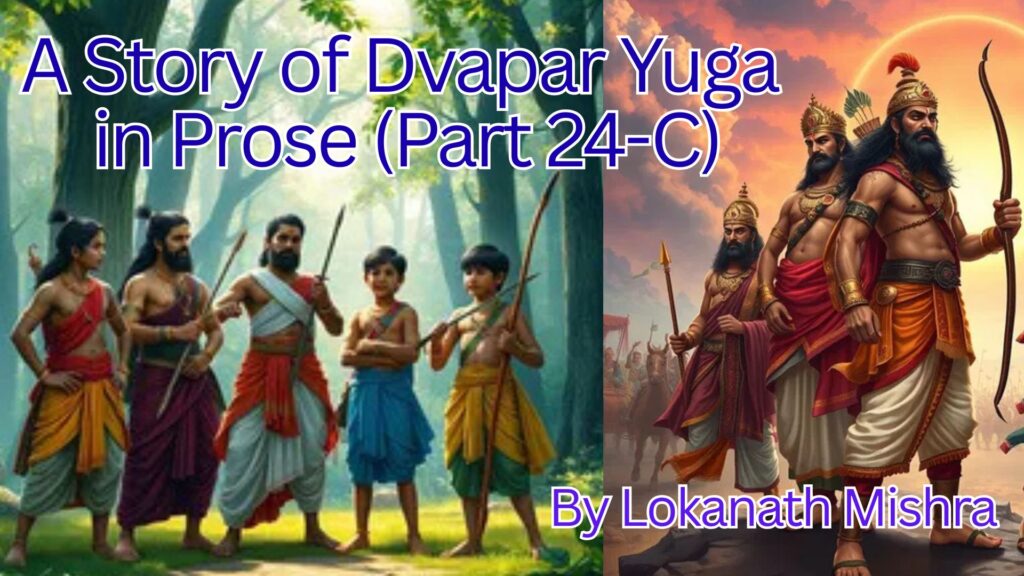
A Story of Dvapar Yuga in Prose (Part-24-C)
By Lokanath Mishra:
Education, Ethics, and Power: The Gurukul Training of the Pandavas and Kauravas under Dronacharya
The education of the Pandavas and Kauravas under Dronacharya constitutes a critical formative phase in the Mahābhārata. This period not only shaped their martial capabilities but also influenced ethical orientations, social order, and political outcomes. This article examines the gurukul system at Hastinapura, the differentiated competencies developed by the princes, the moral dilemma surrounding Dronacharya’s favoritism, and the pivotal Guru Dakshina episode involving King Drupada. By integrating translated Odia narrative material, the study highlights the complex interplay between pedagogy, dharma, and power that ultimately contributed to the Kurukshetra conflict.
- The Gurukul System at Hastinapura
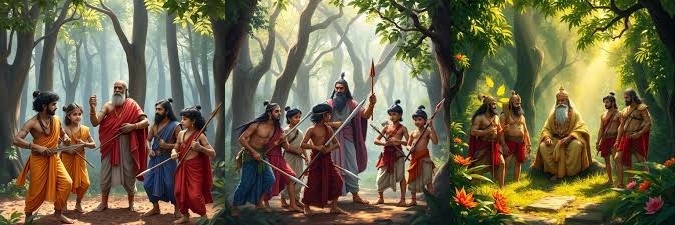
The Pandavas and Kauravas received their education together within the royal gurukul of Hastinapura, a palace-based adaptation of the traditional gurukul system. Although materially distinct from forest hermitages, the institution adhered to classical pedagogical principles emphasizing discipline, obedience, moral instruction, and mastery of both theoretical and practical knowledge. Senior figures such as Bhishma provided overarching guidance, while Dronacharya, son of the sage Bharadwaja and a disciple of Agniveshya, served as the principal instructor in military sciences.
- Scope and Nature of Instruction
Dronacharya’s curriculum was comprehensive, encompassing training in archery, swordsmanship, mace combat, spear warfare, and the deployment of celestial weapons. Instruction also included battlefield strategy and combat in varied terrains—on foot, horseback, and elephant-back. This systematic education aimed to produce warriors capable of defending social order (dharma) and political stability.
Despite shared instruction, individual aptitudes emerged distinctly among the Pandavas. Yudhishthira excelled in ethical reasoning and governance; Bhima attained unrivalled physical strength and mastery of the mace; Arjuna achieved preeminence in archery through discipline and concentration; and Nakula and Sahadeva developed proficiency in swordsmanship, horsemanship, and auxiliary sciences such as astrology. These differentiated competencies illustrate a pedagogical model that accommodated specialization within a collective learning environment.
- Favoritism, Ethics, and Arjuna’s Moral Conflict
Dronacharya’s evident favoritism toward Arjuna, though grounded in recognition of merit, generated ethical tension. The translated Odia narrative offers valuable insight into Arjuna’s internal conflict following the episode involving the Nishada archer Ekalavya. Arjuna perceives Drona’s actions as morally compromising and fears that his own excellence is tainted by injustice.
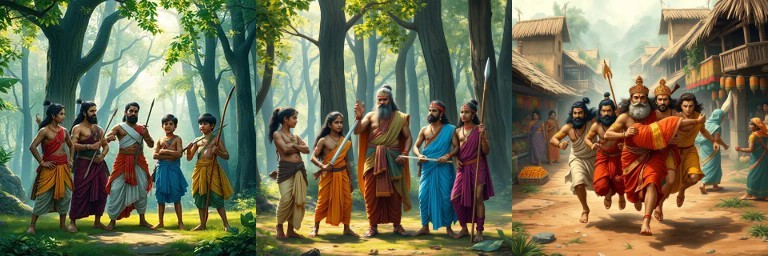
Dronacharya’s response articulates a justification rooted in social ethics rather than personal bias. He asserts confidence in Arjuna’s innate superiority while explaining that his restriction of Ekalavya’s power stemmed from concerns regarding unregulated use of martial knowledge and the preservation of Vedic social order. According to Drona, knowledge divorced from ethical restraint poses a threat to society, and the indiscriminate dissemination of military skills could destabilize established norms. This episode reveals a pedagogical dilemma central to the epic: the tension between universal access to knowledge and socially regulated authority.
- The Guru Dakshina and the Capture of Drupada
The Guru Dakshina episode represents the culmination of the princes’ education and a decisive test of loyalty. Dronacharya’s demand—that King Drupada be captured—was motivated by a prior humiliation inflicted upon him. While the Kauravas prepared a large military expedition, Arjuna asserted that wisdom and skill rendered such force unnecessary.
With Drona’s authorization, Arjuna single-handedly advanced into Panchala territory, neutralized Drupada’s forces using the Mohanastra, and captured the king without unnecessary violence. Notably, Arjuna’s conduct toward Drupada remained respectful, emphasizing obedience to his guru rather than personal hostility. This restraint reflects the ethical discipline imparted during his training.
- Kaurava Conduct and Dronacharya’s Reconciliation
In Arjuna’s absence, the Kauravas subjected the captive Drupada to physical and verbal humiliation, revealing a stark contrast between technical training and moral development. Upon awakening, Dronacharya intervened, halted the abuse, and treated Drupada with dignity—offering hospitality, forgiveness, and reconciliation. This act underscores Drona’s adherence to ethical principles despite his earlier demand for retribution.
Drupada’s subsequent repentance and Drona’s forgiveness restore personal harmony but fail to erase the psychological and political consequences of humiliation. Drupada’s later retreat into asceticism and penance initiates a chain of events with profound implications for the epic’s larger narrative.
- Conclusion
The education of the Pandavas and Kauravas under Dronacharya was instrumental in shaping not only their martial prowess but also their ethical dispositions and political trajectories. The gurukul system at Hastinapura fostered excellence, specialization, and loyalty, yet simultaneously exposed tensions between merit and favoritism, discipline and compassion, and social order and individual aspiration. The Guru Dakshina episode, in particular, illustrates how pedagogical decisions and moral judgments can reverberate beyond the classroom, ultimately contributing to historical and cosmic conflict. In this sense, the Kurukshetra War emerges not merely as a clash of arms, but as the culmination of unresolved ethical contradictions rooted in education itself.
⸻( to be continued)———