
A Story of Dvapar Yuga in Prose (Part 27-B)
By Lokanath Mishra
( Mahabharata in Prose)
Yudhishthira and Bhima bowed before Vidura. Vidura blessed them and said,
“Dhritarashtra had asked who should rightfully be the heir to the throne of Hastinapura. In reply, when grandsire Bhishma, the elder of the Kuru clan Bhurishrava, and I declared that ‘Yudhishthira should be king,’ a grave and dreadful danger has descended upon you. Acting on Shakuni’s counsel, Duryodhana has continued to conspire to remove you from his path by any heinous means whatsoever, so that the throne of Hastinapura may be made free of all obstacles.
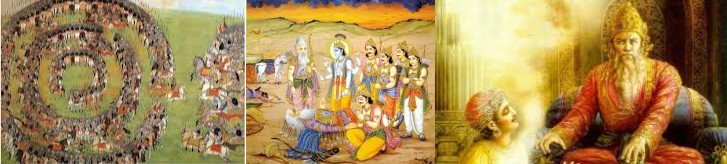
The wicked Purochana has constructed this palace at Varanavata by mixing lac, resin, ghee, and fatty substances. You may test it yourself: in every pillar, in every door and window-frame, and in every attractive sculpture, he has carefully packed these inflammable materials. Know that you are now sitting atop a volcano ready to erupt. At night, Vrikodara must keep watch, and during the day he should rest. Remain alert. As long as you stay here, pass your days by eating fruits and roots. Within a short time, I shall arrange to take you safely out of this death-trap.”
Yudhishthira said,
“Father, as long as you are with us, we have no fear. But the conduct of the guards posted here does not appear trustworthy. They are using fire for their own purposes. Tomorrow I shall order them to return to Hastinapura, telling them that ‘we are capable of protecting ourselves.’”
Vidura replied,
“Do exactly that. Now you both go. I shall carefully observe the surroundings of the house in which you are staying. I too must return quickly; if my absence is prolonged, suspicion will arise. Tell me—this is the direction one must take to reach the riverbank, is it not?”
Having inspected the house of lac from outside, Vidura vanished along the path leading to the riverbank. The two brothers returned and disclosed everything to the others. They examined every part of the house and realized the truth of Vidura’s suspicions.

In the last watch of the night, Vidura was moving swiftly along the royal road of Hastinapura toward his own residence. His eyes fell upon a dwelling by the roadside. Near that house, a dark figure seemed to be engaged in some suspicious activity. Vidura approached silently and, without being noticed, observed the man’s actions. He was a thief, digging into the wall with the help of a tool in order to enter the house. Right before Vidura’s eyes, within moments, the man made a hole large enough to slip through easily.
As he was about to enter, Vidura’s hand fell upon his shoulder. Startled, the man turned around. Seeing a royal minister, he was terrified, folded his hands, and fell at Vidura’s feet. Vidura pressed a finger to his lips, signaling him to remain silent, and ordered him to follow with his digging tool.
Vidura took the thief to his own house, entered, and closed the door. Though Vidura was already aware of the practice of theft, seeing with his own eyes how easily a wall could be pierced awakened a keen curiosity in him about this skill. The thief trembled with fear, but Vidura reassured him, saying, “Do not be afraid.” Then he said:
“Look, I am a senior minister of this kingdom. If you do not wish to spend the rest of your life in prison, answer my questions and act according to my instructions. I shall give you so much wealth that you will never lack anything, and you will not need to adopt this dangerous profession again.”
Vidura’s first question was,
“How were you able to dig such a large hole so quickly? What is the name of the instrument with which you accomplished this task? If you give me that tool, would I be able to dig such a hole with the same speed as you?”
The thief replied,
“My lord, a king is said to possess sixteen arts, a minister thirty-two, but a thief is born with sixty-four arts. A child born under the constellation of Krittika, in Taurus, during the last watch of the new-moon night of the month of Tula, becomes proficient in the art of theft. The digging instrument you see in my hand is called Lakshana. There is a prescribed method for making it. On that new-moon night, one must worship Goddess Chandi and sacrifice a black goat. An iron piece dedicated to the goddess is placed before her and worshipped.
‘Taking an iron piece that has grasped the moment of birth,
Fashion it into plates and heat it in fire.
Through disciplined practice it is forged by a master artisan,
Sharpened into three edges—thus is Lakshana made.’”
Vidura listened with great interest as the thief explained the special qualities of Lakshana and the various skills of the profession of theft. Finally, Vidura asked,
“Using your instrument, could some other strong person dig the earth and construct a tunnel?”
The thief laughed and said,
“Forgive me, my lord. In this matter, strength is less important than sensitivity, special skill, and speed. If you command me, no matter how large the tunnel, I can dig it. But it is not possible for an inexperienced person.”
That day, the thief stayed as a guest in Vidura’s house. On the following night, the two of them set out for Varanavata together.
( to be continued