
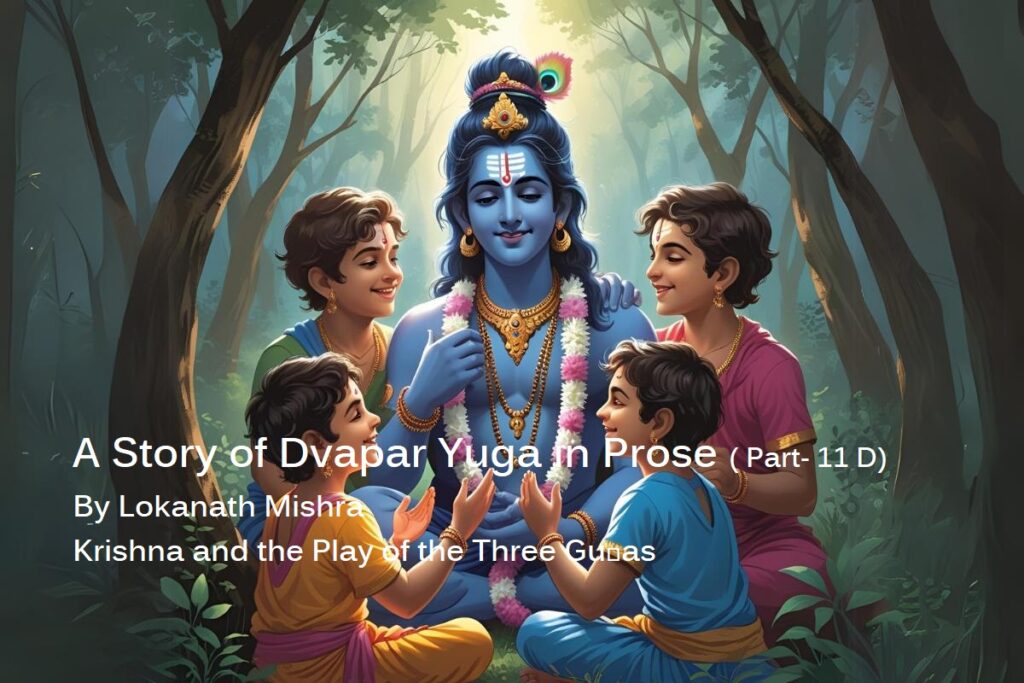
A Story of Dvapar Yuga in Prose ( Part- 11 D)
By Lokanath Mishra
Krishna and the Play of the Three Guṇas
A long time ago, when Rāvaṇa’s cruelty became too much for the world to bear, the devas and sages prayed to the Supreme Lord for help. Out of compassion, the Lord came down to earth as Śrī Rāma. The Rāmāyaṇa tells us that whenever adharma (evil) grows too strong, the Lord himself appears in some form to protect goodness.
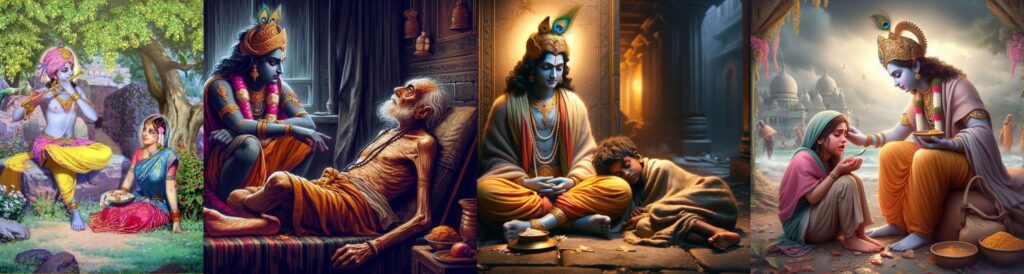
But the same Lord, whom we call Krishna, also teaches us in very playful ways about life and about the three guṇas — sattva (goodness and clarity), rajas (activity and passion), and tamas (darkness and laziness). These three together make up the energy of nature, called prakṛti.
Most people like sattva and think it is the only good quality. Yes, sattva is peaceful, kind, and full of light. But the other two, rajas and tamas, also have their place. Think of it like an orange. The fruit inside is sweet and juicy, but it is protected by the peel. When you eat the fruit, you throw the peel away. Do you get angry at the peel? No! It had a purpose for some time, and when its work is done, you put it aside.
In the same way, rajas and tamas help the world in their own way. They protect, balance, and even test us. Later, when a seeker grows in wisdom, he learns to let them go — but without hating them.
The Story of Jaajali and Utkala
Once, near the Gaṅgā at Kapilāśrama, there lived a wise sage named Jaajali. He was a disciple of Kapila Muni, the great teacher of Sāṅkhya.
One day, a boy named Utkala, the son of an asura, came to the river and began catching fish in a net. Jaajali warned him, “Do not take lives near this holy place.” But Utkala paid no attention. He just sat quietly, staring at the net, looking like a crane waiting for prey.
The sage became angry and cursed him:
“You will become a crane yourself!”
Because of this curse, Utkala was born as Bakāsura, a giant demon-crane, brother of Pūtanā and Aghāsura. Afraid, Utkala begged for forgiveness. But Jaajali could not take back the curse. Kapila Muni then explained:
“This soul will be freed only by Sri Hari, when he takes birth as Krishna.”
Jaajali felt sad. He wanted to save the fish, but instead he had created a demon who would eat fish all his life. This shows how even a saint in sattva can slip into rajas and tamas when anger takes over.
Krishna and Bakāsura

Years later, in Vṛndāvana, Krishna and his friends were grazing calves when suddenly a huge crane demon appeared. It was Bakāsura. With his sharp beak, he seized Krishna and tried to swallow him.
But Krishna is the Lord of the universe. With one foot he pressed down the lower beak, and with his hands he lifted the upper beak until the demon’s body tore into two.
From Bakāsura’s broken body, a shining swan emerged and flew upward to Vaikuṇṭha, the eternal home of the Lord. Without doing any penance or prayer, the tamasic asura was saved by Krishna’s mercy alone.
Krishna and Aghāsura
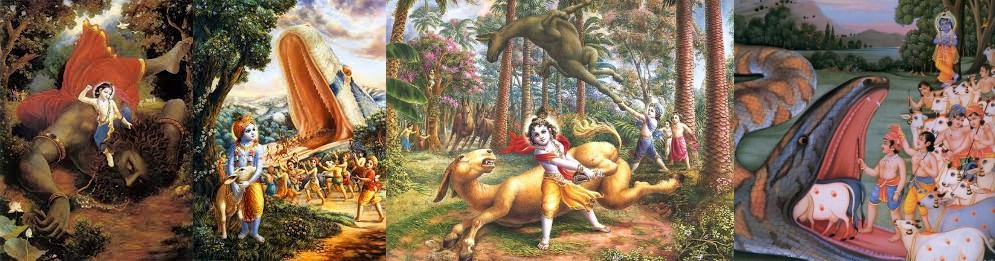
Soon after, Aghāsura, the brother of Bakāsura, came in the form of a giant serpent. His mouth was so wide that it stretched from earth to the sky. Thinking it was a cave, Krishna’s friends began to enter, and suddenly they were trapped inside!
To save them, Krishna also entered the serpent. Once inside, he expanded his body until Aghāsura could no longer breathe. The demon’s life left his body, and his soul rose to the heavens, freed at last.
The boys, rescued by Krishna, danced with joy, praising their beloved friend.
The Lesson of the Guṇas
Through these playful stories, Krishna teaches us an important truth: sattva, rajas, and tamas are not permanent. They rise and fall. Even a sattvic sage like Jaajali can slip into rajas and tamas. And even a tamasic being like Bakāsura can reach Vaikuṇṭha by the Lord’s grace.
So we should not hate rajas and tamas. We should not even cling tightly to sattva. When the time comes, we can gently set them aside — just like peeling an orange.
Krishna shows that all three guṇas are under his control. He plays with them to teach us that beyond sattva, rajas, and tamas shines the Lord himself — eternal, pure, and full of love.
✨ That is why, when we remember Krishna, we remember not only his playful pastimes but also the deep wisdom hidden in them. He is the master of all guṇas, and by his grace, even darkness can be turned into light.
⸻( to be continued) —
The Divine Journey of Lokanath Mishra
A Story of Dvapar Yuga in Prose: ( Part- 11 B)
A story of Dwapar Yuga in Prose : ( part-13)
Pingback: The Divine Story of Radha and Krishna - UniverseHeaven