
Mahabharata ( A Story of Dvapar Yuga in Prose) Part-33
By Lokanath Mishra
Now Hidimbi’s son Ghatotkacha had grown into a young man. The Pandavas crowned him king there and then took leave of the Hidimba forest. Hidimbi pleaded to go with her mother-in-law, but the journey and destination were uncertain. Moreover, Ghatotkacha needed a guardian in the Hidimba forest. Therefore, Hidimbi stayed back with her son.
In the meantime, in Hastinapura, marriages were being celebrated—Duryodhana’s other brothers were married, and his sister Duhshala was married to Jayadratha. The five Pandava brothers, along with their mother Kunti, continued their journey and reached a region called Shivapura. They decided that it was no longer possible to survive only on fruits and roots; now they needed proper cooked food. It was essential to conceal their identities, so they all assumed the guise of Brahmins. They changed their names respectively to Jayanta, Ajayanta, Ajeya, Jayasena, and Jayarashtra. Each of them carried a separate begging bowl.
A problem arose with Bhima. He was constantly irritated that, despite being a prince, he had to beg for alms. Kunti knew well what would happen if someone refused to give alms, drove him away from the doorstep, or showed even slight anger. So she suggested that he become a chakulia panda—a kind of Brahmin who does not go door to door. Instead, standing at the village crossroads with a palm-leaf umbrella and a begging bowl, he would call out, “O righteous beings, are there any here?” Hearing this call, people would come on their own and offer rice, lentils, vegetables, and other food.
Mentally prepared for this new way of life, they searched for a place to stay. Outside the town was the house of a well-to-do Brahmin. On inquiry, they learned it belonged to a Brahmin named Vishnukara Panda. Because the Panda couple was childless, the townspeople had forced them to live outside the city.
At the doorway, the Brahmin’s wife first welcomed the five Brahmins and the woman who seemed like their mother. In return for her greeting, Kunti blessed her, saying she too would be blessed with five sons. The Panda couple was overjoyed and granted them a place to stay, though the Pandavas said they would beg for their own food and cook it themselves. Whatever Kunti cooked, half of it was given to Bhima alone, and the rest was shared among the others. After some time, the Brahmin woman became pregnant. The Panda couple was delighted and began praising the Pandavas everywhere.
During this period, a sacred bathing festival was announced at the Gautami Tirtha. Hoping to gain merit, the Pandavas decided to go there. However, they knew kings, ascetics, and sages from many lands would gather there. Yudhishthira feared that the Kauravas might also be present. If Bhima saw Duryodhana there, he would surely attack him. Kunti also refused to undertake such a long journey on foot. After discussion, it was decided that Bhima and Kunti would remain in Shivapura, while the other four brothers would go to Gautami Tirtha.
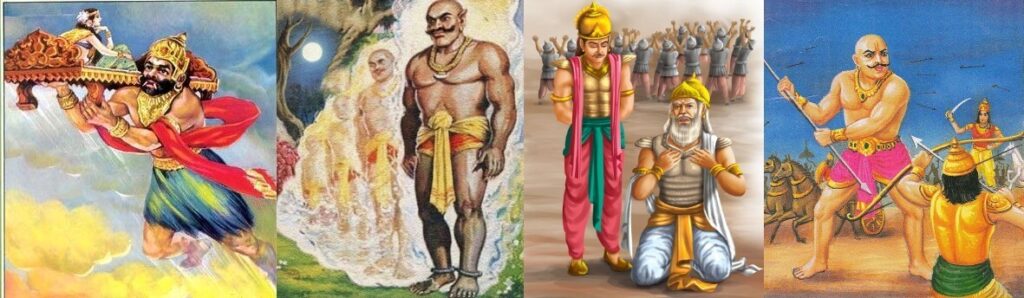
Near the kingdom of Shivapura lay the Odra kingdom, inhabited by Chandala tribes. There was fierce enmity between the two kingdoms, and once every year a battle took place. Every time, the Chandalas emerged victorious, inflicting unspeakable atrocities on the people of Shivapura and looting their wealth.
One morning, seeing the people of Shivapura preparing for war, Bhima asked Vishnukara Panda the reason. The Panda replied, “Today the Chandalas from the neighboring kingdom will attack.” Fearing loss of life and property, he was preparing to flee with his family. With great difficulty, Kunti persuaded him not to flee, assuring him that if he went to battle with Ajayanta, not even a scratch would come to him. Though still reluctant, seeing the fiery eyes of the massive Bhima, the Panda finally agreed, saying, “Yes, yes, I will go—why wouldn’t I?”
The Chandalas marched out of Odra, roaring and terrifying in appearance—disheveled hair, monstrous bodies, dancing wildly in frenzy. A fierce battle erupted between the warriors of Odra and Shivapura. It was almost a one-sided war, for the Chandalas were stronger, highly skilled, merciless, and utterly ruthless, with no hesitation in killing.
The Brahmins of Shivapura offered only token resistance. As always, the Chandalas killed many, wounded many more, and began looting wealth and capturing women. They advanced like a raging sea. Ajayanta—Bhima—held Vishnukara Panda by the hand. Seeing the situation worsen, the Panda thought of fleeing, but Bhima would not let him go.
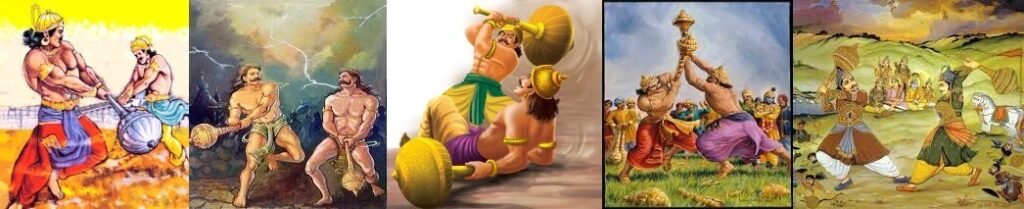
When the Chandalas attacked Bhima with various weapons, Bhima uprooted a massive tree and chased them down, beating them mercilessly. In battle, Bhima was extremely ruthless—those who sought refuge were struck down twice as hard. The entire Chandala force was annihilated. The people of Shivapura advanced and conquered the whole Odra kingdom. By unanimous consent, Ajayanta was declared king of both kingdoms. Bhima took a new name—Kalabara.
A palace was quickly built, Vishnukara Panda became the chief minister, an army was formed, and neighboring kingdoms were subdued. Bhima now received full and delicious meals, though Mother Kunti continued to live in the old house.
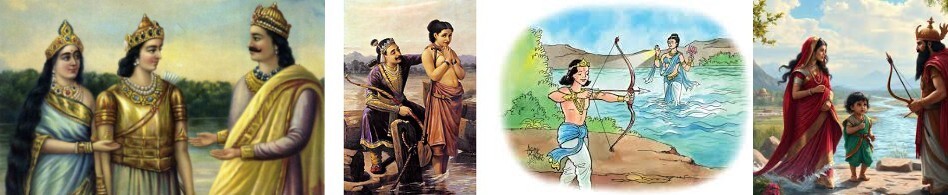
Bhima began thinking that if he built an even larger army, he could attack Hastinapura. Meanwhile, the four Pandava brothers at Gautami Tirtha bathed and gave alms at night, hiding in the forest during the day to avoid recognition. King Drupada also arrived there, searching for Arjuna, for he wished only him to marry his daughter. Though hearing rumors that the Pandavas had died in the lac house, Drupada still announced his daughter Krishnaa (Draupadi)’s swayamvara, declaring that whoever could pierce the target would win her hand.
Months passed. When the four brothers returned toward Shivapura, they saw its splendor and suspected another king ruled there. At night they went to Vishnukara Panda’s house and called “Ajayanta!” Kunti came out, fed them, and told them the whole story of Bhima’s kingship. When Yudhishthira asked whether Bhima consulted her, she replied, “He doesn’t even speak to me.”
All five brothers went together to meet King Kalabara. The guards stopped them. Inside, Bhima assumed they had come to drag him back into begging again, and his anger rose. The frightened guard warned them to leave quickly. Later, the minister Vishnukara whispered to Bhima that they were his mother and brothers. Bhima angrily replied that it was the minister’s duty to ensure they did not beg anymore.
Eventually, Sage Sumantra, Bhima’s priest, intervened and rebuked him for abandoning Yudhishthira. When he learned that Duryodhana was at Draupadi’s swayamvara, Bhima’s body trembled with excitement. He renounced the throne, appointed Vishnukara Panda as king, and left on pilgrimage. He was reunited with his mother and brothers, bowing at their feet and embracing them.
Their journey resumed, and they reached Ekachakra city on the banks of the Sipra River, where they stayed at the house of a Brahmin named Vedashrava. After some days, it was announced that Vedashrava’s family was next to offer food and a human sacrifice to the demon Bakasura. When the family wept over who would go, Kunti offered one of her sons. Despite their horror, she insisted, calling Bhima her “mischievous son” who ate more than his share.
When Kunti told Bhima he would take the cartloads of food to Bakasura, Bhima was overjoyed—first, he would finally eat to his fill, and second, he would get a chance to stretch his limbs after so long.
( to be continued)
The Last Row
Death Is an Illusion : A Modern Near-Death Experience in the Light of the Bhagavad Gita
When Destiny Folded Its Hands
Pingback: Mahabharata ( A Story of Dvapar Yuga in Prose) Part-33 A - UniverseHeaven
Pingback: A Sacred Sojourn to Mahakaleshwar : From Bhubaneswar to Ujjain - UniverseHeaven