
Mahabharata in Prose – Part 55 (continued)
A Story of Dvapara Yuga in Prose
by Lokanath Mishra
After completing his divine missions in the celestial realms, Arjuna had become more than a warrior.
He had stood among gods, defeated mighty asuras, mastered celestial weapons, and learned discipline beyond mortal understanding. Yet the greatest transformation within him was not power—but wisdom.
The fire of youthful pride that once burned fiercely within him had now been tempered by humility, responsibility, and purpose.
The devas saw this clearly.
And the time had come for Arjuna to return to earth.
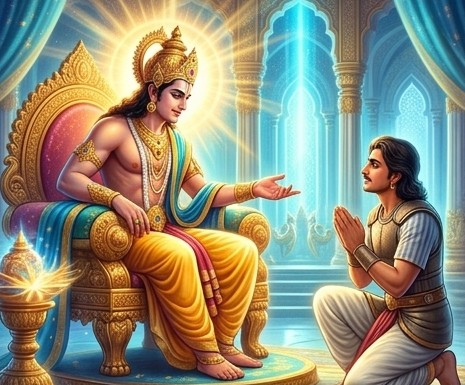
Indra’s Final Counsel
One morning, the great hall of Amaravati was filled once again with divine radiance.
Indra summoned Arjuna privately.
The king of the gods looked upon his son with deep affection, but also with the gravity of one who sees the future.
“Partha,” he said slowly, “your time in heaven nears its end.”
Arjuna bowed respectfully.
“My lord, whatever knowledge I have gained is through your grace.”
Indra raised his hand gently.
“No, Dhananjaya. Divine grace may open the path, but only effort walks upon it. You have earned what has been given to you.”
For a few moments, silence filled the chamber.
Then Indra continued:
“The earth moves toward a great and terrible conflict. The seeds of greed, envy, and pride planted in Hastinapura are now growing beyond control. War cannot be avoided forever.”
Arjuna listened carefully.
“You and your brothers,” Indra said, “shall become instruments through which dharma will be restored. But remember this well—victory in war does not always bring happiness.”
These words settled deeply into Arjuna’s heart.
For the first time, he understood that the coming war would not merely be a struggle for a kingdom.
It would demand sacrifice beyond imagination.
The Gift of the Celestials
Before Arjuna’s departure, the gods gathered to honor him.
One by one, celestial beings bestowed blessings upon the Pandava prince.
Varuna granted him mastery over watery astras.
Vayu blessed his speed and endurance.
Agni renewed his fiery weapons with divine brilliance.
Yama spoke solemnly:
“Use these powers only when dharma demands it.”
Kubera offered treasures and celestial protection.
Even the Gandharvas and Siddhas praised Arjuna’s discipline and purity.
The heavenly sages declared:
“Among mortals, few have risen so high while remaining free from arrogance.”
Arjuna accepted every blessing with folded hands and lowered eyes.
For he understood that divine power carried divine responsibility.
⸻
The Farewell of Chitrasena
Before leaving Amaravati, Arjuna went to meet Chitrasena, the Gandharva king who had guided him in music, dance, and celestial arts.
Chitrasena welcomed him warmly.
“You came here as a warrior,” he said with a smile, “but you leave as something greater.”
Arjuna replied humbly,
“You taught me that strength without balance becomes destruction.”
The Gandharva king nodded.
“Remember those lessons carefully. There may come a time when weapons alone cannot protect you.”
Those words seemed mysterious then, but destiny had already begun weaving their meaning.
For the skills Arjuna had learned in heaven would later protect the Pandavas during their final year of exile.
Nothing in destiny is ever wasted.
⸻
Descent from Heaven
At last, the day of departure arrived.
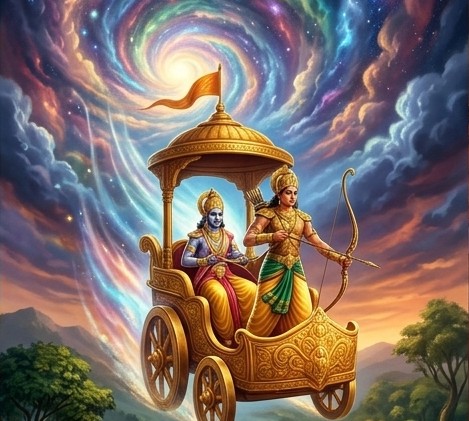
Matali once again prepared the celestial chariot.
The skies glowed softly as Arjuna offered his final salutations to the gods.
Indra embraced his son.
“Go now, Partha,” he said. “Protect dharma upon the earth.”
Arjuna bowed deeply.
Then the chariot descended from Amaravati toward the mortal world.
As he traveled downward through the heavens, Arjuna looked once more upon the celestial realms.
The shining cities, the divine music, the endless brilliance—all slowly faded behind him.
Ahead lay earth.
A world of suffering, struggle, love, betrayal, and destiny.
Yet Arjuna felt no fear.
Only purpose.
⸻
The Reunion in the Forest
Far away, in the forests where the Pandavas continued their exile, the brothers often spoke of Arjuna.
Bhima would say impatiently,
“How much longer will Partha remain among the gods?”
Draupadi too silently longed for his return.
Though she spoke little of it, her heart carried constant concern.
Yudhishthira alone remained calm.
“He will return when destiny wills it,” he would say.
And one day, destiny answered.
A radiant light appeared in the sky above the forest hermitage.
The sages looked upward in wonder.
Soon, the celestial chariot descended gently upon the earth.
Arjuna stepped down.
For a moment, silence filled the forest.
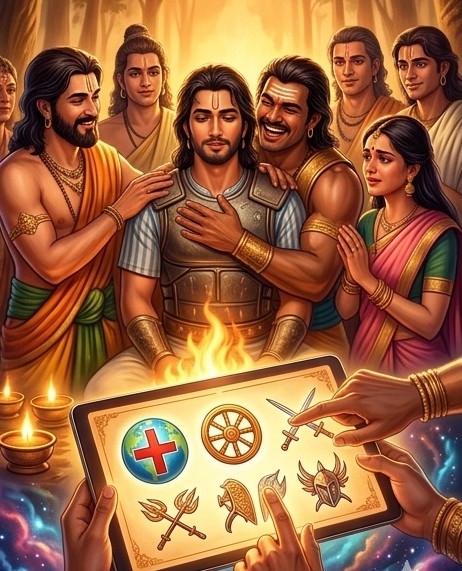
Then Bhima rushed forward with joyous laughter and embraced his brother tightly.
Nakula and Sahadeva bowed with tears of happiness in their eyes.
Draupadi looked upon Arjuna with deep emotion.
He seemed changed.
Not merely stronger—but calmer, wiser, almost luminous with inner power.
Yudhishthira approached last.
The eldest Pandava embraced Arjuna quietly and said:
“Welcome home, Dhananjaya.”
No greater words were needed.
⸻
Arjuna’s Narration
That evening, as sacred firelight flickered beneath the forest trees, Arjuna narrated all that had occurred in heaven.
He spoke of his encounter with Lord Shiva.
Of the Pashupatastra.
Of Amaravati and the celestial realms.
Of the terrible battles against the Nivatakavachas and Kalakeyas.
The Pandavas listened with wonder.
Bhima’s eyes blazed with excitement at the tales of battle.
Nakula and Sahadeva marveled at the heavenly worlds.
Draupadi listened silently, relieved that Arjuna had returned safely.
But Yudhishthira listened most carefully when Arjuna spoke of Indra’s warning.
“The war is inevitable,” Arjuna said softly.
The fire crackled in silence.
No one spoke for several moments.
Deep within each heart arose the same understanding:
The path ahead would lead toward Kurukshetra.
The Calm Before the Storm
Though reunited, the Pandavas did not yet return to comfort or peace.
Their exile was still unfinished.
Many hardships still awaited them.
But now, they were no longer merely princes cast out from a kingdom.
They had become instruments of destiny.
The forest itself seemed to sense the change.
For among the five brothers now stood Arjuna—armed not only with celestial weapons, but with the blessings of gods and the wisdom born from divine trials.
And far away in Hastinapura, Duryodhana remained blind to the storm that slowly approached him.
In his pride, he believed the Pandavas weakened by exile.
He did not know that the forest had transformed them.
He did not know that heaven itself had prepared them.
And when the time came, the world would witness the consequence of that preparation.
⸻
Thus ended Arjuna’s divine journey—
a journey through heaven, battle, humility, and wisdom—
all preparing him for the greatest war the world would ever see.
⸻
(Continued in Part 56…)