
Narendra Modi: A Critical Review of Governance, Achievements, and Concerns
By Lokanath Mishra
Preamble: Concerns of Central Government Employees and Pensioners
During the tenure of Narendra Modi, several concerns have been raised by central government employees and pensioners, who form a significant and structured segment of Indian society. Various associations and forums have alleged that policy decisions in recent years have created difficulties and uncertainties for them.
One of the major grievances relates to the introduction of stricter validation requirements for pensioners, which many elderly retirees find cumbersome. Additionally, the freezing of Dearness Allowance (DA) and Dearness Relief (DR) during the COVID-19 period, without retrospective compensation, has been a long-standing issue of discontent.
There have also been repeated demands for the constitution of the 8th Central Pay Commission, but delays and lack of clarity have led to dissatisfaction among employees. Concerns have further been expressed regarding limited access and perceived inadequacies in services under the Central Government Health Scheme, including the non-expansion of CGHS wellness centres to all districts.
Senior citizens, particularly retired government employees, have also voiced objections to the withdrawal of railway fare concessions, which were earlier a significant support. Moreover, some employee groups argue that court judgments related to service matters are not always implemented uniformly “in rem,” leading to repeated litigation and uncertainty.
These issues collectively form a critical backdrop when assessing the governance record of the current administration from the perspective of employees and pensioners.
Achievements and Contributions
- Economic Reforms and Financial Inclusion
The Modi government has taken several steps toward economic modernization. Initiatives like Pradhan Mantri Jan Dhan Yojana have expanded banking access to millions, enabling direct benefit transfers.
The implementation of Goods and Services Tax (GST) marked a major structural reform, simplifying the indirect tax regime and promoting a unified national market.
- Infrastructure and Development :
India has seen accelerated infrastructure growth in roads, railways, and urban development. The introduction of Vande Bharat Express symbolizes modernization in rail transport. Rural electrification and housing schemes have contributed to improving living conditions.
- Global Diplomacy and India’s Image
India’s global standing has improved through active diplomacy. Engagements with global powers and leadership in forums like the G20 and United Nations have enhanced India’s international influence.
- Welfare and Social Schemes
Key welfare initiatives include:
• Pradhan Mantri Ujjwala Yojana
• Swachh Bharat Abhiyan
• Ayushman Bharat
These programs have aimed at improving sanitation, healthcare, and basic living standards.
- National Security and Policy Decisions
The government has adopted a strong national security stance, including cross-border actions against terrorism. The abrogation of Article 370 remains a major and debated policy decision.
Defects and Criticisms
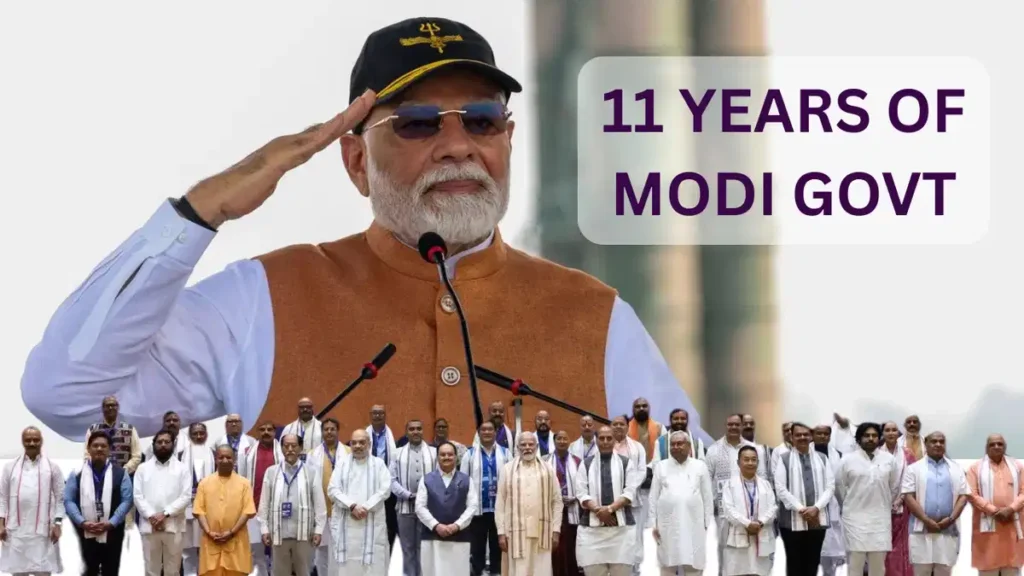
- Employee and Pensioner-Related Issues
Despite overall development, dissatisfaction persists among central government employees and pensioners. Issues such as:
• Non-restoration of DA/DR arrears
• Delay in 8th Pay Commission formation
• Limited CGHS coverage and facilities
• Removal of railway concessions for senior citizens
have contributed to a perception of neglect among this group.
- Economic Concerns
Policies like demonetization caused short-term disruptions, especially for small businesses. Unemployment and inflation remain key concerns raised by critics.
- Social and Political Criticism
Opponents argue that social harmony has faced challenges, with increasing debates around secularism and minority rights.
- Centralization of Governance
Critics highlight the concentration of decision-making power within the central leadership, raising questions about institutional independence.
- Governance and Administrative Issues
Allegations regarding inconsistent implementation of court orders in service matters and lack of uniform policy application have been raised by employee groups.
Conclusion
The tenure of Narendra Modi is marked by significant transformation as well as notable criticism. While his government has achieved progress in infrastructure, global diplomacy, and welfare delivery, concerns from central government employees and pensioners highlight gaps in inclusive governance.
Thus, Modi’s leadership presents a mixed legacy—one of ambition and large-scale reform, alongside ongoing debates about administrative fairness, economic impact, and social balance.
Namaste. Thanks for the opportunity. I am a person with Disability by birth. Though an Act of 1995 and judgement dt.30-6-2016 of the Hon. ble Supreme Court of India permitted persons with Disability to get reservation in promotions upto Group A Cadre, the Departments of the Government of India not only failed to implement the same but forced some of the employees, with disability, including me, to approach the Courts of Law. Contempt petition Number 700/2017 (civil) and many more contempt petitions / cases in the Hon ble Supreme Court show the attitude of the authorities in the Government of India towards even its own employees with Disability. With regards.
Kota Dasaradhi Gupta, retired Superintendent of Central Excise, Vijaywada of Andhra Pradesh State.
This is totally failure on the part of the government.