
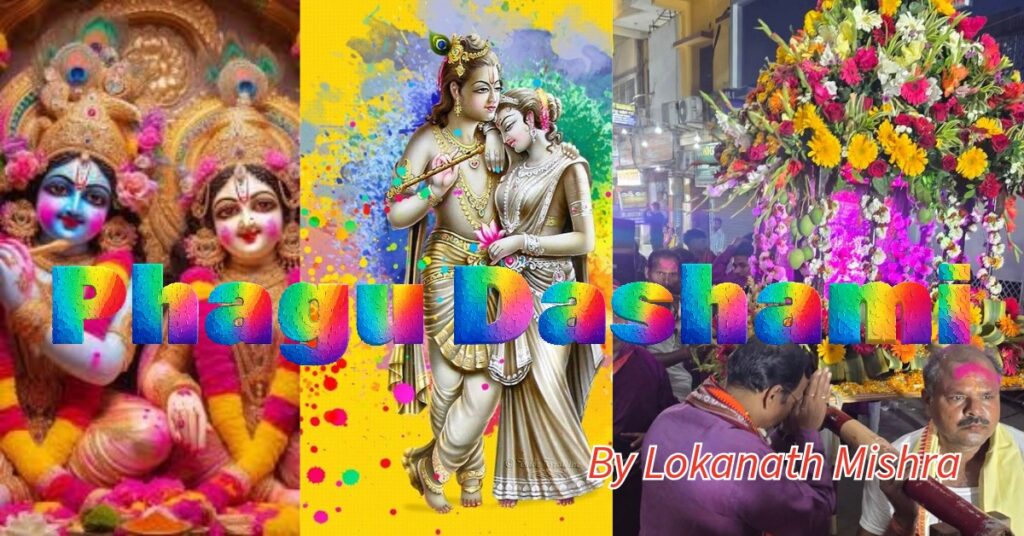
🔱⭕ Phagu Dashami
By Lokanath Mishra
From the tenth lunar day (Dashami) of the bright fortnight of the month of Phalguna begins the service and worship of Phagu or the Abhir deity. This festival is observed as a prelude to the festival of Holi. Dashami is especially dedicated to the Dashavatara (the ten incarnations of Lord Vishnu), particularly to Kalia Kala Thakura Koti Kabalyanatha. In every religious procession, the number ten holds significance. Everyone knows that the Rath Yatra is also known as the Dashavatara Yatra. On Bahuda Dashami, Lord Jagannath returns to His abode. Therefore, Phagu Dashami is a unique and special festival.
In villages, towns, and cities everywhere, Hindus celebrate this festival with great devotion and enthusiasm. It was during this sacred period that Chaitanya Mahaprabhu appeared. His incarnation was complete with the essence of Radha and also contained the divine aspect of Krishna.
Among all the divine plays of Lord Krishna, the Rasa Leela is considered the greatest. Rasa Leela is celebrated three times a year:
• Sharad Rasa on the full moon of Kartika month
• Basanta Rasa on Dola Purnima
• Prabudha Rasa during Jhulan Yatra
During Dola, one sees Dola Govinda; on the stage, Madhusudana; and on the chariot, when one beholds the Lord in His Vamana form, that soul is liberated and never takes human birth again.
Legend (Kimbadanti):
Hiranyakashipu had a son named Prahlada, a devoted servant of Lord Hari. Hiranyakashipu declared that he himself was not a devotee of Hari and forbade the chanting of Hari’s name. Prahlada replied, “Father, there is no kirtan without Hari. Above is Hari, below is Hari, Hari is in all ten directions. My Lord exists everywhere—on land, in water, and in fire.”
Thus, instead of the father teaching the son, the son taught the father. Children who are devoted to Lord Hari often end up imparting spiritual wisdom to their parents. The knowledge of Hari is truly extraordinary.
Prahlada was thrown from a mountain, trampled by elephants, and poisoned—but he did not die. For whom the Lord protects, who can destroy?
During this same period—from Phalguna Shukla Dashami to Purnima—Hiranyakashipu’s sister Holika played a crucial role. She had received a boon that fire could not harm her. Hiranyakashipu requested her help to protect his honor and status.
A massive fire was prepared, reaching the sky. The plan was for Holika to sit in the fire holding Prahlada, so that the child would perish. A wooden structure called Aighara was built. Holika took Prahlada, who was innocent and unaware, into the fire.
The vehicle of fire is believed to be a ram (Mesha), hence this burning is called Mesha Podi. Holika’s son was also named Mesha. Fire was lit from all sides. At this moment, the Lord’s divine play began. The Lord declared that anyone who harms His devotee unjustly would lose even the boons granted to them.
Holika, whose heart was filled with sinful intent, was burned to ashes, while Prahlada emerged unharmed, laughing joyfully. This event is commemorated as Holika Dahan, which is part of the Holi festival.
A similar event occurred in Krishna’s incarnation when the demoness Putana came disguised as a beautiful woman with poison on her breast. When she tried to poison Krishna, He sucked out her life instead. Though she died, she attained Vaikuntha. When asked why, the Lord replied, “Outwardly she carried poison, but inwardly she had devotion for Me. Anyone who carries devotion within attains liberation.”
From Phagu Dashami, the Lord travels seated on a bimana (palanquin). In Puri, this form is called Chacheri Besha. The Lord is adorned in Abhir-colored garments. Offerings such as puffed rice, jaggery sweets, raw mango, roasted grains, and chickpeas are made.
From Dashami onward, the Lord—whether as Radha-Krishna, Rama, Nrusingha, or Shankara—travels village to village, appearing in different forms. At every doorstep, offerings are presented before proceeding to the Dola altar.
According to Vaishnava belief:
In Vrindavan, the gopis played Chacheri with their supreme beloved, Lord Krishna. They adorned Him with garlands, swung Him on cradles, and joyfully played Phagu with Him. Hence, during Dola Yatra, the combined idol of Radha-Krishna is carried in beautifully decorated small palanquins to almost every household in the village.
Offerings made at each doorstep are called “Dwari Bhoga.” The idea is to show that God belongs to the devotees. Usually, devotees go to the temple to see the Lord; but during Dola Utsav, the Lord descends from His throne and comes to the devotees’ very doorsteps to accept their devotion.
Just as Lord Jagannath comes out during Rath Yatra to bless the masses, similarly, during Dola Utsav, Lord Krishna comes close to His devotees to receive offerings. Like the Puri Temple, Dola Yatra is also celebrated with great grandeur at the Lingaraj Temple in Bhubaneswar.
This is a highly renowned festival. Anyone who witnesses or participates in this yatra from Dashami onward, becoming a companion in the Lord’s divine play, is absolved of the ten major sins. The spiritual effect of this festival lasts from five days before Dola Purnima to five days after it.