

Pigeons: Nature’s Loyal Messengers and Their Association with London and Shri Jagannath Temple, Puri
By Lokanath Mishra, MA, LLB, IRS (Retired)
Introduction
Among all birds living alongside human beings, pigeons occupy a unique position. They have served mankind as messengers during wars, symbols of peace in religion and art, companions in cities and villages, and even subjects of scientific research. Their remarkable ability to return home over hundreds of kilometres has fascinated people for thousands of years.

Today pigeons are found on almost every continent and in nearly every major city of the world. Whether in London’s historic squares, the villages of India, or the sacred surroundings of Shri Jagannath Temple at Puri, pigeons have adapted successfully to life alongside humans.
Origin of Pigeons
Pigeons belong to the bird family Columbidae, one of the oldest groups of birds. Scientists believe that their ancestors evolved more than 25 million years ago.
The ancestor of most domestic pigeons is the Rock Dove (Columba livia), which originally nested on cliffs surrounding the Mediterranean, Europe, North Africa and western Asia.
When humans began building large stone structures resembling cliffs, pigeons naturally adopted them as nesting sites.
Why Are There So Many Different Types of Pigeons?
There are approximately 350 species of pigeons and doves worldwide.
This remarkable diversity developed because pigeons gradually adapted to different environments over millions of years.
Some species inhabit:
- Tropical rainforests
- Deserts
- Mountains
- Islands
- Grasslands
- Coastal cliffs
- Large cities
Humans have also selectively bred domestic pigeons for more than 5,000 years, producing hundreds of ornamental and racing varieties.
Characteristics
Pigeons possess many remarkable features.
They have:
- Powerful flight muscles
- Excellent eyesight
- Outstanding memory
- Ability to recognise individual people
- Strong family bonds
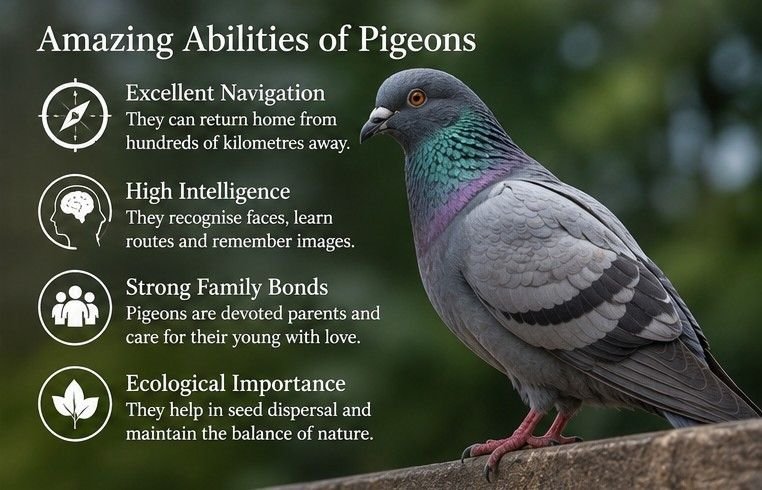
- Extraordinary homing ability
Scientists believe pigeons use several methods for navigation, including the position of the sun, familiar landmarks, Earth’s magnetic field and even their sense of smell.

Lifespan
Wild pigeons generally live 3–6 years, although many die earlier because of predators and accidents.
Under protected conditions they commonly live 10–15 years, and some individuals survive beyond 20 years.
Family Life
Pigeons are devoted parents.
Most species form long-term pairs.
The female usually lays two eggs.
Both parents incubate the eggs and later feed their chicks with a highly nutritious secretion called crop milk, produced inside the crop of both males and females. Few other birds possess this remarkable ability.
Food
Pigeons mainly eat:
- Seeds
- Grains
- Rice
- Wheat
- Fruits
- Small berries
- Young leaves
In cities they also feed on food provided by people.
Pigeons During the World Wars
Before modern communications, pigeons played an essential military role.
Thousands of carrier pigeons transported confidential messages during both World War I and World War II.
Many soldiers owed their lives to pigeons that successfully delivered messages despite enemy fire.
Several pigeons received military decorations for exceptional bravery.
Pigeons in London
London supports one of Europe’s largest urban pigeon populations.
The most common species is the Feral Pigeon, descended from the wild Rock Dove.
Other pigeons found in and around London include:
- Common Wood Pigeon
- Eurasian Collared Dove
- Stock Dove
- Turtle Dove (now much rarer)
These birds live in parks, railway stations, churches, bridges, historic buildings and riverside areas.
Why Are Pigeons Seen on Historic Buildings?
Historic buildings provide ideal nesting places because their ledges, towers and stone carvings resemble natural cliffs where Rock Doves originally nested.
The towers and ornamental architecture of the Palace of Westminster therefore offer excellent resting and nesting sites.
The Second World War and Parliament
During the Second World War, London experienced extensive bombing, smoke, noise and destruction.
Many birds, including pigeons, temporarily abandoned heavily disturbed areas.
However, after peace returned, pigeon populations naturally recovered as food became available and normal urban life resumed.
Although stories are sometimes told that the British Government deliberately attempted to bring pigeons back to the Parliament building, historians have found no convincing evidence of any official programme specifically for that purpose.
Benefits and Problems
Pigeons provide several benefits.
They:
- Help disperse seeds.
- Support ecological research.
- Delight birdwatchers and tourists.
- Connect modern cities with nature.
- Have contributed greatly to military history.
Large populations, however, can also create sanitation and maintenance challenges if not properly managed.

Pigeons in India
India possesses several native pigeon and dove species.
Common examples include:
- Rock Pigeon
- Spotted Dove
- Laughing Dove
- Eurasian Collared Dove
- Yellow-footed Green Pigeon (the State Bird of Maharashtra)
- Emerald Dove
- Mountain Imperial Pigeon in northeastern forests
These birds inhabit temples, villages, forests, agricultural land and cities throughout the country.
Why Do Pigeons Live on Shri Jagannath Temple at Puri?
The sacred temple of Prabhu Shri Jagannath provides an ideal habitat.
Several factors explain why pigeons gather there.
High Structures
The towering temple resembles the rocky cliffs where wild Rock Doves naturally nest.
Safety
For centuries, the temple has been regarded as a sacred place where birds are rarely disturbed.
Food
Pilgrims often scatter grains and rice, providing abundant food.
Nesting Places
Numerous ledges, carvings and small openings in the ancient stone architecture offer excellent nesting sites.
Tradition
For generations, pigeons have become part of the temple’s living environment.
Many devotees regard them as symbols of peace and divine grace.
Although popular beliefs sometimes associate the pigeons with religious miracles, ornithologists explain their presence mainly by the excellent habitat and continuous food supply.
Intelligence
Pigeons are far more intelligent than many people realise.
Experiments have shown that they can:
- Recognise individual human faces.
- Distinguish paintings by different artists.
- Remember hundreds of images.
- Learn complex routes.
- Return home from hundreds of kilometres away.
Their intelligence has made them valuable subjects in scientific research.
Conservation
Although common urban pigeons are abundant, several wild pigeon species are declining because of:
- Forest destruction
- Hunting
- Illegal trapping
- Climate change
- Habitat loss
Protecting natural habitats benefits pigeons along with countless other bird species.
Conclusion
Pigeons are among humanity’s oldest feathered companions. They have carried messages during wars, inspired poets and artists, enriched religious traditions and adapted successfully to cities across the globe.
The pigeons flying above London’s historic buildings and those circling the sacred spire of Shri Jagannath Temple in Puri belong to the same remarkable family that has shared its history with humankind for thousands of years.
Their loyalty, intelligence, devotion to family and astonishing homing ability remind us that even the most familiar birds possess extraordinary natural gifts. By respecting and protecting them, we preserve not only an important part of nature but also a living chapter of human civilisation.