
The Pride of Knowledge and the Wisdom of Life
By Lokanath Mishra
In the sacred town of Puri, people often teased one another by saying, “Oh, you think you are a great Puri Pandit, don’t you?” Beneath this light remark lay a timeless truth about knowledge and humility.
Long ago, in Markandeswar Sahi of Puri, there lived a renowned scholar named Laxman Sastry. He was a man of immense learning—well-versed in the Vedas, fluent in the Upanishads, and able to recite all 700 verses of the Bhagavad Gita effortlessly. People in and around Puri admired him deeply and would often say, “There is no one wiser than him in our region.”
One day, Laxman Sastry, along with a few other learned pandits, received an invitation from the king of Parikud, an island region situated in the middle of the vast Chilika Lake. They were invited to perform a grand yajna in the royal palace. Accepting the honor, the group set out on their journey.
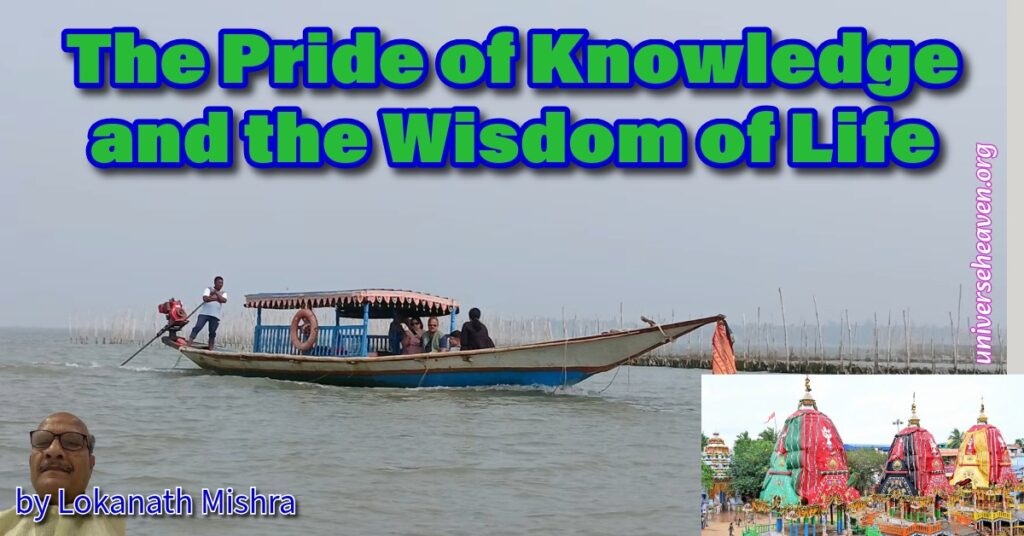
To reach Parikud, they had to cross the expansive waters of Chilika. At the shore, they boarded a simple wooden boat operated by a humble boatman. His appearance was modest—torn clothes, sunburnt skin, and rough hands that spoke of years of hard labor.
As the boat moved gently across the lake, Laxman Sastry, sitting among the other pandits, looked at the boatman and asked,
“Tell me, how much education have you received?”
The boatman replied respectfully,
“None, Maharaj. I have never studied.”
Laxman Sastry smiled faintly and said,
“Then a quarter of your life is wasted.”
After some time, he questioned again,
“Do you know anything about the Vedas, the Upanishads, or the nature of Brahman and the soul?”
The boatman shook his head,
“No, Maharaj.”
The scholar remarked,
“Then half of your life is wasted.”
The other pandits listened silently as Sastry continued,
“Have you read the Gita? Do you understand Karma Yoga, Jnana Yoga, or Bhakti Yoga?”
The boatman replied simply,
“Maharaj, I only know how to row this boat and take people safely across the lake.”
Laxman Sastry said with a tone of pride,
“Then three-quarters of your life is wasted.”
The boatman remained quiet, focusing on rowing.
Suddenly, the sky changed. Thick, dark clouds gathered overhead, and a fierce wind began to roar across Chilika. The calm waters turned violent, waves rising high and striking the boat. It began to sway dangerously, and the pandits grew anxious.
In the midst of the storm, the boatman turned toward Laxman Sastry and asked calmly,
“Maharaj, do you know how to swim?”
The scholar, now pale with fear, replied,
“No… I do not.”
The boatman said gently but firmly,
“Then, Maharaj, your entire life is about to be wasted now. What use is all your knowledge if you do not know the skill needed to save your own life?”
At that moment, Laxman Sastry fell silent. His pride vanished, replaced by a deep realization. The other pandits, too, understood the truth in the boatman’s words.

Moral of the Story
This story offers a profound lesson:
Knowledge is not merely the recitation of scriptures or the display of intellectual pride. True knowledge is that which serves us in real life and helps us act wisely in critical moments.
As Lord Krishna says in the Bhagavad Gita:
“Yogah Karmasu Kaushalam”
— Excellence in action is true Yoga.
If knowledge becomes a source of ego, it distances us from true wisdom. Real understanding lies in humility, practical skill, and respect for every form of knowledge—whether from scriptures or from life itself.