
Rath Yatra in London: Lord Jagannath’s Chariot Festival as a Celebration of Faith, Unity, and Cultural Harmony
By Lokanath Mishra
Introduction
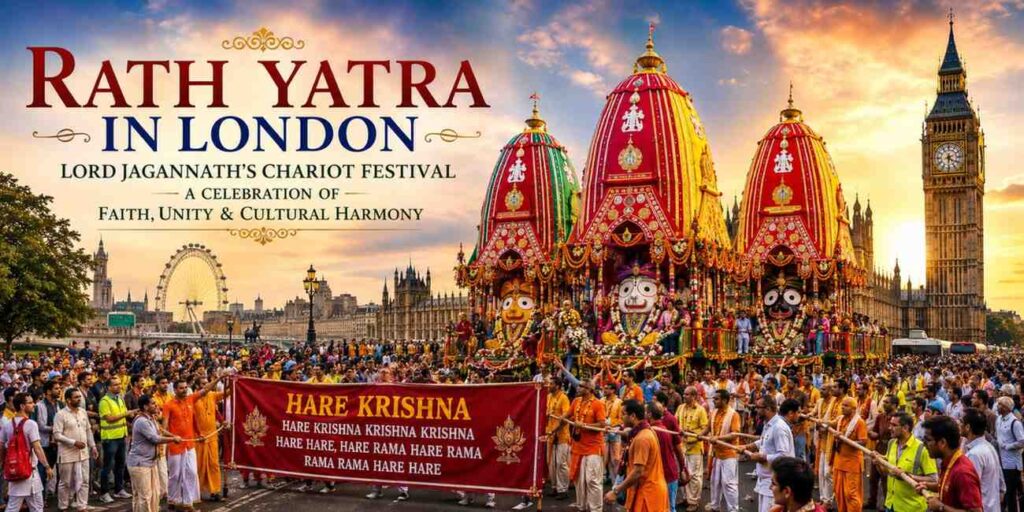
Among the many Hindu festivals celebrated in the United Kingdom, the Rath Yatra of Lord Jagannath occupies a unique place. Originally celebrated for centuries in Puri, Odisha, India, the festival has crossed geographical boundaries to become an annual spiritual and cultural event in London. Every summer, thousands of devotees and visitors gather to witness the majestic procession of Lord Jagannath, Lord Balabhadra, and Devi Subhadra through the streets of the British capital. The festival is not only a religious observance but also a powerful symbol of multiculturalism, peace, and universal brotherhood.
The London Rath Yatra demonstrates how an ancient Hindu tradition has become part of Britain’s diverse cultural landscape while preserving its sacred spiritual significance.
The Origin of Rath Yatra
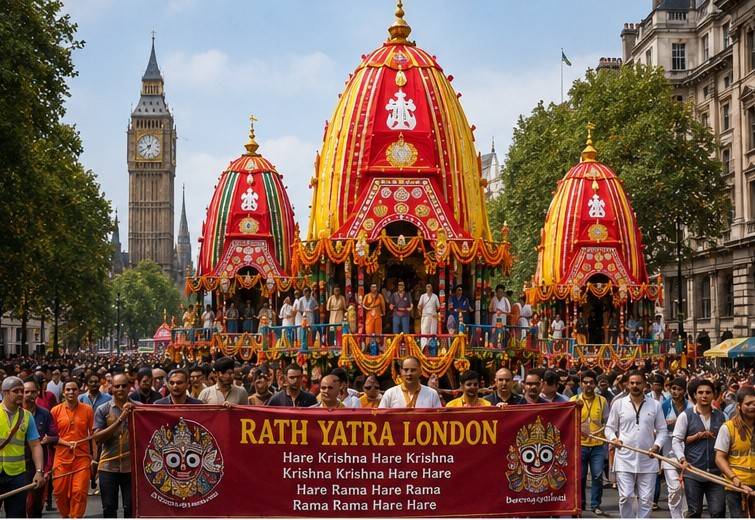
The Rath Yatra, or Chariot Festival, has its origins in the sacred city of Puri in Odisha. According to Hindu tradition, Lord Jagannath, accompanied by His elder brother Lord Balabhadra and sister Devi Subhadra, leaves the Jagannath Temple once every year to visit the Gundicha Temple, symbolising His desire to bless all humanity without distinction of caste, creed, nationality, or social status.
Unlike many temple rituals restricted to sanctified premises, the Rath Yatra brings the deities onto public streets, allowing everyone to have their darshan. This universal accessibility reflects the compassionate nature of Lord Jagannath, whose name literally means “Lord of the Universe.”
Rath Yatra Comes to London
The celebration of Rath Yatra in London began in the late twentieth century through the efforts of the International Society for Krishna Consciousness (ISKCON). Inspired by the annual festival in Puri, devotees organised the first London Rath Yatra to introduce British society to the spiritual message of Lord Jagannath.
Over the decades, the festival has grown into one of Europe’s largest Hindu public celebrations. Each year, devotees from across the United Kingdom and visitors from many countries participate with deep devotion.
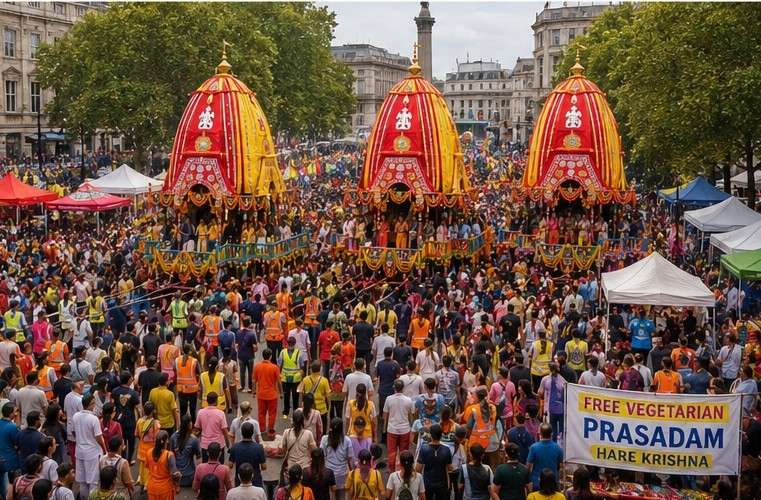
The beautifully decorated wooden chariots carrying Lord Jagannath, Lord Balabhadra, and Devi Subhadra travel through central London amid continuous chanting of the Hare Krishna Mahamantra, devotional music, and joyous dancing.
The Grand Procession
The Rath Yatra procession transforms the streets of London into a vibrant spiritual celebration.
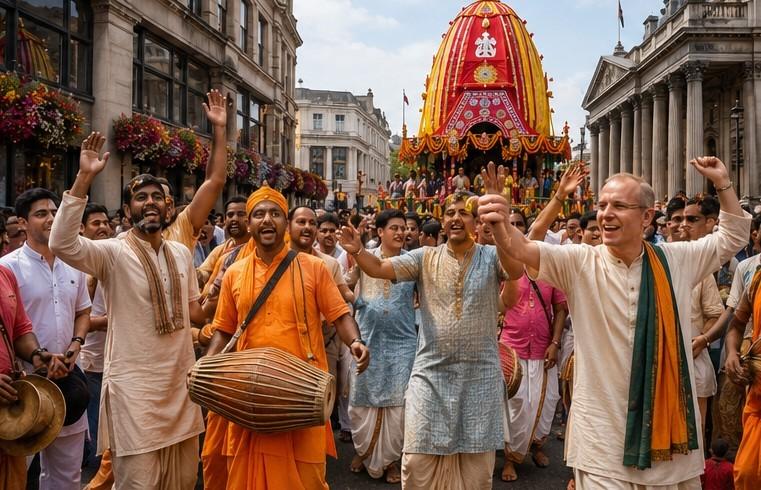
Men, women, children, monks, and visitors from every background pull the sacred ropes of the chariot. According to Hindu belief, pulling Lord Jagannath’s chariot is considered an act of great spiritual merit, symbolising one’s desire to draw closer to God.
Devotional singing (kirtan), traditional Indian musical instruments, classical dances, and colourful cultural performances accompany the procession. The atmosphere is filled with joy, devotion, and a spirit of universal friendship.
People standing along the route enthusiastically greet the procession, many receiving sanctified vegetarian food (prasadam) distributed freely by volunteers.
A Festival Beyond Religion
One of the remarkable features of London’s Rath Yatra is its inclusiveness.
Although deeply rooted in Hindu tradition, the festival welcomes everyone irrespective of religion, nationality, or ethnicity. British families, tourists, students, and people from many faiths participate with curiosity and respect.
The festival has become an important example of Britain’s multicultural society, where ancient religious traditions are celebrated openly and appreciated by diverse communities.
Many participants are inspired by the festival’s central message of peace, compassion, equality, and devotion to God.
The Role of Volunteers
The success of the London Rath Yatra depends upon hundreds of dedicated volunteers.
Months before the festival, volunteers prepare the chariots, decorate the deities, organise cultural programmes, coordinate public safety, distribute literature, and prepare thousands of servings of vegetarian prasadam.
Doctors, engineers, teachers, students, business owners, homemakers, and retired professionals work together selflessly. Their voluntary service reflects the Hindu ideal of seva—serving humanity as an offering to God.
Bhaktivedanta Manor: The Spiritual Centre
Much of the spiritual inspiration for the London Rath Yatra comes from Bhaktivedanta Manor in Hertfordshire, one of the most important centres of Krishna devotion outside India.
Donated in 1973 by the legendary musician George Harrison of The Beatles, the Manor has become a major centre for worship, education, cultural preservation, and spiritual learning.
Throughout the year it welcomes thousands of pilgrims, but during the Rath Yatra season it becomes especially vibrant with devotional preparations.
Cultural Significance
For British Hindus, the Rath Yatra represents much more than a religious festival.
It strengthens cultural identity among younger generations born in Britain while connecting them with the spiritual heritage of India. Children learn devotional songs, traditional dances, scriptures, and the history of Lord Jagannath.
The festival also promotes Indian classical music, Odissi dance, Bharatanatyam, folk traditions, Sanskrit prayers, and vegetarian cuisine, introducing these cultural treasures to wider British society.
Jagannath: Lord of the Universe
Lord Jagannath occupies a unique place in Hindu philosophy.
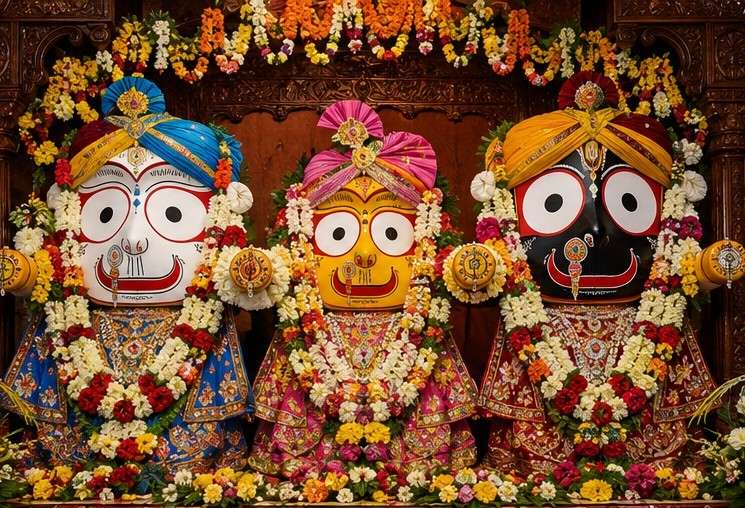
Unlike conventional representations of Hindu deities, Jagannath’s large round eyes, smiling face, and simplified form symbolise His universal nature. His appearance transcends conventional artistic styles and reminds devotees that God belongs to every human being.
The Rath Yatra carries this universal message through the streets of London, demonstrating that spirituality can unite people beyond national, racial, or religious boundaries.
Social Harmony and Community Service
The London Rath Yatra also promotes charitable activities.
Free vegetarian meals are distributed to thousands of visitors. Educational exhibitions explain the philosophy of the Bhagavad Gita, yoga, meditation, and vegetarian living. Cultural workshops encourage dialogue between different communities.
Environmental awareness has become an important feature of recent celebrations, with organisers emphasising recycling, sustainable materials, and responsible public participation.
The festival thus combines devotion with social responsibility.
The Global Legacy of Puri
Although thousands of kilometres separate London from Puri, the spiritual bond remains profound.
Every year millions gather in Puri to witness the world’s oldest and largest chariot festival. London’s Rath Yatra serves as an extension of that sacred tradition, carrying Lord Jagannath’s message across continents.
For devotees of Odia heritage, the festival evokes memories of home while allowing younger generations born abroad to experience the timeless traditions of their ancestors.
For non-Indians, it provides an opportunity to appreciate one of the world’s oldest living religious traditions.
Conclusion
The Rath Yatra in London beautifully illustrates how faith can transcend geographical boundaries while preserving its essential spiritual message. It is a celebration of devotion, equality, compassion, and cultural harmony.
As the magnificent chariots of Lord Jagannath, Lord Balabhadra, and Devi Subhadra move through the streets of London each year, they remind humanity that God belongs to all people and that love, service, and unity are universal values.
The continued success of the London Rath Yatra reflects the growing contribution of the Hindu community to British society. It enriches the cultural life of the nation while preserving one of India’s most sacred traditions for future generations.
In an increasingly interconnected world, the London Rath Yatra stands as a shining example of how ancient spiritual heritage can flourish in a modern multicultural society, bringing people together in celebration of peace, friendship, and the universal Lord—Jagannath.
— Lokanath Mishra