
Mahabharata Based on Sarala Mahabharata (Odia Tradition)
A Story of the Dvapara Yuga in Prose:
Part 34-D: Lakhabindha
By Lokanath Mishra
Balarama spoke with pain in his heart, “Kanha, I cannot bear to see the Kauravas in such misery. Come, let us return to Dwaraka.”
Krishna replied gently, “We shall surely go, brother. Yet my mind does not agree to leave without knowing who will win the maiden’s hand.”
At that very moment, Jarasandha confronted Arjuna on the battlefield. Arjuna released a single sharp arrow; it pierced Jarasandha’s armour and struck his chest. The mighty king lost consciousness and collapsed upon his chariot. His charioteer quickly drove him away from Arjuna’s sight.
Balarama, who had long carried anger against Jarasandha, turned to Krishna and said, “I truly underestimated Arjuna’s strength. This wicked Jarasandha has caused us endless suffering. Tell Partha to end his earthly play here and now.”
Krishna smiled and replied, “No, brother. Arjuna never strikes a warrior who is unarmed, retreating, or fleeing the field. Do not worry about Jarasandha. One day, by the hands of the Pandavas, I myself shall grant him death. For now, enjoy the spectacle of war.”
Indeed, the battle was astonishing to behold. On one side stood countless kings; on the other, merely four warriors disguised as Brahmins. Sahadeva’s mace struck Shakuni so powerfully that he lost consciousness. Ashwatthama, Kripa, Karna, and others withdrew, saving their own lives.
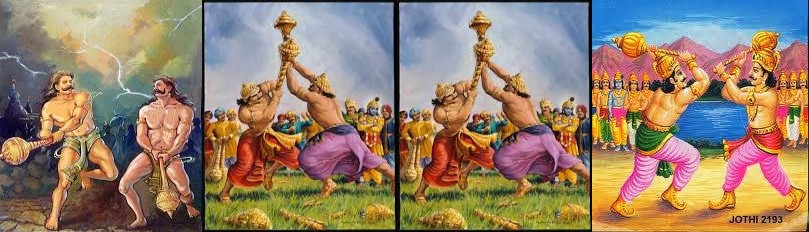
Duryodhana charged forward atop a mighty elephant. Bhima seized the beast by its legs and overturned it, throwing Duryodhana violently to the ground. As Duryodhana fled on foot, Bhimasena roared, “Stop, brother, stop!” Without looking back, Duryodhana ran until he stood before Bhishma and Drona.
Bhima stood like a mountain, his footsteps making the earth tremble. Bhishma and Drona recognized not only his identity but also the blazing fire of vengeance within his heart. Bhishma cried out in anger, calling him foolish and wicked, while Drona warned that if they did not fight, the king would accuse them of cowardice.
Together, Bhishma and Drona showered arrows upon Bhima. But mercy had no place in Bhima’s heart that day. Weapons struck his body and fell away harmlessly. With his mace, he struck the horses of Bhishma’s and Drona’s chariots, forcing both commanders to retreat from the battlefield along with the fleeing Kaurava army.
The battlefield gradually grew silent. Most warriors had departed, and daylight faded into dusk. Yet in the half-darkness, Bhima continued to pursue and strike the remaining foes.
Soon, five hostile kings—Shishupala, Dantavakra, Shalva, Rukmi, and Pundarika—fell into Bhima’s path while attempting to flee. Enraged, Bhima seized all five by their hair with his powerful hands, lifted them off the ground, and dragged them toward Yudhishthira.

By then, Draupadi, Keshini, Arjuna, Nakula, and Sahadeva had gathered together. Seeing the five kings bound by Bhima’s grip, Yudhishthira rose from his seat. Bhima declared, “These five caused great disturbance in the assembly. Tell me, brother, what punishment they deserve.”
Yudhishthira answered calmly, “Violence and revenge do not befit Brahmins. Let them go.”
Though Bhima was not one to spare enemies without punishment, he obeyed his elder brother’s command. He forced each king to bow at Yudhishthira’s feet and released them. They fled and later reunited with Duryodhana and others, many leagues away.
Duryodhana, who had witnessed Bhima capturing them, questioned, “How did that sinner let you go?”
Shishupala replied, “Their eldest brother, the Brahmin among them, is exceedingly forgiving and righteous. By his mercy, we were freed.”
Under the cover of night, the Pandavas departed with Draupadi and Keshini toward the potters’ quarter. Drupada, Dhrishtadyumna, and Shikhandi entered the palace to arrange lighting and prepare the assembly hall, unaware of the Pandavas’ departure.
Thus ended that fierce and wondrous encounter—an episode where strength bowed before righteousness, and mercy triumphed over vengeance in the unfolding saga of the Dvapara Yuga.
( to be continued)