

THE DAY THE SIRENS LOOKED AWAY
By Lokanath Mishra:
Ananya Sharma had learned, over forty years of living, that danger rarely announced itself. It arrived quietly, disguised as routine. That Monday afternoon felt ordinary enough—lectures completed, attendance sheets tucked into her cloth bag, the echo of student voices trailing behind her as she stepped out of the college gate. The clock near the administration block read 4:27 pm. The police station stood across the road, its faded blue signboard catching the last weak light of the winter sun. She remember thinking, absurdly, that the air smelled of chalk and dust, the way it always did.

The Bolero came fast, skidding slightly as it halted. For a fraction of a second, she thought it was an accident. Then hands grabbed her—rough, practiced hands. Someone covered her mouth. Someone else pressed cold metal against her ribs. Students shouted. A security guard ran. The sound of gunfire cracked the air, not aimed at bodies but at courage. Panic scattered the crowd. Ananya felt herself lifted, pushed, swallowed by the vehicle. The door slammed shut. The engine roared. The police station remained where it was.

Inside the car, time fractured. Her thoughts leapt backward, violently, as if her life were a reel being dragged in reverse.
Fifteen years earlier, she had stood in another kind of vehicle, decorated with marigolds, her hands trembling under red bangles. Raghav Verma had looked confident, almost smug, as if marriage were a prize he had won rather than a partnership he was entering. She had been twenty-five then, hopeful in the way women are taught to be hopeful—quietly, obediently, without asking too many questions.
The years that followed were not dramatic. That was their cruelty. Raghav was not a man who hit. He was a man who dismissed. Who stayed out late and came home smelling of other people’s lives. Who learned to weaponize silence. Ananya adapted, as women do. She adjusted her expectations, lowered her voice, poured herself into motherhood. Aarav arrived and became the axis around which her world rotated. She believed endurance was love’s mature form.

When her younger sister Kavita arrived with a single suitcase and swollen eyes, Ananya did not hesitate. Blood was blood. Kavita spoke of a failed marriage, of needing time. “Just until I find work,” she said. Ananya welcomed her into the home she had carefully held together.
At first, it felt like healing. Kavita helped with cooking, listened to Aarav’s stories, laughed easily. Then the house began to tilt. Raghav lingered longer in common rooms. Conversations extended past midnight. Private jokes formed, excluding Ananya without ever naming her exclusion. She noticed changes in small things—perfume missing, doors closing softly, glances exchanged too quickly. She told herself she was imagining it. That suspicion was uglier than truth.
The night she walked into the living room and saw Kavita asleep on the sofa, Raghav’s arm draped casually around her, something inside Ananya went silent. Kavita opened her eyes and looked directly at her, not startled, not ashamed.
“He loves me,” Kavita said evenly. “You don’t deserve him.”
Betrayal, Ananya learned then, did not scream. It stated facts.
What followed was harassment dressed as domestic normalcy. Insults disguised as concern. Pressure applied gently but constantly. When Ananya protested, she was accused of hysteria. When she threatened to leave, she was reminded of her son. She tried anyway. She packed clothes. She reached for Aarav. Raghav stood in the doorway.
“He stays,” he said. Not angrily. Certainly.
The law moved slowly. Complaints were filed, statements recorded, promises made. Kavita moved into the master bedroom. Ananya moved back to her father’s house with empty arms and a chest full of unspent love.
Mahendra Sharma aged visibly during those months. A retired schoolteacher, he believed in systems, in patience, in justice as an eventual certainty. Savitri Sharma prayed. Ananya enrolled herself in a postgraduate course, then took up a lecturer’s post at a reputed college. Teaching gave her language for pain. Words became a scaffold that kept her upright. Her students sensed something unspoken in her, a gravity that made them listen.
She filed another case for custody. Another complaint for harassment. Files thickened. Action did not.
The day she was abducted, several of her students tried to intervene. Ritika Malhotra screamed. Faizan Sheikh threw a stone. Manoj Gurjar, the security guard, ran until the gunshots stopped him. Inspector Devendra Kaman later described the incident calmly: three to four men, firing in the air, no casualties. The CCTV in Pahari captured it all—faces, vehicle, violence. The footage existed. Justice did not follow.
Three police teams were formed. Headlines flickered briefly. Mahendra Sharma stood before reporters, his voice cracking. “My daughter was married fifteen years ago. She has a son. Her husband and sister ruined her life. I warned the police.” His words fell into the familiar void reserved for inconvenient truths.
Inside the Bolero, Ananya lost track of hours, then days. She was moved, hidden, threatened. Names floated around her like shadows—Suraj Khan, Irfan Ali. She understood, slowly, with a terrible clarity, that this was not random violence. This was orchestration. A solution to a problem that refused to disappear quietly.
She did not break. That, later, would surprise people.
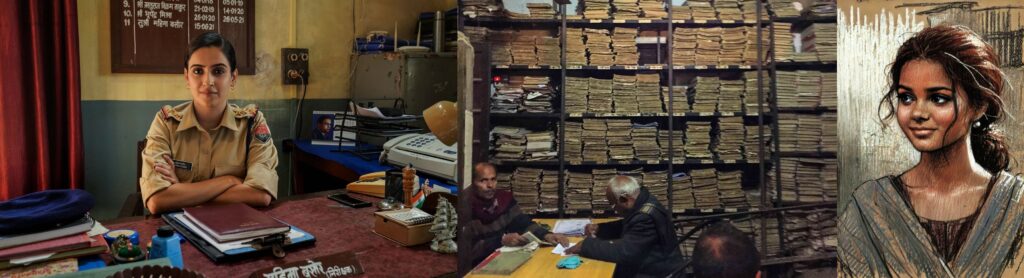
A year passed. The case cooled. Raghav and Kavita married publicly. Aarav grew taller, quieter. He stopped asking about his mother because answers were painful. Journalist Arvind Kulkarni tried to revive the story, connecting dots no one wanted connected. His article vanished before it could finish breathing.
Ananya remained absent. Rumors replaced facts. Dead. Trafficked. Forgotten.
Until one morning, in another district, a thin woman with scars on her wrists walked into a police station. Constable Meera Solanki looked up.
“I am Ananya Sharma,” the woman said. “I was abducted one year ago.”
Sirens finally screamed, as if sound could make up for time.
Investigations reopened. Statements were revised. Evidence resurfaced. Some men were arrested. Some were not. The law did what it always did—moved carefully, cautiously, without apology for delay. Raghav denied everything. Kavita cried. Aarav stared at his mother as if she were a ghost made real.
Ananya did not return to teaching. She understood now that survival was not the same as restoration. She began writing instead—not for courts, not for headlines, but because silence had cost her too much.
She wrote about betrayal that wears familiar faces. About institutions that look away. About sirens that arrive only when it is safe to arrive.
And about a woman who refused to vanish, even when the world found it convenient that she did.
ସାହିତ୍ୟିକ ସୁରେନ୍ଦ୍ର ମହାନ୍ତିଙ୍କ ପୁଣ୍ୟତିଥିରେ ଶ୍ରଦ୍ଧାଞ୍ଜଳି
Collateral Tomorrow
A Story of Dvapar Yuga in Prose (Part-27-C)