
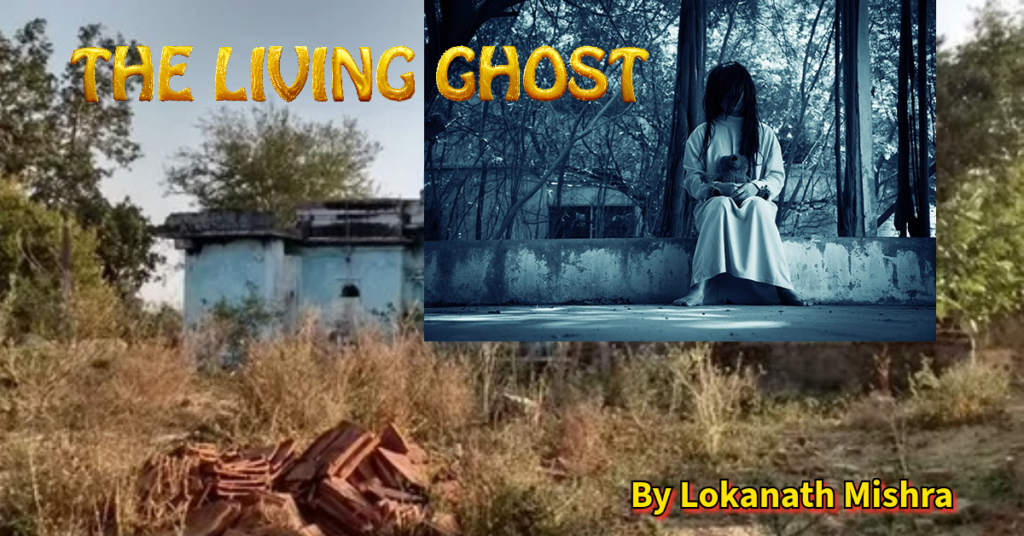
THE LIVING GHOST
By Lokanath Mishra
(Based on a True Incident)
Korua village lay where the Mangala River curved like a sleeping serpent, its waters whispering secrets to the night. The river was sacred—but it was also feared. On its bank stood the ancient shrine of Goddess Bhagabati Kalika, dark, fierce, and unforgiving.

The elders said the Goddess had ruled Korua since the eighth century. She did not bless easily. She judged. She punished. And when she spoke, she did so through fear.
Every Ashwin Ashtami, blood touched the earth in her name. Every Chaitra, the village united in the great Jantala feast. Before marriages, vows, or sacred beginnings, her permission was demanded. No one dared ignore her.
Yet even the Goddess could not stop what came next.
The Woman Who Screamed on Saturdays :
Nari Raut married a widow from a nearby village. She came with two children from her first husband, and in time, she bore four more children with Nari. Six children filled the house with noise, hunger, and life.
For a while.
Then, on one Saturday night, the lamps went out by themselves.
The woman began to shake.
Her eyes rolled back. Her mouth twisted unnaturally wide. A voice burst from her throat—not hers.
“Why did you replace me?”
The children screamed. Neighbors ran in. By the time anyone reached her, she had collapsed—cold, breath shallow, eyes staring at something no one else could see.
From that night onward, every Saturday, the same thing happened.
The possession always began after sunset.
Her body would stiffen like a corpse. Her voice turned hollow, echoing as if spoken from underground. She spoke of places she had never visited. She named people long forgotten. She described scars on her old husband’s body that only he could have known.
The village whispered:
“Her dead husband comes back every Saturday.”
Twelve Years of Fear:
For twelve years, the ritual repeated.
Priests chanted. Ash was smeared. The Goddess was invoked in full Shodasha Upachara worship. The spirit was driven out—screaming, cursing, promising to return.
And it always did.
The children grew up watching their mother possessed by something that hated them. The two older children hid in corners, terrified, because the voice sometimes spoke only to them:
“You belong to me.”
The four younger children cried without knowing why.
Some nights, villagers heard footsteps around the house when no one was awake. Other nights, the woman laughed in her sleep—low, broken laughter that didn’t sound human.
People stopped passing the house after dark.
The Man Who Should Not Exist:
One afternoon, under a burning sun, a stranger walked into Korua.
Thin. Aged. Alive.
He stood before the village elders and said calmly:
“I am the man you buried.”
The ground seemed to tilt.
He claimed he had never died. Years ago, he had run away to Bengal with another woman, abandoning his wife and children. He let the world believe he was dead—and never looked back.

Until now.
The villagers stared at him in horror.
Because if this man had been alive for twelve years…
Then what had been entering the woman’s body every Saturday night?
The Final Judgment
An emergency village council was called. The shrine of Goddess Kalika was consulted. Silence fell thick as smoke.
The verdict came without argument.
The widow would return to her first husband—the man once believed dead.
The two elder children would go with their real father.
The four younger children would remain behind.
No one celebrated.
Because as the woman left the village, she turned back once—just once—and smiled.
That night, for the first time in twelve years, Saturday passed without possession.
But near the Mangala River, some villagers swear they heard footsteps…
and a voice whispering:
“Living or dead… betrayal always comes back.”
And in Korua, people still say:
Not all ghosts are dead.
Some are alive—and far more dangerous.
The Quiet House on Colony Road
A Brief but Memorable Sojourn in Diu