
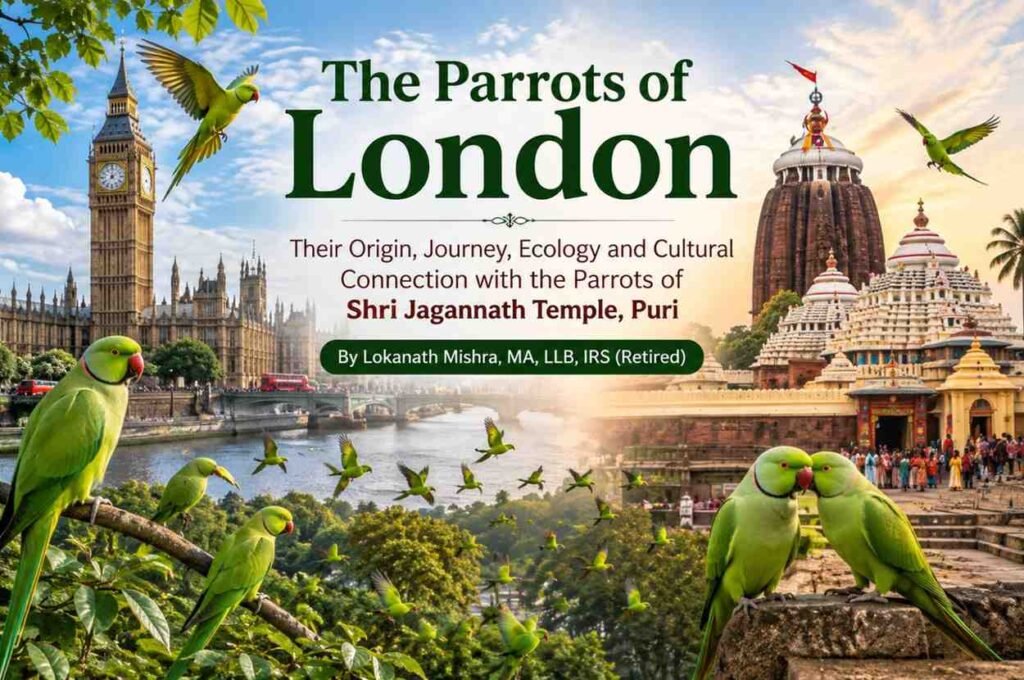
The Parrots of London: Their Origin, Journey, Ecology and Cultural Connection with the Parrots of Shri Jagannath Temple, Puri
By Lokanath Mishra, MA, LLB, IRS (Retired)
Introduction
One of the most delightful surprises for visitors to London is the sight of thousands of bright green parrots flying over parks, gardens, riversides and residential areas. Their loud calls and graceful flight have become a familiar feature of the city’s landscape. Few people realize that these parrots are not native to Britain. They originated thousands of kilometres away in Asia and Africa and have successfully established one of the world’s largest urban wild parrot populations.
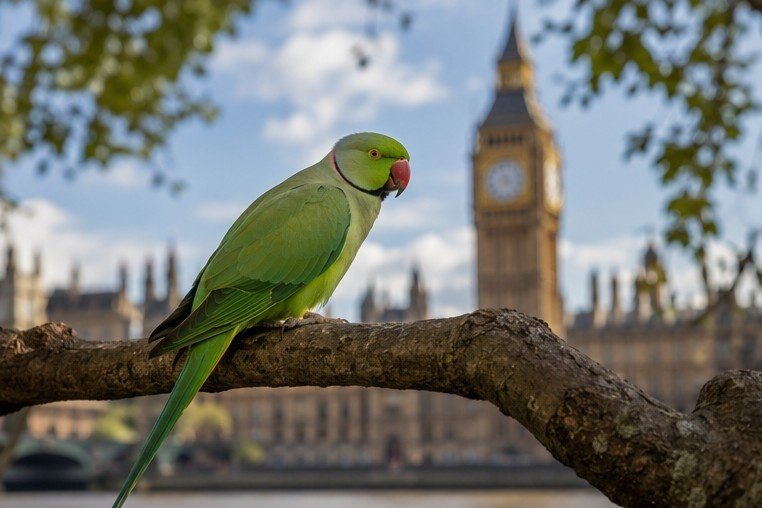
During my visit to London, I had the opportunity to observe these beautiful birds in parks and tree-lined neighbourhoods. Their adaptability demonstrates how wildlife can flourish even in one of the world’s largest metropolitan cities when suitable habitats are available.
Which Parrots Live in London?
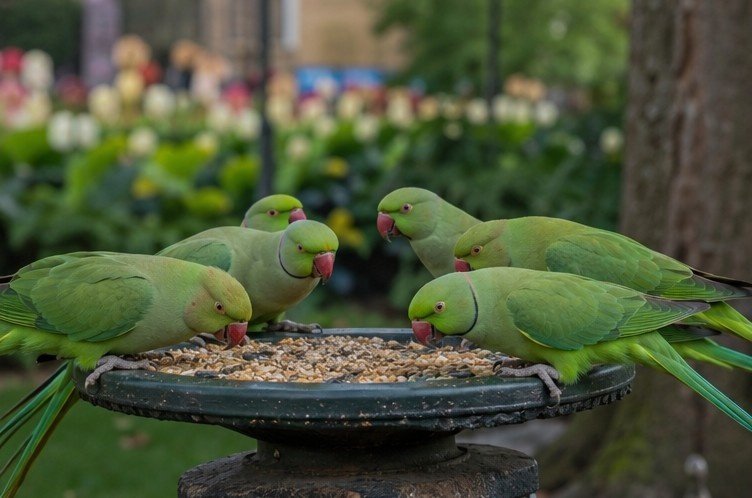
The parrots commonly seen in London are the Rose-ringed Parakeets (Psittacula krameri). These medium-sized green parrots have long tails and a distinctive red beak. Adult males possess a narrow black-and-pink ring around the neck, giving them the name “rose-ringed.”
They are intelligent, social and highly adaptable birds that usually live in flocks rather than alone.
Their Original Home
The Rose-ringed Parakeet is naturally found in:
- India
- Pakistan
- Bangladesh
- Sri Lanka
- Nepal
- Parts of Myanmar
- Several countries of sub-Saharan Africa
In India they are common in forests, villages, orchards, temple gardens and agricultural fields. They are especially abundant in Odisha, West Bengal, Uttar Pradesh, Rajasthan, Gujarat and many southern states.
How Did They Come to London?
There are several well-supported explanations.
The most widely accepted explanation is that many Rose-ringed Parakeets were imported into Britain during the twentieth century as pet birds. Because they are attractive, intelligent and capable of mimicking sounds, they became very popular in the pet trade.
Some escaped accidentally from homes, aviaries and pet shops. Others were intentionally released by owners who could no longer keep them.
Over many years these escaped birds found suitable nesting sites, formed breeding colonies and gradually established permanent wild populations.
Several popular stories suggest that parrots escaped during the filming of movies or after storms damaged aviaries. While these stories are well known, there is no convincing scientific evidence that any single event created London’s population. Researchers conclude that the population developed through repeated escapes and releases over many years.
Why Could They Survive in Britain?
Many people once believed that tropical parrots could never survive the cold climate of Britain. Surprisingly, they adapted extremely well because:
- Southern England has relatively mild winters compared with many other parts of Europe.
- London has a warmer “urban heat island” effect.
- Numerous parks and gardens provide suitable nesting trees.
- People regularly feed birds in gardens.
- Fruit trees, berries, seeds and buds are abundant.
- Natural predators are relatively few.
These favourable conditions enabled the parrots to increase steadily.
Present Population
The exact number changes from year to year, but recent scientific surveys estimate that the United Kingdom now has well over 100,000 Rose-ringed Parakeets, with the largest concentration in Greater London and south-east England. London alone supports many tens of thousands of individuals, making it one of the largest wild urban parakeet populations in Europe.
The population has grown steadily over the past few decades because breeding success is high and food is plentiful.
Their Daily Routine
The parrots follow a remarkably organised daily schedule.
At sunrise they leave their communal night roosts in large noisy flocks.
During the day they spread across different parts of London in search of food. They visit:
- Parks
- Public gardens
- Orchards
- Residential gardens
- Golf courses
- Nature reserves
- Riverbanks
They feed on:
- Fruits
- Seeds
- Flower buds
- Nuts
- Berries
- Young leaves
- Grain
- Bird feeders provided by residents
Throughout the day the birds remain in small feeding groups before gradually returning toward their communal roosts.
Why Do Thousands Gather at One Place Every Evening?
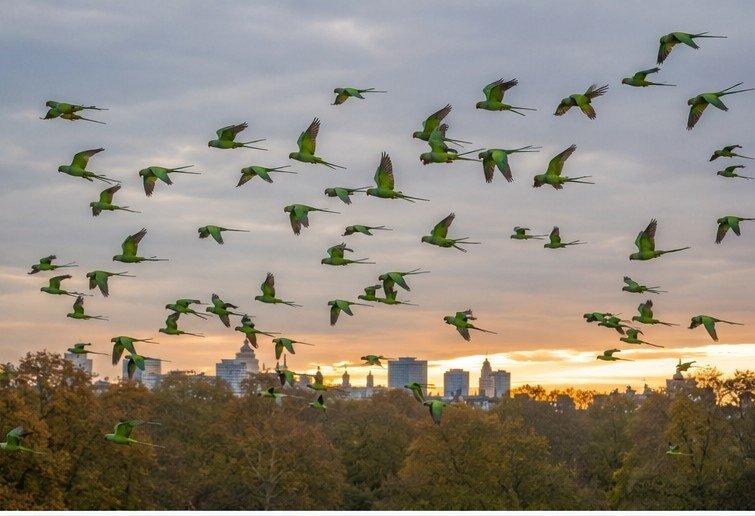
Perhaps the most fascinating behaviour of London’s parrots is their communal roosting.
Before sunset thousands of parrots fly from many directions toward a few large roosting sites. These sites usually contain tall evergreen trees or mature deciduous trees.
Scientists believe communal roosting offers several advantages:
Protection from predators
Large groups make it difficult for predators such as hawks to attack individual birds.
Exchange of information
Birds may learn from one another about food sources available the following day.
Warmth
Roosting together helps conserve body heat during winter nights.
Social interaction
Parrots are highly social birds. They communicate constantly through loud calls before settling for the night.
One of London’s best-known winter roosts is found around parts of west London, where spectacular evening gatherings attract birdwatchers and photographers.
Benefits to the People of London
Although the parrots sometimes compete with native birds for nesting cavities and may occasionally damage fruit crops, they also provide several benefits.
Enhancing Urban Beauty
Their bright green feathers add colour and life to London’s parks throughout the year.
Tourism
Many tourists specifically visit parks to watch and photograph these unusual birds.
Environmental Education
Schools use the parrots to teach children about ecology, adaptation and wildlife conservation.
Scientific Research
The birds have become valuable subjects for research into urban ecology, invasive species and animal behaviour.
Public Enjoyment
Many London residents enjoy feeding and observing the parrots in their gardens, strengthening people’s appreciation of nature.
Parrots in the Temple of Prabhu Shri Jagannath, Puri
The Rose-ringed Parakeets of London remind Indian visitors of similar parrots seen around the sacred temple town of Puri in Odisha.
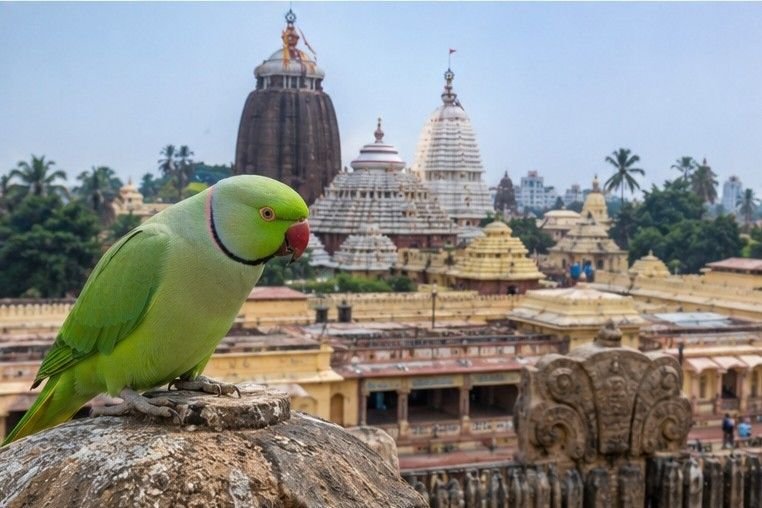
For centuries, green parrots have been observed in and around the temple precincts, nearby gardens and old trees. They find shelter in large trees and feed on fruits, seeds and grains available in the area. Devotees often regard these birds with affection as part of the temple’s natural surroundings.
While there is no historical evidence that the London parrots originated from Puri or from the Jagannath Temple, they belong to the same species that is naturally widespread across much of the Indian subcontinent. Their presence in both places creates a touching symbolic connection between Odisha and London.
Conservation and Responsible Management
Wildlife experts generally recommend that London’s parakeets should be monitored carefully. Their growing population should be managed scientifically to ensure that they do not negatively affect native bird species or agricultural crops.
Similarly, conservation of native parrots in India requires protection of forests, old trees and nesting sites. Illegal capture for the pet trade should be prevented, and people should appreciate parrots in their natural habitats rather than keeping them in cages.
Conclusion
The story of London’s parrots is one of nature’s extraordinary adaptability. Birds that originated in the forests and villages of Asia and Africa have found a new home in one of the world’s busiest cities. Every morning they spread across London’s parks in search of food, and every evening they gather in great flocks to spend the night together, creating one of the city’s most remarkable wildlife spectacles.
For an Indian visitor, especially one from Odisha, these green parrots evoke memories of the Rose-ringed Parakeets seen around the sacred surroundings of Prabhu Shri Jagannath Temple at Puri. Although separated by thousands of kilometres, both populations remind us that birds know no national boundaries. They flourish wherever nature provides food, shelter and peace.
The parrots of London therefore stand not only as a symbol of successful adaptation but also as a living bridge between the natural heritage of India and the modern urban landscape of Britain.
Thanks a lot. Excellent story. very interesting and eduative. please indicate how population of parrots can be increased in Odisha